AI Highlights — the whole picture — 2026-10-17 (Sat) Evening News
Source links point to the original outlet. The AI Integrated Analysis is auto-generated from the headlines below only and is not intended to add facts beyond them. Not investment advice.
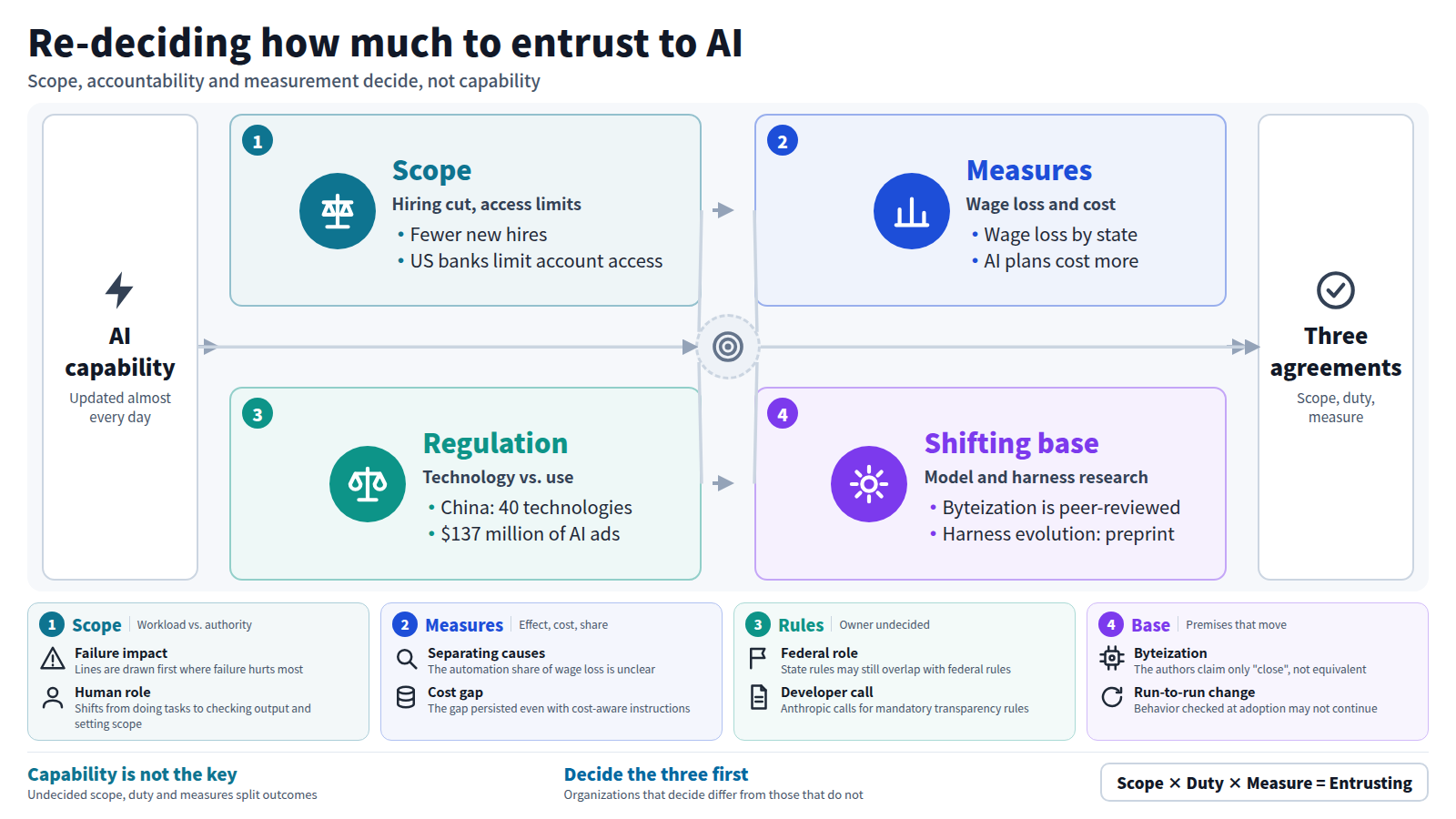
What AI can do is updated almost every day. However, when we look at the materials used this time, we find that what separates companies, governments, and individuals from making decisions is not the level of ability, but rather the fact that it has not been decided how much to entrust, who is responsible, and how to measure effectiveness. Anthropic, for example, has scaled back on new hires, while U.S. banks such as Citi have begun restricting AI agents' access to accounts. At the same time, moves to expand and narrow the scope of responsibility are occurring side by side. Job loss numbers, regulatory targets, costs and effects in health care, and underlying research trends are all on the same page. I will read this half-day article along those lines.
Companies and banks that have begun to narrow down the scope of their work
Anthropic has scaled back on new hires, India Today reports. The headline says, ``AI does 6 times more work than humans.'' This means that the companies that develop AI have themselves moved to narrow the scope of their reliance on humans. Meanwhile, the Financial Times reported that US banks, including Citi, are moving to restrict access to accounts by AI agents. The former is about increasing the number of tasks entrusted to AI, and the latter is about tightening the range of tasks entrusted to AI. Around the same time, Anthropic has cut back on hiring and Citi and others have restricted account access. This shows that the choice between expansion and suppression is not determined solely by what AI can do.
If the reader is applying this to their own company, deciding whether to reflect the workload of AI in personnel planning and deciding on the range of assets that will be exposed to AI need to be treated as separate decisions. In the bank example, the line is drawn first from the account where the impact of failure is greatest. Delegating the amount of work and handing over authority are not the same thing.
Articles that reconsider the role of people also stand out. Pipeline Magazine covers ``the importance of human involvement to bring out the power of AI,'' and Bentley University takes the position that ``human skills are important even in the age of AI.'' At first glance, the situation in which companies are selective about hiring and media outlets that advocate human involvement are at odds with each other. However, since Anthropic is reported to have reduced the number of new employees, and Citi and others are reported to have narrowed down the authority of agents, it can be seen that the work required of people is shifting from carrying out tasks to checking the output of AI and deciding how much to delegate. Human involvement is beginning to be talked about as a condition for bringing out the power of AI.
Even when it comes to customer service, there is a choice to leave staff behind. According to the Reform Sangyo Shimbun, LIXIL will renovate its showroom in Tokyo and propose an ``ideal lifestyle'' by combining AI and escort-type services. While AI is being introduced, the role of working closely with customers is still considered human work, which is a different line from banks' limits on authority. The closer you are to the customer, the more you can see the content of the service: what should be left to machines and what should be done by people.
What all three examples have in common is that the process of determining the scope of responsibility and who will be in charge is underway before assessing the ability. However, there is still no common answer as to who should decide the scope and what indicators should be used to measure the results.
Employment losses begin to be seen in numbers
ZDNET reported on efforts to track AI-induced layoffs by state and quantify wage losses. Until now, discussions about AI and employment have centered on predictions about what percentage of jobs will be replaced. By looking at wage losses by state, we can compare how much income was lost in which regions. When companies decide how much of their workforce to replace with AI, some of that cost will be visible externally in the form of local income. The same numbers will be used by state governments when considering the scale of support measures.
In the same vein, there is a statement by Mr. Warsh. According to The New York Times, he vowed to curb inflation and characterized AI as a "shock" to the economy. This view treats AI not as a matter of individual industries, but as an impact on the entire economy, including prices and employment. Juxtaposing ZDNET's state-by-state amounts with statements reported by The New York Times, we can say that we are starting to have the material to look at the impact at both a national and local level. However, it is not possible to tell from just these two articles how much of this is due to the influence of automation and which is due to other factors. Even if the numbers are released, it has not been decided who will be responsible for interpreting them.
Once the numbers are visible, the next question is to whom the losses and benefits belong. Monthly Review discusses AI from the standpoint of Marxist ecology and develops a critique of capital. The view is that the issue of allocation lies not with the technology itself, but with the capital that owns and operates it. The more wage losses in each state are expressed in monetary terms, the easier it becomes to see on the same scale the difference between those receiving the benefits and those bearing the losses. This is a criticism from one standpoint, and it is up to the reader to decide whether or not they agree with it, but the question remains as to whether ``whose share'' should be included in the criteria for measuring effectiveness.
On the other hand, there are some questions that are difficult to translate into monetary amounts. GeekWire reported that Amazon's developer garage will become a museum of old computers. The work of preserving old-fashioned machinery cannot be measured in terms of efficiency or wages. It concerns the meaning of human work: what to create, what to leave behind, and who is in charge of it. The amount of wage losses, the categorization of economic "shocks," the criticism of capital, and the preservation of obsolete machinery all indicate not the power of AI itself, but how we measure its impact. In the next section, we will look at how these different measuring sticks differentiate decisions made by companies, governments, and individuals.
Regulations and export controls come first
China plans to add 40 technologies to its export control list, including AI, biotechnology, and solar power (Reuters). Rather than dealing with AI in isolation, the regulatory web is wrapped around a bundle of cross-industry technologies. During the same period, the US saw $137 million worth of AI-generated ads flow into the midterm elections (The New York Times). One side concerns the export of technology, and the other concerns how it is used; even though they use the same term, ``AI regulation,'' they have different targets. For companies doing business overseas, there is an increased need to check for each product which country's regulations their technology meets.
It has not yet been decided who will be in charge of regulation. Two members of the U.S. House of Representatives expect the federal government to play a role in regulating AI (The Des Moines Register). The prospecting stage means there remains the possibility that state-by-state rules overlap with federal rules. In areas such as advertising, where problems have arisen in specific situations such as elections, it is conceivable that rules for that area will be implemented first. However, it is not clear from the material in the article which order they will move.
There are also movements that transcend national borders. Anthropic is in talks with India's Ministry of Electronics and Information Technology (MeitY) about AI safety testing. The company is also calling for mandatory transparency rules (Konsulteer). It is worth noting that the developers themselves are seeking obligations. If we leave it up to the operators to decide what to test and what to make public, there will be no standard for users to compare.
Even among industry organizations, the way they decide on their positions is not uniform. The Writers' Association said its position on generative AI remains ``unchanged.'' This was a response to the backlash against the Ethics Charter (The Bookseller). For this association, whether or not to move the organization's policies has become an issue of accountability to its members.
Export control is determined by the state, advertising by election sites, safety testing by companies and national authorities, and position statements by industry groups. If individual rules pile up without a common yardstick, those deciding on the scope of work will have to read and understand the applicable rules from scratch each time.
Cost and effectiveness in the medical and psychological fields
In the field of lung cancer screening, there are examples of AI expanding the scope of medical treatment. Radiology Business reported on a radiology department's efforts to use AI to identify patients for lung cancer screening from electronic medical records. There is hope that if people who should undergo a medical examination can be found without the hassle of picking them up on paper or visually, there will be fewer oversights. In the mental health field, Substack asked the question, ``Can AI solve the problem of getting a doctor's appointment?'' and expectations are high for AI as a solution for people who cannot get an appointment and have to wait. However, both are still in the hopeful stage, and it is difficult to tell from these materials how much improvements have actually been made in consultations and outcomes.
Costs should be considered alongside expectations for effectiveness. The NEJM AI's peer-reviewed original paper featured on its website did not ask whether LLM was accurate, but rather whether there was a difference in cost between the treatment recommended by the AI and the treatment provided by the attending physician when reading the same consultation record. The authors summarized that the AI plan was more expensive than the doctor's plan, and the difference persisted even after cost-aware instructions were given. The design is to compare two plans written from the same record and priced using the same price list, so the difference is not due to a difference in unit price, but a difference in the content recommended. Please note that the main text is not available for reference at the time of writing, and the information here is limited to what was confirmed in the authors' published materials. If the selection of people eligible for screening is to increase the number of tests, those implementing the test will need to measure for themselves whether the effects are worth the cost of the test.
In the realm of the mind, effects and costs are even more difficult to measure. People.com has released the cover of a new book depicting a pseudo-relationship between chatbots and podcasters. This is an example of how the relationship with a companion has become so familiar that it becomes the subject of a story. The evaluation criteria changes depending on whether the person is used to fill in the gaps of getting medical attention or to replace the relationship with people. Meanwhile, on the education side, Google held an AI training summit for students and faculty at Florida Agriculture and Technology University (FAMU). There is a movement to have the people who use them learn how to use them.
What all three stories have in common is that while progress has been made in the introduction of AI, who measures costs, effects, and changes in relationships, and by what standards, has not yet caught up with the speed of introduction. If the scope of use expands without the ability to measure it, the basis for judgment will depend on changes in billing amounts and users, which can only be seen after use.
Research to rebuild the foundations of models and agents
Discussions about the scope of responsibility and the locus of responsibility tend to proceed as if the model and agent were already fixed parts. However, the system that is the premise for this is also moving. Here we will discuss two studies with different characteristics. One is a peer-reviewed paper published in Nature, and the other is a preprint that has not yet been peer-reviewed.
The first is "byteization," which reads existing language models in bytes (Nature). Many large-scale language models read sentences by dividing them into subwords. As a result, it has the weakness of easily overlooking the differences between individual characters. This paper showed a method to convert an existing subword-based model into a byte-based model with a small amount of additional learning without having to retrain from scratch. The authors claim that they showed good performance in letter-by-letter reasoning, approaching the ability of the subword method. The method was previously published as a preprint, and the current publication indicates that it has been peer-reviewed (on our own website).
This result shows that there is room to modify the units that the model reads at a later date. In situations where mixing up characters is a problem, the decision as to whether or not to leave the task to the task depends on how the model used is read. Installers need to check not only the model name and generation, but also how the input is separated and read. However, the authors' claim is only "close." It does not say that they have become equivalent, so if you are using them for your own business, you will need to confirm with your own data.
The second is to organize when agents keep rewriting their own boundaries (own site). Changing instructions, memory, and tools while keeping the weight fixed is called "harness self-evolution." The LLM agent rewrites the bounds from the experience of a run, and those revisions remain in the next run. This preprint is organized by what should be rewritten and how the revisions should be proposed and adopted. He then claims that he has theoretically derived recruitment rules based on explicit assumptions. However, this is not a paper that demonstrates a new method through experiments, but rather a draft that the authors themselves consider to be a survey. And that's before peer review. Hugging Face votes and GitHub stars only indicate popularity and do not guarantee the accuracy of the content.
When you put the two side by side, the difference in treatment becomes clear. The conversion into bytes is the result of peer review, and can be evaluated as an improvement in reading. The self-evolution of harnesses is currently only a sketch, and it is still at an early stage to become the basis for operational rules in the field. However, even if the weights do not change, if the instructions, memory, and tools change each time it is executed, there is no guarantee that the behavior observed at the time of introduction will continue. In addition to deciding the scope of responsibility, you will also need to decide who will check the behavior after the change and how.
The events covered in each section are from different fields and countries. However, what they have in common is that AI's abilities do not directly determine decisions, and three agreements have not yet been decided: the scope of entrustment, where responsibility lies, and how to measure effectiveness. Companies have cut back on hiring and banks have tightened access to accounts. Job losses will begin to be seen in state-by-state amounts, and regulation will depend on technology and usage being targeted separately. In the medical and psychological fields, it is necessary to check both expectations and costs. On the research side, the mechanisms of models and agents continue to operate. As your abilities improve, the difference between an organization that decides these three things on its own and an organization that proceeds without deciding will become more apparent.
Q1: Of the tasks you entrust to AI in your business, which one would have the biggest impact if it fails, and who decided on the scope? Q2: When a problem occurs with AI output, is there a person who will be responsible and a procedure for detecting the problem in advance? Q3: What indicators have you decided to use to measure the effects and costs of introducing AI and by when?
Finally, three questions
- Of the tasks you entrust to AI in your work, which ones would have the biggest impact if they fail, and who decided on the scope? Q2: When a problem occurs with AI output, is there a person who will be responsible and a procedure for detecting the problem in advance? Q3: What indicators have you decided to use to measure the effects and costs of introducing AI and by when? - When a problem occurs with AI output, is there a person who will be responsible and a procedure for detecting the problem in advance? Q3: What indicators have you decided to use to measure the effects and costs of introducing AI and by when? - What indicators have you decided to use to measure the effects and costs of introducing AI and by when?
📚 Sources (all material)
Every item this issue drew on. External links open in a new tab. 21 items.
AI and the Economy
AI and Finance
Living and Working with AI
AI and Healthcare
AI and International Politics
AI Around the World
AI, Philosophy & Thought
AI, Arts & Creativity
AI in Medicine (Cancer Care, Rare Diseases)
AI and Agriculture
AI Regulation, Safety and Geopolitics
AI and Frontier Research (Papers)
- Does the care an LLM recommends cost more than the treating physician's? ── Pricing AI-written plans and physicians' plans from the same visit records against one fee schedule — Japanese media
- Converting existing language models to read bytes ── Byteification recovers character-level information without training from scratch — Japanese media
- When an agent keeps rewriting its own scaffolding, what justifies accepting a change? ── A learning-theory framing of harness self-evolution with fixed model weights — Japanese media