AI & Education News — 2026-10-14 (Wed) Evening News

Source links point to the original outlet. The AI Integrated Analysis is auto-generated from the headlines below only and is not intended to add facts beyond them. Not investment advice.
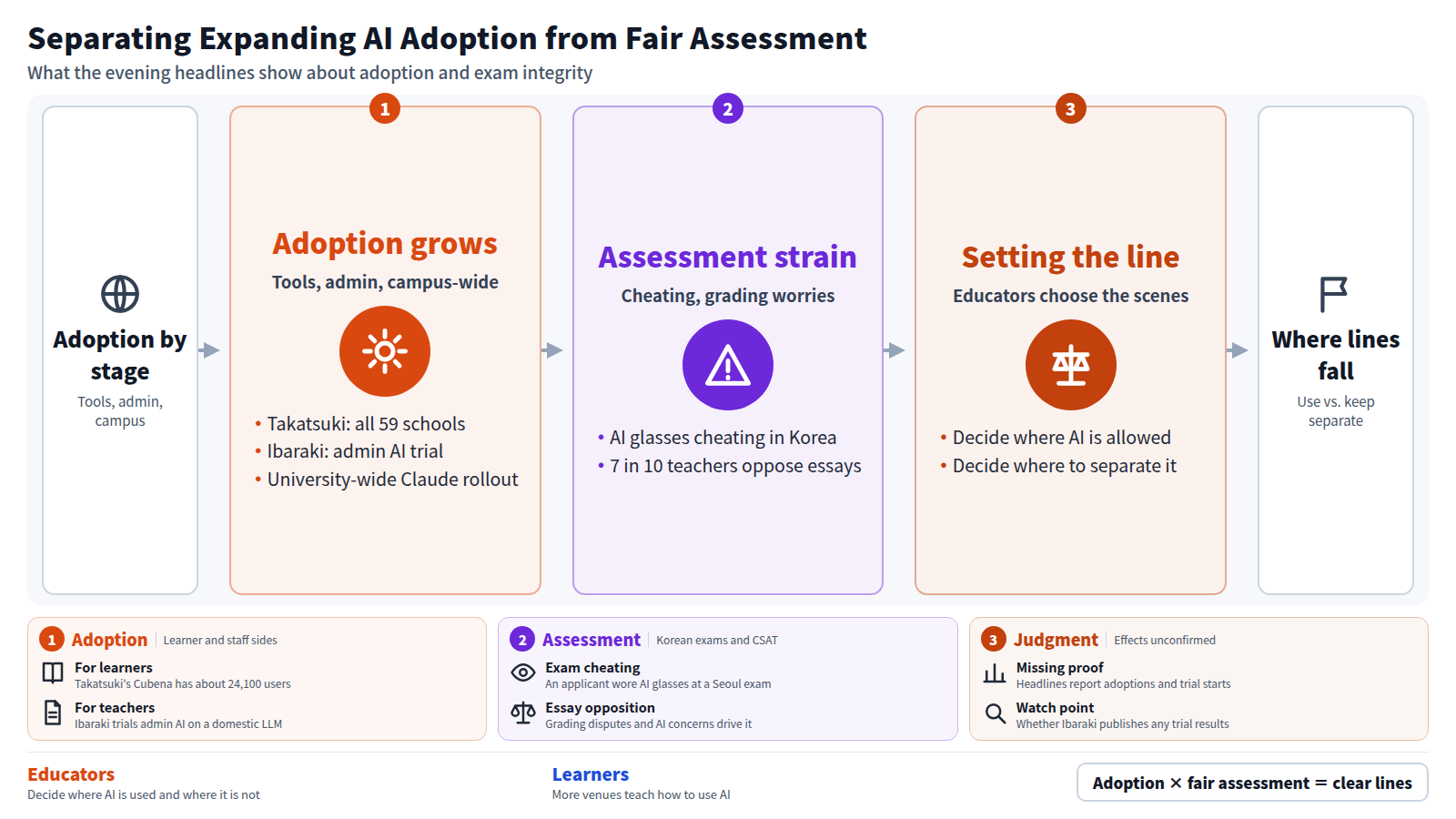
Overview
Activity centered on universities and on K-12 schools in Japan. Digital Hollywood University adopted Claude university-wide, and Ibaraki City began a school administrative AI demonstration with a domestic LLM (PR TIMES, Resemom). In South Korea, AI smart glasses used for cheating in university entrance exams drew an emergency response from the Ministry of Education (BigGo Finance). Events on AI literacy for families and young people were announced in Japan, the US and South Korea (PR TIMES, Clemson News, Maeil Business).
AI literacy
- In the US, the OpenAI Forum put AI skills for polling professionals on its agenda (EdTech Innovation Hub). Clemson announced October workshops to put AI into practice (Clemson News). - In South Korea, Shinsegae I&C said it will run AI utilization training for young people to narrow regional IT education gaps and train future AI talent (Maeil Business). This is an announced plan. - In Japan, the first Aura Children's AI Film Festival 2026 was announced. It involves children from Japan and abroad in what the headline calls AI education without using AI (Brand New Creativity). - In Japan, a free parent-child AI literacy stage event will be held at Matsudo Civic Theater on October 31, with songs and dance and the local character Bakegorou (PR TIMES, Ikoyo News).
Early childhood education
- In Japan, nursery teacher Tii-sensei became an official partner of "WOMAN AI UPDATE 2026" and will speak on parenting in the AI era (Asahi Shimbun). The audience is adults raising children, not children themselves.
Elementary school students
- In Japan, a contest for school AI use is accepting entries until 10/16, with results due 11/14 (Resemom). - In Japan, Takatsuki City, Osaka, formally adopted the AI-based learning material Cubena for all 59 municipal elementary and junior high schools, with about 24,100 users (Jiji.com). This is an adoption; learning effects are not reported in the headline. - In Japan, the Sakubun-sensei app for elementary students went on sale. It offers AI correction of essays for aptitude tests and supports the question formats of all 47 prefectures (Fukushima Minyu). - In Japan, a Senkyo.com piece on a budget-settlement review covers education generative AI guidelines and notes they were updated the following month (Senkyo.com).
Junior high school students
- In Japan, Ibaraki City and NTT West began what is described as the first demonstration in Japan of school administrative AI for elementary and junior high schools using a fully domestic LLM, tsuzumi 2 (Resemom, Cloud Watch, kabu-ir.com). The target is school administrative work, and this is a demonstration, not a confirmed result. - In Japan, Meisei Junior and Senior High School started SEL learning for the AI era, using dialogue and inquiry to build abilities that cannot be measured in numbers (Asahi Shimbun). - In Japan, Langaku and ELSA will jointly hold a webinar for English educators on using manga and AI (PR TIMES).
High school students
- In the US, AI weapons detection systems are now at Hillsboro schools (KMOV). - In South Korea, 7 in 10 teachers oppose CSAT essay questions over grading disputes and AI concerns, according to the headline "7 in 10 teachers oppose CSAT essay questions over grading disputes, AI concerns" (The Korea Times). - In Vietnam, the headline states an aim of helping students use AI wisely and responsibly (Vietnam.vn). - In Japan, a seminar on October 29 features a DeNA staff member who promotes AI use (Okinawa Times). A lecture by Professor Ikegaya of the University of Tokyo on the brain and learning in the AI era will be held in Kawasaki on November 14 (Jiji.com). - In Japan, four students including those from Tsukukoma all won silver or bronze medals at the International AI Olympiad (Resemom, Yahoo! News).
University students
- In Japan, Digital Hollywood University will adopt Anthropic's Claude university-wide, the first such adoption by a university in Japan (PR TIMES). Students can use it heavily without worrying about cost (KAI-YOU). - In South Korea, cheating with AI smart glasses is reported to be recurring in university entrance essay exams, slipping past supervision, and the Ministry of Education took emergency measures (BigGo Finance). An applicant to an AI department was caught wearing AI glasses at a Seoul university entrance exam (Infoseek). - In Japan, the University of Tokyo is hosting a two-day gathering of AI experts at Yasuda Auditorium (Digital PR Platform).
Adults
- In Japan, an Asahi Shimbun feature in the series on what to read in the AI era carries Toyoshi Inada's comments on intellectual training and widening gaps (Asahi Shimbun). - A guide to free AI subscriptions for students in 2026 was published (Pasquale Pillitteri). It targets students, not adult learners. - No headline covered reskilling courses or qualifications for adults.
Older adults
- In Japan, CodeZine ran a piece on five devices for building thinking skills in AI-era engineer education, with the phrase "survival skills for seniors" in its title (CodeZine). - In Japan, a Senkyo.com item reports attendance at the kickoff ceremony of the Tokyo Metropolitan Johnan Vocational Skills Development Center's Ota campus. The headline is truncated and gives no further detail (Senkyo.com).
Statements by key figures
No notable developments. No headline mentioned Sal Khan, founder of Khan Academy. 【Integrated analysis: how lifelong learning is changing】 - Common across stages: AI is moving from individual experiments to institutional adoption and rules. Examples are Takatsuki's adoption across all municipal schools, Digital Hollywood's university-wide adoption, and guidelines (Jiji.com, PR TIMES, Senkyo.com). In parallel, concern about fairness is rising, seen in the CSAT essay opposition and the smart-glasses cheating cases (The Korea Times, BigGo Finance). - Differences by stage: for elementary students the headlines show tools for writing and practice. For junior high schools the emphasis is on teachers' administrative work and non-cognitive learning such as SEL. At universities, access to the tools and the integrity of exams are the issues. For younger children and older adults, headlines are few and aimed mainly at adults, such as parents, with little on learners themselves. - Decisions that appear to be changing: schools and municipalities are likely to weigh adoption of tools alongside supervision and assessment methods. Headlines show adoptions and plans but no confirmed learning effects, so whether adoption helps children cannot be judged from this material.
What to watch
Whether South Korea's entrance exam measures against AI glasses extend to the CSAT and to other countries' exams (BigGo Finance, The Korea Times). 2. Whether the demonstrations and adoptions in Ibaraki and Takatsuki produce any reported results (Resemom, Jiji.com). 3. Whether adult reskilling and lifelong-learning programs on AI appear, as no headline covered them this period.
- OpenAI Forum puts AI skills for polling professionals on the agenda — EdTech Innovation Hub10/13 23:30 UTC
- Put AI into practice with October workshops — Clemson News10/14 01:30 UTC
- First Aura Children's AI Film Festival 2026 Set, Japanese and British Children Take On 'AI Education Without Using AI' — Brand New Creativity10/14 09:00 UTC
- Halloween stage where you can learn AI through singing and dancing! Free admission parent-child event at Matsudo Civic Theater — Japanese media10/14 05:48 UTC
- Shinsegae I&C announced on the 14th that it will promote AI utilization ability development education for young people in order to eliminate regional information technology (IT) education disparities and foster creative future AI talent. There is a relative lack of AI education infrastructure. — 매일경제10/14 06:27 UTC
- Teacher Ti Named Official Partner of WOMAN AI UPDATE 2026, to Speak on Parenting in the AI Era — Japanese media10/13 15:32 UTC
- Keitoku Review: Educational Generation AI Guidelines. Update next month — Japanese media10/14 05:53 UTC
- AI-Based Learning Material Qubena Officially Adopted by Takatsuki City, Osaka, in All 59 Public Schools — Japanese media10/14 04:16 UTC
- AI Essay-Marking App for Elementary Students, 'Sakubun Sensei', Launches, Covering Aptitude Test Formats in All 47 Prefectures — Japanese media10/13 16:51 UTC
- Myojo Junior and Senior High School Begins Social-Emotional Learning for the Coming AI Era — Japanese media10/14 04:55 UTC
- Manga and AI Turn Students' Wish to Read into Wish to Speak: Langaku and ELSA Co-Host Webinar for English Educators — PR TIMES10/14 03:00 UTC
- AI weapons detection systems now at Hillsboro schools — KMOV10/13 21:33 UTC
- 7 in 10 teachers oppose CSAT essay questions over grading disputes, AI concerns — The Korea Times10/14 06:26 UTC
- Seminar 'Thinking About Your Future' on Oct. 29 on Zoom: Takuya Suyama on Promoting AI Use at DeNA — Japanese media10/14 05:00 UTC
- To help students use AI wisely and responsibly. — Vietnam.vn10/14 06:21 UTC
- Brain researchers explain! The new common sense of "brain and learning" to survive in the age of AI A lecture by brain researcher Professor Iketani of the University of Tokyo will be held in Kawasaki City on Saturday, November 14th! — Japanese media10/14 04:16 UTC
- Digital Hollywood University Rolls Out Generative AI Claude Across Campus — KAI-YOU10/14 07:42 UTC
- AI smart glasses fraud continues to occur in South Korean university entrance exams and essay exams...The South Korean Ministry of Education takes emergency measures as they slip through the supervisory network — Japanese media10/14 07:06 UTC
- Applicant to AI Department Caught Wearing AI Glasses in University of Seoul Entrance Exam — Infoseek10/14 06:04 UTC
- (What to read in the age of AI? Re:Ron) “Strengthening” of intelligence, widening disparity Toyofumi Inada — Japanese media10/14 07:30 UTC
- Complete Guide to Free AI Subscriptions for Students in 2026: What Is Truly Free — Pasquale Pillitteri10/14 08:10 UTC
- Five Mechanisms and Foundational Skills for Cultivating Thinking, From Classroom Practice: Engineer Education and Senior Survival in the AI Era — CodeZine10/13 23:00 UTC
- [Metropolitan Jonan Vocational Ability Development Center Ota Campus] Kick-off Ceremony Attended] Because we are in the AI era, small factories are gathering... — Japanese media10/14 04:53 UTC