AI Ethics News — 2026-10-09 (Fri) Daily News
Source links point to the original outlet. The AI Integrated Analysis is auto-generated from the headlines below only and is not intended to add facts beyond them. Not investment advice.
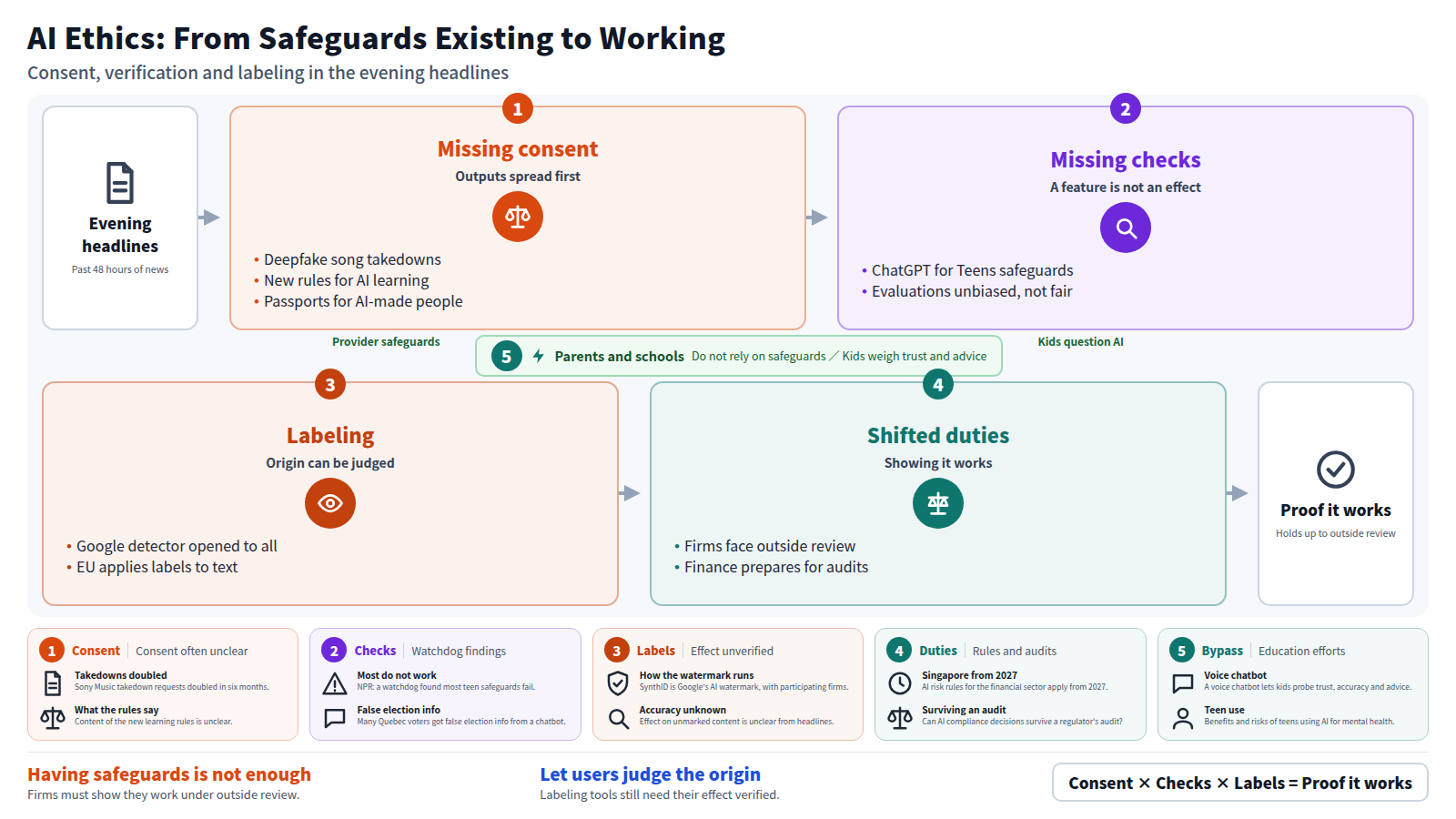
Overview
- The question of whether safety measures for AI aimed at minors are actually working has come to the fore at the same time as the need to improve the identification (labels and detection tools) of AI-generated content. - There were a number of issues where AI output disadvantages certain people, such as AI fairness evaluation, gender-based digital violence, and errors in election information caused by AI. - In Japan, the rights and consent of creators became a theme, such as requests for deletion of deep fake music and learning rules for generative AI.
Bias, discrimination, fairness
- UN Meetings Coverage addressed experts' warning that "AI is not gender neutral." Digital violence and backlash against women's rights are at issue. Women are said to be at a disadvantage, but the measurement method and scale are unclear from the headline. - Yale Insights titled "AI Evaluations May Look Unbiased, But They're Not Fair." This appears to be raising the issue of the difference between apparent neutrality and fairness in evaluation. Details not confirmed. - New York State Bar Association addresses AI, bias, and fairness in legal practice. - Quarles & Brady reports that the New Hampshire Board of Pharmacy has proposed rules for the use of AI in pharmacy operations. This is a proposal stage, not a decision. - KOTA reports that the City Council in Rapid City, South Dakota, has postponed its decision on AI policy for further consideration.
Privacy/Monitoring
- There are no reports that clearly indicate data collection, consent, or use for other purposes from the headline. - Medicine Hat News reports that MPs were told in a hearing that many Quebec voters received incorrect election information from chatbots. The extent of the damage is unclear from the headline. - Судово-юридична газета reports that China has started issuing passports to people created by AI. Details and facts cannot be confirmed from the headline alone. - The Verge and Legal Reader report that Anthropic has tightened its rules for users, banning "abusive or cruel behavior" towards Claude. The content regulates the behavior of users, and involves both the ethics of handling models and the rights of users, but the specific implementation has not been confirmed.
Transparency/Accountability
- Federal News Network reports that U.S. lawmakers are considering additional federal measures regarding AI standards, security, and disclosure. It is still under consideration. - FinTech Global published an article asking whether compliance decisions regarding AI can withstand regulatory audits. - Accounting Today argues that auditors facing AI need to understand their uniqueness. - The Express Tribune published an article on understanding AI on social media. - It is not possible to determine from the headline what is and is not disclosed.
Creator/Copyright/Consent
- StreetInsider discusses why human participation is important in the AI era through VAYLA Arena's "AI Music Discovery Challenge" (the host is the organizer; the point of contention is the positioning of human involvement). Related trends in Japan are described in Section 9.
False information/deep fake
Confirmed facts (reported as announcements from each company/institution): - Google announced that it will make it easier to identify AI-generated content globally (blog.google). An AI-generated content detection tool has been made available to the public, Businessday NG and Mezha report. There is also an article explaining how SynthID (Google's AI watermarking technology) works and who participates (Basic Tutorials). - Tubefilter reports that the European Union is applying the same standards to text, given the current state of labels on AI-generated videos.
Reports on damage: - In Quebec, MPs reportedly heard that many voters received incorrect election information from chatbots (paragraph 3).
The accuracy of the detection tool and its effect on non-watermarked products are unclear from the headline.
Protection of children and vulnerable people
- Target users are teenagers. - NPR reports that ChatGPT for Teens has special safeguards, but watchdog groups say most of them don't work. Business Standard reports that the report said the service posed an "unacceptable risk" to children. Common Sense Media raised concerns, according to Tri-State Alert. These are evaluations from monitoring groups and reports, and OpenAI's counterargument cannot be confirmed from the headline. - The Idaho State Journal (Health West) covered the benefits and risks of using AI for mental health in teens. - EducationHQ introduces a voice-interactive chatbot that allows children to question AI (consider its reliability, accuracy, and advice). - Measures were taken by the businesses that put in place protective measures, the monitoring organizations that conducted the investigation, and the efforts of the education side.
Ethical principles and guidelines
Things decided: - Malay Mail reports that Singapore will apply rules on AI risks in the financial sector from 2027. - Ticker News reports that the AI Review Committee provided expert advice on governance (the agency's affiliation is unclear from the headline).
Suggestions/Opinions: - Crain's Chicago Business published an opinion piece saying that the true value of "responsible AI" will be shown on the factory floor in Chicago. - The University of Utah reported on a hackathon in which students developed AI for education. It is a business trend, not an ethical guideline.
Japanese AI ethics
- The Asahi Shimbun reports in a series on copyright that they are exploring ways to create a system for the spread of AI. - d Menu News discusses whether new rules regarding the "learning" of generative AI can balance technological progress and intellectual property protection. The specific content of the rules is unclear from the headline. - Music Ally Japan reports that Sony Music has applied for the deletion of more than 260,000 AI deepfake songs, doubling the number of targets in six months. The parties involved are the music companies and the music was created without permission, and the issue at issue is the creation without the consent of the rights holder. - On Yahoo! News, Reiwa Roman's Kemuri Matsui talked about his thoughts as a parent about not wanting his children to see generated AI videos. The theme is the sense of distance that fosters children's sensibilities. - AWS explains the changes Amazon Bedrock's automated inference checks bring to the compliance of generated AI. This is a product commentary, not an ethical evaluation.
Remarks from VIPs
This headline does not include statements from Timnit Gebru (DAIR, AI ethics researcher), Fei-Fei Li (Stanford HAI, AI researcher), and Yoshua Bengio (AI safety researcher), who are being tracked. No applicable information.
Integrated analysis: How do ethical questions fit together?
- Lack of consent: The requests for deletion of music deepfakes (Japan), the learning rules for generative AI (Japan), and the reports on the issuance of passports to AI-generated people in China all have in common that artifacts and images of people are handled without clear consent from the parties concerned. - Lack of explanation/verification: ChatGPT for Teens' point out that the protection measures do not work, Yale Insights' "looks fair but isn't" assessment, and Quebec's misinformation all have one thing in common: the existence of a mechanism is one thing, but the fact that it actually has a protective effect is another thing. - Improving identification methods: Google's release of detection tools and the expansion of EU labeling standards to text are moves aimed at making it possible for users to determine the source. However, as stated in Section 10, verification of effectiveness cannot be confirmed from the headline. - Points that will change the judgment: Business operators will not only have to claim that they have put in place protective measures, but will also need to demonstrate their effectiveness to withstand external scrutiny. Financial users need to keep records of their decisions based on audits and regulations (Singapore 2027). Parents and educational institutions can consider options to develop children's ability to question AI without relying on the protection measures taken by businesses.
Future points of interest
OpenAI's response to the complaints about ChatGPT for Teens and whether there are any improvements to the protection measures. 2. Will Google's detection tools and EU text labeling standards actually work to combat disinformation? 3. Specific details of Japan's new rules regarding generative AI learning and trends in requests for deletion of deepfake songs.
- ‘Artificial Intelligence Is Not Gender-Neutral,’ Third Committee Hears, as Experts Warn of Digital Violence, Backlash against Women’s Rights — UN Meetings Coverage and Press Releases10/08 04:00 UTC
- New Hampshire Board of Pharmacy Proposes Rules Governing Artificial Intelligence in Pharmacy Practice — Quarles & Brady10/09 00:59 UTC
- AI Evaluations Look Unbiased Without Being Fair — Yale Insights10/08 19:58 UTC
- Anthropic bans ‘abusive or cruel behavior’ toward Claude — The Verge10/08 17:00 UTC
- Many Quebec voters got false election information from chatbot, MPs hear — Medicine Hat News10/08 18:54 UTC
- Lawmakers eye more federal action on AI standards, security, disclosures — Federal News Network10/09 00:22 UTC
- Can your AI compliance decisions survive a regulator’s audit? — FinTech Global10/09 08:19 UTC
- Making sense of AI on social media — The Express Tribune10/09 00:13 UTC
- In the face of AI, auditors need to know what makes them unique — Accounting Today10/08 17:43 UTC
- VAYLA Arena and the AI Music Discovery Challenge — Why Human Participation Matters in an Age of Expanding Creation — StreetInsider10/09 09:06 UTC
- AI-generated videos get labels. The European Union is applying the same standards to text. — Tubefilter10/08 22:43 UTC
- We're making it easier to identify AI-generated content globally. — blog.google10/07 14:18 UTC
- Google opens AI content detector to the public as synthetic media grows — Businessday NG10/08 18:57 UTC
- Google's tool for detecting AI-generated content is now available to all users — Mezha10/07 15:50 UTC
- SynthID: How Google’s AI Watermark Works and Who’s Participating — Basic Tutorials10/08 02:52 UTC
- Health West: Teens using AI for mental health: Benefits and risks — Idaho State Journal10/08 16:25 UTC
- Helping kids question AI: interactive voice-based chatbot explores trust, accuracy and advice — EducationHQ10/09 05:41 UTC
- EY revenue hits USD $57 billion as AI demand surges — CFOtech Asia10/09 06:03 UTC
- AI Review Committee provides expert advice on governance — Ticker News10/08 23:30 UTC
- Singapore sets AI risk rules for financial sector from 2027 — Malay Mail10/08 01:20 UTC
- Opinion: ‘Responsible AI’ will be proven on Chicago’s factory floors — Crain's Chicago Business10/08 20:41 UTC
- Students build AI-powered solutions for education at Minds and Machines Hackathon — The University of Utah10/08 01:56 UTC
- Copyright Wars, Part 5: AI spreads as stakeholders seek ways to build a system — Japanese media10/09 07:30 UTC
- "I don't want to show kids generative AI videos": Reiwa Roman's Kemuri Matsui on parenting — Japanese media10/09 02:00 UTC
- Sony Music requests removal of over 260,000 AI deepfake songs, double the figure from six months earlier — Music Ally Japan10/09 05:14 UTC
- Can technological progress and IP protection coexist? New rules for generative AI "learning" — Japanese media10/09 03:00 UTC
- How Amazon Bedrock Automated Reasoning Checks Change Generative AI Compliance — Amazon Web Services (AWS)10/08 04:38 UTC