AI Ethics News — 2026-10-09 (Fri) Morning News
Source links point to the original outlet. The AI Integrated Analysis is auto-generated from the headlines below only and is not intended to add facts beyond them. Not investment advice.
Overview
- The safety of AI for children (an “unacceptable risk” rating for ChatGPT for Teens) and the limitations of detection technologies for identifying AI-generated content emerged as key questions. - Compensation for creators (consent and payment), bias in chatbot responses, protection of personal information, and application of principles in the field of humanitarian aid were also listed.
Bias, discrimination, fairness
- Digital Information World reports that research shows AI chatbots have a status quo bias on climate change (per headline). - It is unclear from the headline who will be disadvantaged, how it will be measured, and the scale. The point of contention can be read as the possibility that providing information on climate may weaken options that promote change.
Privacy/Monitoring
- Cal Poly Pomona will hold a cybersecurity fair that will focus on protecting personal information and data in the age of AI. - Practice Business reprints an article dealing with the ethics of AI surveillance ("Watching the Watchers"). - It is unclear from the headline which data was used for what purpose and with whose consent.
Transparency/Accountability
- Disclosure: Google released SynthID Detector to determine AI-generated content (SiliconANGLE). - What is not disclosed: Detection accuracy, scope of coverage, and detection standards of each company are unclear from the headline.
Creator/Copyright/Consent
- Parties: Minderoo, the Forrest family, and a leading AI company. At issue: Minderoo proposes to require AI companies to pay artists (The Australian). This is a suggestion, not a decision.
False information/deep fake
- Confirmed fact (above heading): Google has released a detection tool. Cybernews reports that there are situations in which the detectors cannot distinguish between each other. - Claim: A North Shore News editorial argues that local reporting can be trusted amid the spread of AI-generated fake news. - The exact scale of the damage is unclear from the headline.
Protection of children and vulnerable people
- Target audience: Teenage users. - Dangerous: TRT World, Deccan Chronicle, and ForkLog report that watchdog groups (listed by Common Sense Media and ForkLog) have rated ChatGPT for Teens as an "unacceptable risk." TRT World also reports that it is not working as intended. - Who took action: A monitoring group published the evaluation. The response from the operating company is unclear from the headline. - In the humanitarian context, a ReliefWeb article covers principled AI implementation for humanitarian organizations (see item 8).
Ethical principles and guidelines
- ReliefWeb: ``Humanity in the Loop,'' which discusses principles-based AI adaptation for humanitarian organizations. The name of the issuing agency is unclear from the headline. It can be read as a proposal stage. - Decode39: In an interview with IBM's Francesca Rossi, she says the real challenge with AI is trust. This is a personal opinion and not a decision.
Japanese AI ethics
- No relevant information (no headings related to Japan). - Reference: 매일경제 (South Korea) reports that YouTube is full of fake money-making content that reproduces the faces and voices of celebrities, and calls for clearer AI display and stronger detection technology.
Remarks from VIPs
- Yoshua Bengio (AI safety researcher): Reportedly said in a Transformer (Substack) headline, "If you prioritize safety, leave frontier AI companies." - Timnit Gebru (DAIR), Fei-Fei Li (Stanford HAI): No applicable information.
Integrated analysis: How do ethical questions fit together?
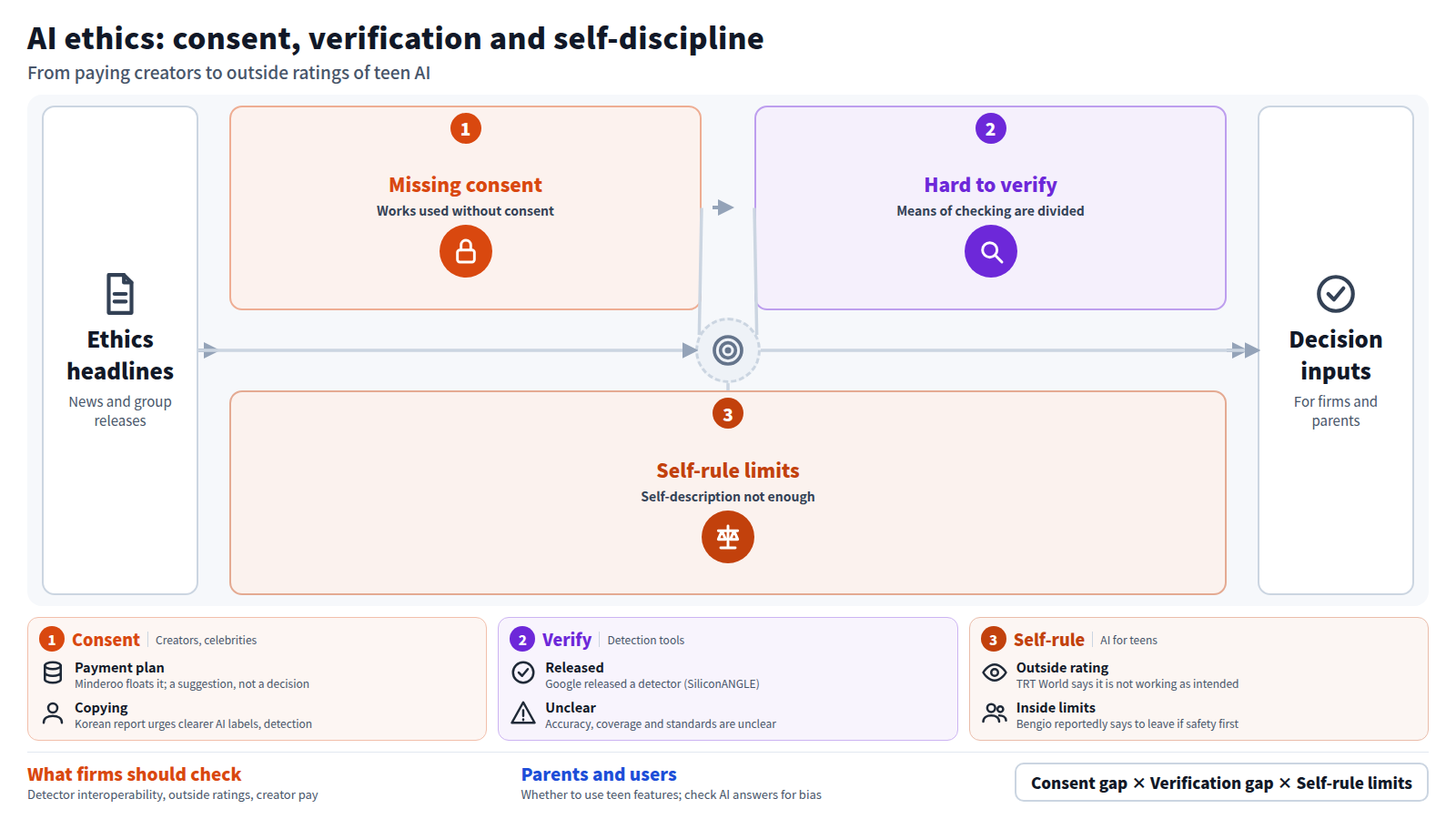
- Lack of consent: Proposed payments to creators (item 5) and unauthorized reproduction of celebrities' faces and voices (item 9) have in common a structure in which a person's work or characteristics are used without the person's consent. - Lack of explanation/difficulty in verification: The inability of detectors to distinguish from each other (items 4 and 6) indicates that the means by which users can verify authenticity are divided. External evaluation of children's products (item 7) also shows that it is difficult to judge safety based solely on companies' self-explanations. - Limits of self-discipline: Bengio's comments indicate that there are limits to prioritizing safety within companies. - Points where judgment changes: - Companies: The interoperability of detection tools, response to external evaluation of functions aimed at minors, and consideration of compensation to creators will be factors in the decision. - Users/Parents: The deciding factors are whether or not functions for teenagers can be used and confirmation of information based on the bias of AI answers.
Future points of interest
The operating company's response to the evaluation of ChatGPT for Teens and its handling of external evaluations. 2. Does it solve the problem of detection tools not being able to identify each other? 3. Which policy discussions will the Minderoo payment obligation proposal lead to?
- Are AI Chatbots Hesitant to Recommend Change? Study Finds Climate-Related Status Quo Bias — Digital Information World10/08 11:12 UTC
- Cybersecurity Fair to Focus on Protecting Personal Information, Data in Age of AI — Cal Poly Pomona10/07 07:00 UTC
- Read Again: Watching the Watchers: The Ethics of AI — Practice Business10/08 12:18 UTC
- Forrests' Minderoo floats plan to force AI giants to pay artists — The Australian10/08 10:34 UTC
- Editorial: In a world of AI-made 'fake news,' you can still trust local journalism — North Shore News10/07 14:30 UTC
- Two tech giants – two AI detectors that are blind to each other — Cybernews10/08 08:49 UTC
- Humanity in the Loop: Principled AI Adaptation for Humanitarian Organizations — ReliefWeb10/08 13:19 UTC
- Trust is the real challenge for AI. An interview with Francesca Rossi (IBM) — Decode3910/08 10:28 UTC
- Yoshua Bengio: ‘If you prioritize safety, leave frontier AI companies’ — Transformer | Substack10/08 14:00 UTCYoshua Bengio / AI safety researcher
- It's DAF Day! Wait...What's a DAF? — EFF10/08 16:02 UTC