AI Ethics News — 2026-10-08 (Thu) Evening News

Source links point to the original outlet. The AI Integrated Analysis is auto-generated from the headlines below only and is not intended to add facts beyond them. Not investment advice.
Overview
- Multiple media reported that a monitoring group pointed out that the safety features of ChatGPT for minors "do not work as promised." - Questions about protecting victims of sexual deepfakes created without permission and transparency surrounding the use and disclosure of AI have come to the fore. - Questions of fairness were also raised, such as whether AI would reproduce existing values and differences in treatment based on gender.
Bias, discrimination, fairness
- “AI chatbots are hardwired to defend the status quo” (Neuroscience News). The headlines suggest a trend of response in favor of the existing order. The measurement method and scale are unclear from the headline. - A study was reported that ``AI assistants with female names are paid less than those with male names for the same job.'' (dev.ua) AI that is set to be feminine is at a disadvantage, and the human gender perspective behind this is being questioned. Method and scale unknown. - There is a proposal to apply the ideas of 13th century theologians to AI medical triage ethics (Bioengineer.org). This is at the proposal stage and not a final decision.
Privacy/Monitoring
- EFF discusses ``how concerned we should be'' about recent trends in AI. - It was reported that "Personal data is the fuel for AI development" (The Recorder Online). It is unclear from the headline who's consent and what scope will be used. - Trust and privacy concerns are holding back AI adoption in business travel (FutureIOT). This is an example of user concerns affecting the speed of implementation.
Transparency/Accountability
- Facebook whistleblower says, "It's time for AI whistleblowers to speak out, too" (NPR). What has not been disclosed is internal information of AI development companies, and the need to protect whistleblowers has become a point of contention. - Congressman Peters introduces bipartisan bill calling for transparency in the federal government's use of AI (The Alpena News). It is at the proposal stage and has not been approved. Law enforcement is treated as a separate area.
Creator/Copyright/Consent
No applicable information
False information/deep fake
- A new benchmark for Arabic deepfake text shows AI detectors failing (Bioengineer.org). This confirms the limitations of the detection means. - It was reported that "nudifier (naked image generation using AI)" has exposed deficiencies in protecting victims (IOL). - Janhvi Kapoor says she was "deeply violated" by her sexual deepfake video (NST Online). The statement is made by the person himself/herself, and is treated as the testimony of the victim.
Protection of children and vulnerable people
- Teenage users are at risk. Watchdog groups have noted that some of ChatGPT for Teens' safety features do not work as promised (Washington Post). - Another group (Christian Action Research and Education) criticized it as an "unacceptable risk". - TechCrunch reported that the conversation continues during the mental health crisis. - Watchdog groups criticize OpenAI's claim that teens use it less than 15 minutes a day (New York Post). - The actors taking action are based on the headlines and points out and criticisms made by monitoring groups, and it is not possible to confirm OpenAI's response.
Ethical principles and guidelines
- Anthropic consults Hindu monks on AI ethics (The American Bazaar). This is at the opinion hearing stage and is not a final guideline. - Within the scope of the heading, no new principle decisions by the Agency can be identified. - AI Communications Consulting introduced “Pause.Prove.Protect™” to warn against fraud during open registration period (Business Wire). This is a warning to private companies.
Japanese AI ethics
- An introductory fact-checking book that deals with information literacy in the era of generative AI will be released on October 8, 2026 (PR TIMES). - In Osaka, it is suspected that generated AI was used to commit fraud by a fake police officer, and people are calling on people to suspect fraud through video calls (NHK News). Misuse of AI is at the stage of suspicion and is distinct from confirmed fact.
Remarks from VIPs
Headlines regarding the tracked targets (Timnit Gebru/DAIR, Fei-Fei Li/Stanford HAI, Yoshua Bengio) are not included in this input, so no relevant information is available.
Integrated analysis: How do ethical questions fit together?
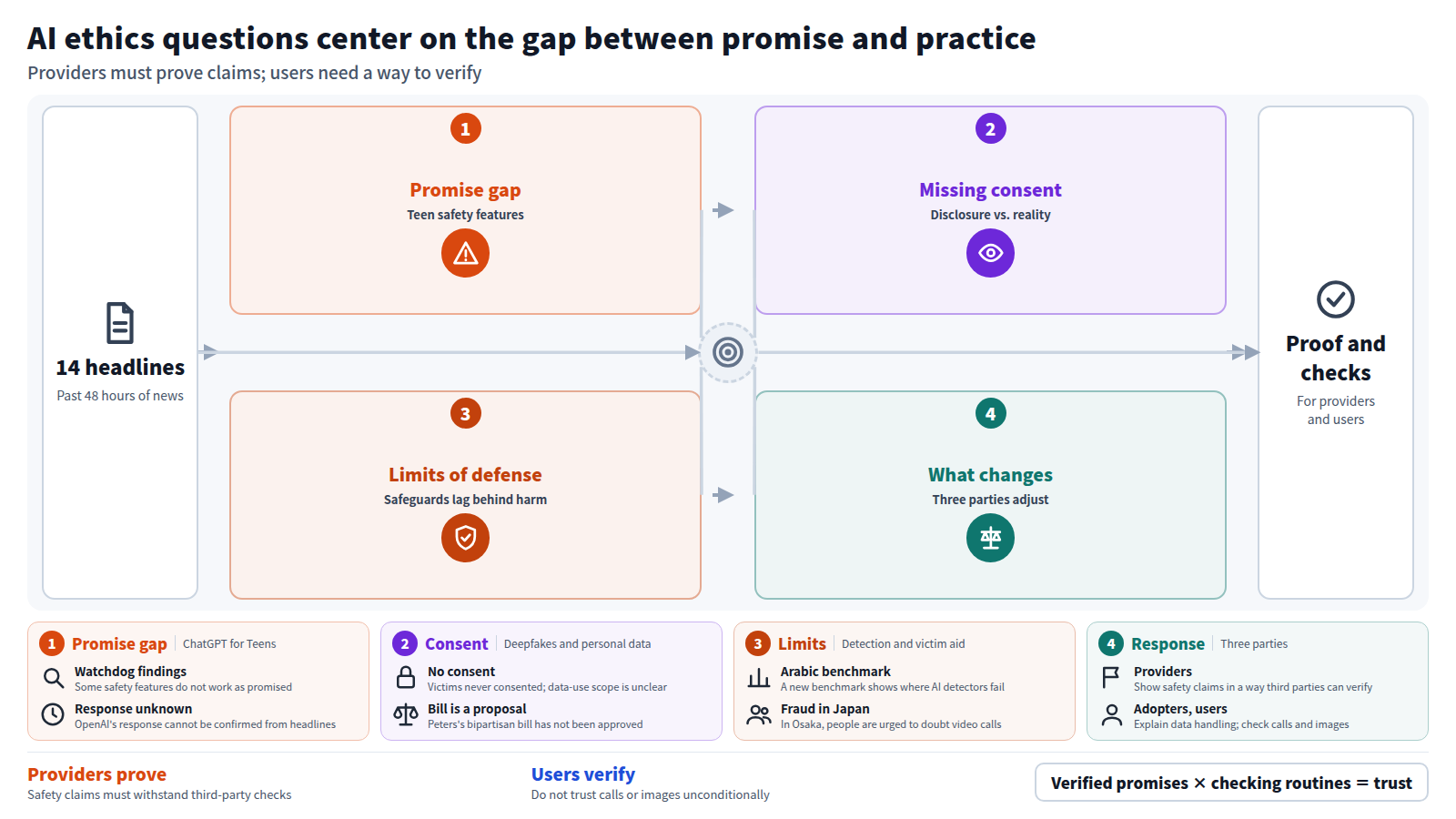
- Lack of consent is common in deepfakes and nudifiers (victims have not consented to their creation) and in the use of personal data for AI development (the scope of consent is unclear). - Lack of explanation can be seen in the indication that features for teenagers do not work as promised, criticism of usage time claims, calls for AI whistleblowing, and the government's bill for transparency on AI use, and the gap between what is disclosed by businesses and the government and the reality is a problem. - The limits of detection and prevention overlap with the Arabic detection benchmark and inadequate victim protection, and countermeasures are not keeping up with the damage caused. In cases of fraud in Japan, the burden of suspicion has shifted to the users. - The points where the judgment changes are as follows. - Business operators: Functions intended for minors are required to demonstrate safety claims in a manner that can withstand third-party verification. - Corporate adopters: Privacy concerns are holding back adoption, so explanations of how data will be handled will influence adoption decisions. - Users: They need to have a procedure for checking calls and images without trusting them unconditionally.
Future points of interest
How will OpenAI respond to and modify the safety features of ChatGPT for teens? 2. Progress in the federal government's AI use transparency bill and the debate over AI whistleblower protections. 3. Is it possible to improve the detection accuracy of deepfakes and develop a system to protect victims?
- A 13th-Century Theologian Offers a Surprising Fix for AI Triage Ethics — Bioengineer.org10/08 07:46 UTC
- AI Chatbots Are Hardwired to Defend the Status Quo — Neuroscience News10/07 15:40 UTC
- How Much Should We Worry? Recent Developments in Artificial Intelligence — Electronic Frontier Foundation10/07 16:59 UTC
- Personal data becomes fuel for artificial intelligence work — The Recorder Online10/08 06:06 UTC
- Trust And Privacy Concerns Temper AI Adoption In Business Travel — FutureIOT10/08 01:00 UTC
- Facebook whistleblower says it's time for AI whistleblowers to speak up : Here & Now Anytime — NPR10/07 19:00 UTC
- Peters introduces bipartisan bill to require transparency about federal government’s use of AI — The Alpena News10/07 05:31 UTC
- New Arabic Deepfake-Text Benchmark Reveals Where AI Detectors Fail — Bioengineer.org10/07 22:50 UTC
- AI ‘nudifiers’ expose gaps in protection for victims — IOL10/08 08:30 UTC
- ChatGPT for Teens keeps teens talking, even during mental health crises — TechCrunch10/07 18:15 UTC
- Watchdogs slam OpenAI’s claim that teens use ChatGPT less than 15 minutes per day — New York Post10/07 19:57 UTC
- AI Communications Consulting Launches Pause.Prove.Protect™, Shares Top Tips for Navigating Open Enrollment Scams — Business Wire10/06 13:01 UTC
- A must-read in today's world, where fake information is overflowing: "The easiest fact-checking textbook: Information literacy to face "fake" in the age of generative AI taught by a popular instructor" will be released on Thursday, October 8, 2026. — PR TIMES10/08 02:00 UTC
- Osaka fake-police fraud may have used generative AI; public urged to doubt video calls — NHKニュース10/07 21:00 UTC