AI Ethics News — 2026-10-08 (Thu) Morning News
Source links point to the original outlet. The AI Integrated Analysis is auto-generated from the headlines below only and is not intended to add facts beyond them. Not investment advice.
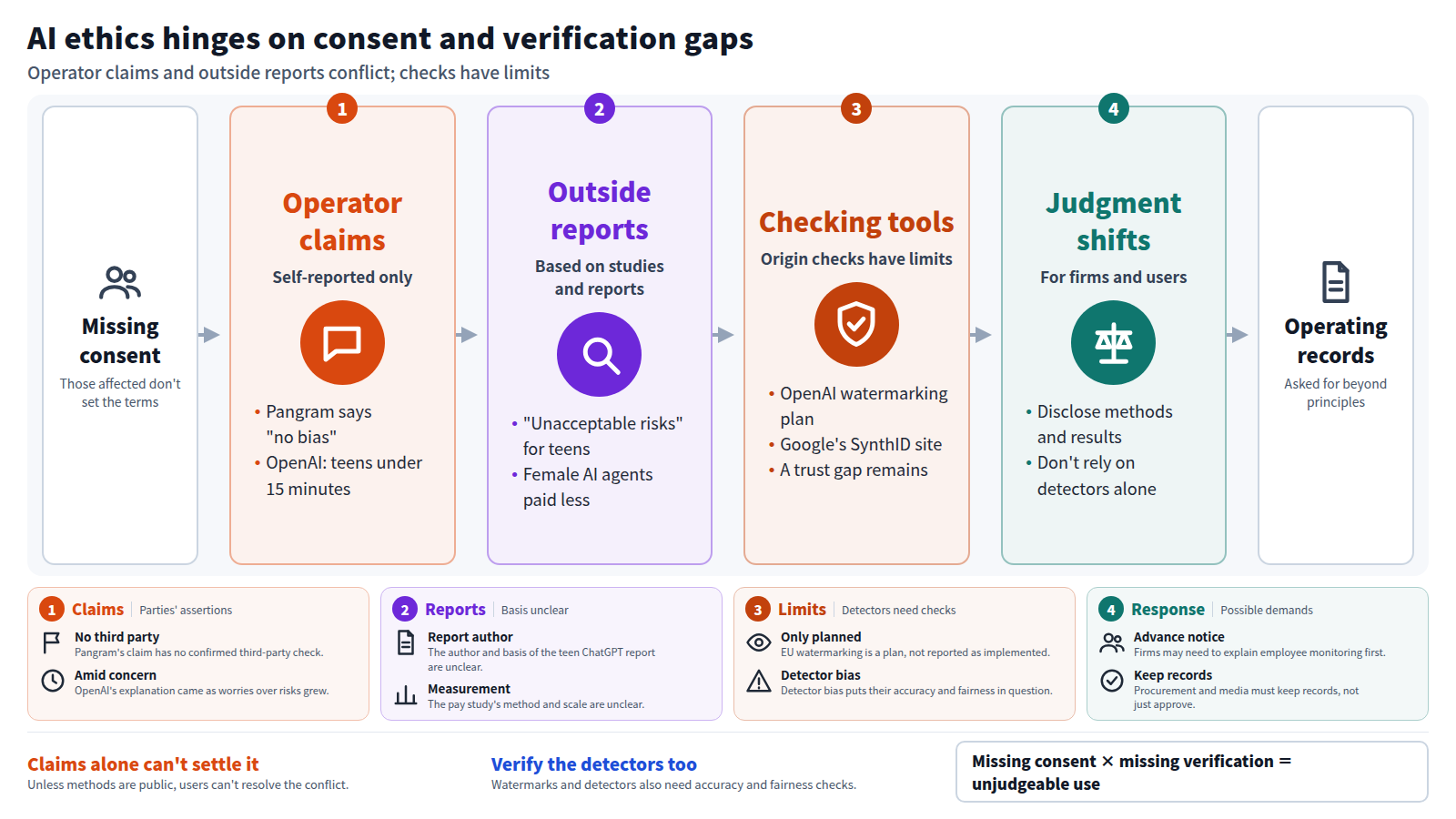
Overview
- Verifying bias (AI detection tools, rewards for AI agents) and ensuring authenticity through watermarking and disclosure were addressed simultaneously under multiple headings. - Regarding the use of ChatGPT by teenagers, a report has been published that provides an explanation from the operator and points out the risks. - Consent is being questioned regarding the rights of voice actors (Kenjiro Tsuda case) and remote monitoring of employees.
Bias, discrimination, fairness
- A study reported that female AI agents were paid less than male AI agents (NDTV). The study warns of gender bias. The measurement method and scale are unclear from the headline. - Pangram's chief executive says the company's AI detection tools are "unbiased" (The Bookseller). This is the assertion of the parties involved, and the results of third-party verification cannot be confirmed from the headline. It is reported that usage is increasing. - A scoping review summarizing the ethical issues of AI clinical decision support systems used during surgery was published in Nature. It is unclear from the headline which groups will be disadvantaged.
Privacy/Monitoring
- Avast warns of "trap of overconfidence in AI" regarding chatbot data (SecurityBrief UK). It is unclear from the headline what data it is. - PwC discussed the actions companies should take when using AI to remotely monitor employees. It is unclear from the headline how consent is obtained and the purpose of use.
Transparency/Accountability
- What has been decided to be disclosed: - The Artificial Intelligence Alliance has approved the principles for the use of AI in the media (posted on the official website). - Ibrahimaj presented a model for transparency in Albania's public procurement AI system (cna.al). - Something in the planning stage. OpenAI plans to watermark ChatGPT and Codex text output in the EU (Business Today). It is not reported that it has been implemented. - Invisible disclosure. The content of the principles, procurement AI evaluation criteria, and watermark detection methods are unclear from the headline. The NDTV Profit video only introduces the program and the content is unknown.
Creator/Copyright/Consent
- In the case of Kenjiro Tsuda, the use of AI became a point of contention over the rights of voice actors, and the labor union announced that it would protect the rights of voice actors (FandomWire). The expression ``Japan won the AI war'' is an evaluation of the same media's headline, and the content and basis of the judgment are unclear from the headline.
False information/deep fake
- AI-generated images of child sexual abuse are causing real harm, it was reported (The Hill). The number and nature of the damage is unclear from the headline. - As a confirmed countermeasure, Google has released a SynthID site that detects AI-generated media (The Tech Buzz). - IT Security Guru argues that there is a "trust gap" that AI watermarks cannot bridge. This is a claim made by the same media, and the specific basis is unclear from the headline.
Protection of children and vulnerable people
- Target users are teenagers. - A report claimed that ChatGPT for teens has "unacceptable risks" and is unsafe (Gizmodo, Bloomberg). The author and basis of the report are unclear from the headline. - OpenAI said teens use it less than 15 minutes a day (Reuters). This is an explanation from the business operator, and it is reported that it was issued amid growing concerns about risks. - Jenna Bush Hager criticizes lack of regulation of AI and talks about potential harm to children (AOL.com) - From the headline, it is not possible to identify the entity that implemented the protection measures.
Ethical principles and guidelines
- What has been decided: - The Secretariat of the World Parliament of Religions adopted a document on climate and AI ethics (Qazinform). - The Artificial Intelligence Alliance approved the principles for the use of AI in the media (same issue as Section 4). - Proposal/promotion: - University of South Carolina engineering and education researchers begin collaboration on responsible AI. - Arab Insurance Federation promotes ethical AI implementation and parametric insurance (Jordan News Agency). - In both cases, the deliverables and binding force are unclear from the headlines.
Japanese AI ethics
- Only the case of Kenjiro Tsuda (paragraph 5). Since this was not an announcement by the parties involved in Japan, but was reported by an English-language media overseas, the facts need to be confirmed with primary information from the Japanese side.
Remarks from VIPs
No relevant information (no headlines about Timnit Gebru, Fei-Fei Li, Yoshua Bengio).
Integrated analysis: How do ethical questions fit together?
Common points of lack of consent - The rights of voice actors, remote monitoring of employees, chatbot data, and use of teenagers are all questions of who consented to what. - A common structure is that those affected are not in a position to decide the conditions of use.
Lack of explanation and reliance on self-reporting - Pangram's statement that "there is no bias" and OpenAI's statement that "teenage users use it for less than 15 minutes" are both explanations from the operators. On the other hand, those who point out the bias of the tool and the risks for teenagers are reported to be based on studies and reports. - Unless the verification method is made public, users cannot determine the discrepancy between the two.
Limitations of confirmation methods - Watermarks (OpenAI) and detection sites (Google) are means of verifying the origin of products. Meanwhile, IT Security Guru points out that the trust gap will not close. - Combined with the problem of bias in the detection tool itself (Pangram), the accuracy and fairness of the detection side will also be subject to verification.
Points where judgment changes - Companies may be required to disclose evaluation methods and results, provide advance explanation to employees, and independently verify features for teenagers. - It becomes reasonable for users not to rely on the detection tool's judgment as the sole basis. - The ordering side (procurement, media) is asked not only to approve the principles, but also to be able to keep records of operations.
Future points of interest
When will OpenAI watermarking for the EU be implemented and will the detection method be made public? 2. Will OpenAI respond to risk reports about ChatGPT for teens with independent verification and specific safeguards? 3. Will the content of the judgment in the Kenjiro Tsuda case and specific standards for protecting the rights of voice actors be presented?
- Ethical considerations for intraoperative implementation of artificial intelligence clinical decision support systems: a scoping review — Nature10/07 15:37 UTC
- Pangram CEO says ‘no bias’ in its AI-detection tool, as use rises — The Bookseller10/07 09:28 UTC
- Avast warns of AI confidence trap over chatbot data — SecurityBrief UK10/07 07:30 UTC
- Artificial Intelligence and remote Monitoring of employees: What companies need to do — PwC10/07 10:07 UTC
- The Artificial Intelligence Alliance has approved principles for the use of AI in the media — Корпоративний Сайт Суспільного10/07 13:43 UTC
- Video | Closing Argument Episode 1: Artificial Intelligence — NDTV Profit10/07 14:23 UTC
- AI System in Public Procurement/ Ibrahimaj: We presented the model for transparency — cna.al10/07 12:32 UTC
- Japan Officially Wins the A.I. War in Heated Kenjiro Tsuda Case, Union Vows to Protect VA Rights — FandomWire10/06 09:36 UTC
- AI-generated child sexual abuse images cause real-life harm — The Hill10/07 15:00 UTC
- Google Launches SynthID Site to Detect AI-Generated Media — The Tech Buzz10/07 14:08 UTC
- The trust gap that AI watermarking can’t close — IT Security Guru10/07 13:24 UTC
- USC engineering and education researchers join forces on responsible AI — University of South Carolina10/07 15:06 UTC
- Secretariat of World Religions Congress adopts climate and AI ethics documents — Qazinform10/07 16:04 UTC
- General Arab Insurance Federation pushes for ethical AI integration, parametric coverage — وكالة الانباء الاردنية10/07 13:30 UTC