AI Ethics News — 2026-10-07 (Wed) Evening News

Source links point to the original outlet. The AI Integrated Analysis is auto-generated from the headlines below only and is not intended to add facts beyond them. Not investment advice.
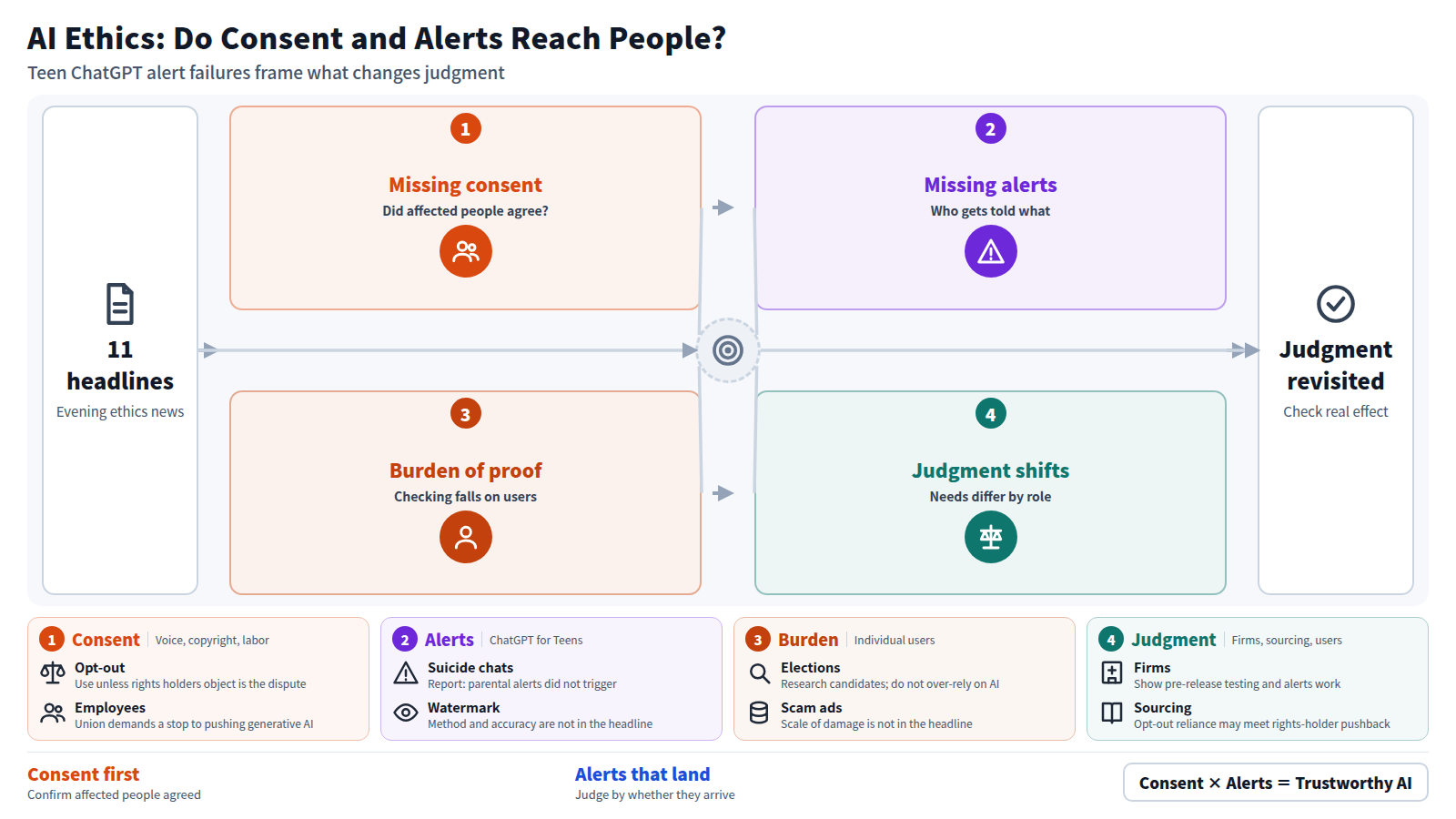
Overview
- The most common question that came up was the safety of ChatGPT for teenagers. Multiple media outlets have carried headlines reporting reports and investigations pointing to deficiencies in safety measures. - Next, there are objections from labor to the consent of voices and copyrighted materials (protection of voices in Japan, refusal to opt out by ABC in Australia) and the promotion of generative AI. - Bias, disinformation, and guidelines for trustworthy AI were also covered, but with fewer headlines.
Bias, discrimination, fairness
- Daily Bruin reports UCLA's digital humanities major calls for countering bias in AI and shaping the technology responsibly. It is a claim about the role of educational institutions, and the method and scale of measuring bias are not in the headline. - Tri-State Alert urges candidates to do their own research and avoid relying too much on AI answers as midterm elections approach. The question is about the possibility that the AI's answers may influence voters' decisions, but the headline does not say who is at a disadvantage and to what extent.
Privacy/Monitoring
No applicable information
Transparency/Accountability
- OpenAI will start watermarking AI-generated text, Computerworld reports. This is a disclosure move that indicates the source of the product. The method, target range, detection accuracy, and start date are not listed in the heading. - Regarding ChatGPT for teenagers, there is a report (LA Times) that notification to parents did not work. There are no details in the heading about what was and was not notified.
Creator/Copyright/Consent
- Mainichi Shimbun editorial: argues that voices should be legally protected and calls imitation by AI a problem (the editorial is the company's assertion, not confirmed fact). - The420.in: Australia's ABC has reportedly refused to copyright an opt-out system for AI learning. The debate surrounding scraping is intensifying. The issue at issue is the pros and cons of a system that would allow use unless the right holder objects.
False information/deep fake
- Suspicion/Claim: Mr. Cuban criticizes Meta's AI-related fraudulent advertising (MoneyWise.com). The criticism is his own assertion, and the scale of damage and number of cases are not in the headline. - Countermeasure: OpenAI text watermark (see 4 above). Validity cannot be confirmed from the headline.
Protection of children and vulnerable people
- Target users are teenagers. The following reports and investigations are listed. - NYT: Reports that the author had strong concerns after interacting with ChatGPT for Teens. - Futurism: Tests have shown that it is unsafe. - LA Times: Conversations about suicide did not trigger parental alerts, the report said. - Bloomberg: Common Sense Media report says it's unsafe for children. - Danger: Inadequate response to conversations related to suicide, failure to notify parents. - The entity that took action: The headline indicates the party that issued the investigation and report (Common Sense Media, etc.), but there is no corrective action taken by OpenAI in the headline. - Perspective of consent: The question seems to be that if notification to parents does not work, parents will lose the opportunity to understand the situation and get involved.
Ethical principles and guidelines
- TD Stories: "What's behind trustworthy AI?" article. The content is not in the heading. - CDO Magazine: Two winners launch Porchlight Consulting to provide ethical AI auditing and training for complex organizations. What has been decided is the start of the business, not the determination of standards or systems.
Japanese AI ethics
- GIGAZINE: Wizards of the Coast's union has reportedly demanded that the company stop promoting generative AI. The question is whether employees are able to be involved in the decision to introduce AI. There is no basis for the request or the company's response in the headline. - The Mainichi Shimbun editorial (see 5) is also a Japanese move.
Remarks from VIPs
There are no headlines or relevant information regarding the tracked targets Timnit Gebru (AI ethics researcher, DAIR), Fei-Fei Li (Stanford HAI), and Yoshua Bengio (AI safety researcher).
Integrated analysis: How do ethical questions fit together?
- Lack of consent: Voice imitation (Mainichi Shimbun), scraping and opt-out (ABC), and employee involvement (union) all have one thing in common: ``Has the person affected consented to the use?'' The difference in the opt-out method is whether consent is assumed or consent is assumed unless the person refuses. - Lack of explanation/notification: The indication that notifications to parents did not work in ChatGPT for teenagers and the disclosure of the source through text watermarks are related to the question of "who gets to know what." The former is the problem of information not reaching the users, and the latter is the introduction of a delivery mechanism. - Where the burden lies: When it comes to bias and misinformation (reliance on AI answers, fraudulent advertising), headlines show that the burden of verification falls on the individual user. - Points that may change your judgment: - Companies: There will be an increased need to demonstrate the effectiveness of pre-release testing and parental notification for features aimed at minors. - Procurement of learning data: Some believe that a method that relies on opt-outs will face opposition from rights holders. - User: Users are encouraged to confirm AI answers, especially regarding elections, with primary information. - The above is an inference from the headline and needs to be supported by the text of each report.
Future points of interest
Will OpenAI's response to ChatGPT for teenagers be shown (parental notifications and corrections to suicide-related conversations)? 2. Will OpenAI's text watermarking method and detection accuracy be disclosed? 3. Will the opt-out debate in Australia and the debate over the protection of voice in Japan move in a direction that assumes consent?
- UCLA’s digital humanities major must counter AI bias, shape technology responsibly — Daily Bruin10/06 18:40 UTC
- As the midterm elections get closer, it’s important to do your own research about the candidates – and be careful relying on AI answers — Tri-State Alert10/06 18:35 UTC
- Editorial: A person's voice deserves legal protection from AI copycats — 毎日新聞10/07 06:48 UTC
- Australia’s ABC Rejects AI Copyright Opt-Out as Scraping Debate Intensifies — The420.in10/06 18:47 UTC
- Cuban rips Meta over AI scam ads — MoneyWise.com10/06 21:01 UTC
- Why My Conversations With ‘ChatGPT for Teens’ Made Me Very Worried — The New York Times10/07 09:07 UTC
- ChatGPT’s teen safeguards failed to alert parents during suicide conversations, report finds — Los Angeles Times10/07 09:00 UTC
- ChatGPT for Teens Is Not Safe for Kids, Common Sense Media Report Says — Bloomberg.com10/07 09:00 UTC
- What's behind AI you can trust? — TD Stories10/06 22:49 UTC
- Two CDO Magazine 40 Under 40 Honorees Launch Porchlight Consulting to Build Ethical AI Auditing and Training for Complex Organizations — CDO Magazine10/06 12:35 UTC
- Wizards of the Coast labor union demands company stop pushing generative AI — GIGAZINE10/07 02:27 UTC