AI and Rare Diseases ── Heart and lung ── 2026-10-10
Rare cardiovascular and respiratory diseases: treatment, trials and AI
- Abstract
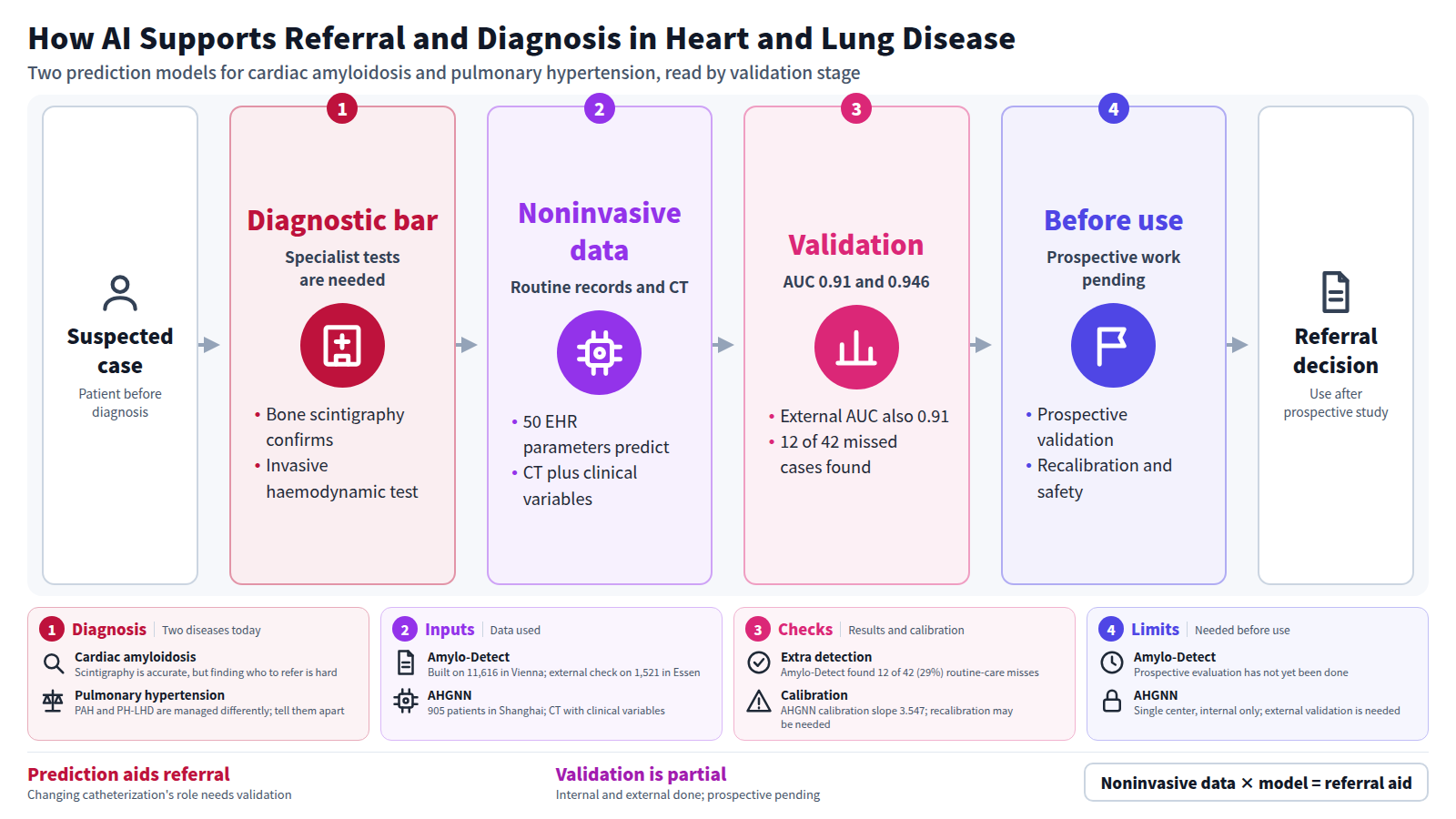
Timely detection is crucial to improve outcomes in patients with cardiac amyloidosis (CA) by initiation of guideline-directed disease-modifying treatments. Although confirmatory bone scintigraphy is highly accurate for CA detection, identifying at-risk patients for referral remains challenging. This study aimed to develop and validate a machine learning model, Amylo-Detect , using structured multimodal electronic health record (EHR) data to guide referrals for confirmatory scintigraphy and monoclonal protein testing. Consecutive all-comer patients (n = 11,616) referred for bone scintigraphy at the Vienna General Hospital (2010–2023) were retrospectively included. Patients referred before August 2020 formed the development cohort. The remaining patients comprised the internal validation cohort. External validation was performed at the University Hospital Essen (n = 1,521). Amylo-Detect was trained using 50 routinely available parameters to predict CA-suggestive uptake (Perugini grade ≥2) and compared with an existing score and clinical routine. High-grade uptake was present in 388 patients (3.0%). Amylo-Detect demonstrated excellent performance in development (AUC 0.93), independent internal validation (AUC 0.91), and external validation cohort (AUC 0.91), outperforming existing scoring systems and clinical routine. Results were consistent across subgroups, even when crucial predictors were missing. Of the 42/388 (10.8%) patients missed in clinical routine, 12/42 (29%) were additionally detected by Amylo-Detect . The model further conveyed significant prognostic value for mortality and heart failure hospitalization. We present Amylo-Detect , a validated EHR-based tool for CA risk prediction, available as a web app, allowing application and further evaluation. By improving timely detection and referral, Amylo-Detect may help address diagnostic delays, pending prospective evaluation.
Journal IF-equivalent: 6.5 (OpenAlex 2-year mean citedness, value as of 2026-10-09, retrieved 2026-10-10; not the official Clarivate IF)Reference: Spielvogel CP, Kersting D, Haberl D, Autherith M, Hauptmann L, Yu J, et al. Screening for patients at risk for cardiac amyloidosis via electronic health records: A multicenter machine learning development and validation study. PLOS Digit Health. 2026 Oct 8;5(10):e0001637. doi:10.1371/journal.pdig.0001637; PMCID: PMC13649026.Checked: Full text checked - Abstract
Differentiating pulmonary arterial hypertension (PAH) from pulmonary hypertension associated with left heart disease (PH-LHD) is clinically important because management differs substantially, but definitive classification requires invasive haemodynamic assessment together with clinical evaluation. We retrospectively studied 905 patients with PAH or PH-LHD treated at Shanghai Pulmonary Hospital and developed an adaptive heterogeneous graph neural network (AHGNN) that integrates contrast-enhanced thoracic CT images with noninvasive clinical variables. The model combines differentiable graph construction using Gumbel-Softmax reparameterization, hierarchical cross-modal attention, and dual-level self-supervised contrastive learning. Across 100 outer test folds from repeated patient-level five-fold cross-validation, AHGNN achieved a mean area under the receiver operating characteristic curve (AUC) of 0.946 ± 0.023 and a precision–recall AUC of 0.952 ± 0.009. At a fixed probability threshold of 0.50, sensitivity was 0.867 ± 0.070 and specificity was 0.867 ± 0.072. The Brier score was 0.139, although a calibration slope of 3.547 indicated that recalibration may be required. These findings support the potential of multimodal noninvasive data to assist referral and diagnostic triage. Prospective external validation, recalibration, and clinical safety evaluation are required before clinical use or any change to the role of right heart catheterization.
Journal IF-equivalent: 13.7 (OpenAlex 2-year mean citedness, value as of 2026-10-09, retrieved 2026-10-10; not the official Clarivate IF)Reference: Shen Y, Mi J, Zhao X, Liu G, Yang G, Yang B, et al. Adaptive heterogeneous graph neural networks for differentiating pulmonary arterial hypertension from left heart disease. npj Digit Med. 2026 Oct 8 [Epub ahead of print]. doi:10.1038/s41746-026-03305-x.Checked: Abstract only