AI & Education News — 2026-10-13 (Tue) Evening News

Source links point to the original outlet. The AI Integrated Analysis is auto-generated from the headlines below only and is not intended to add facts beyond them. Not investment advice.
Overview
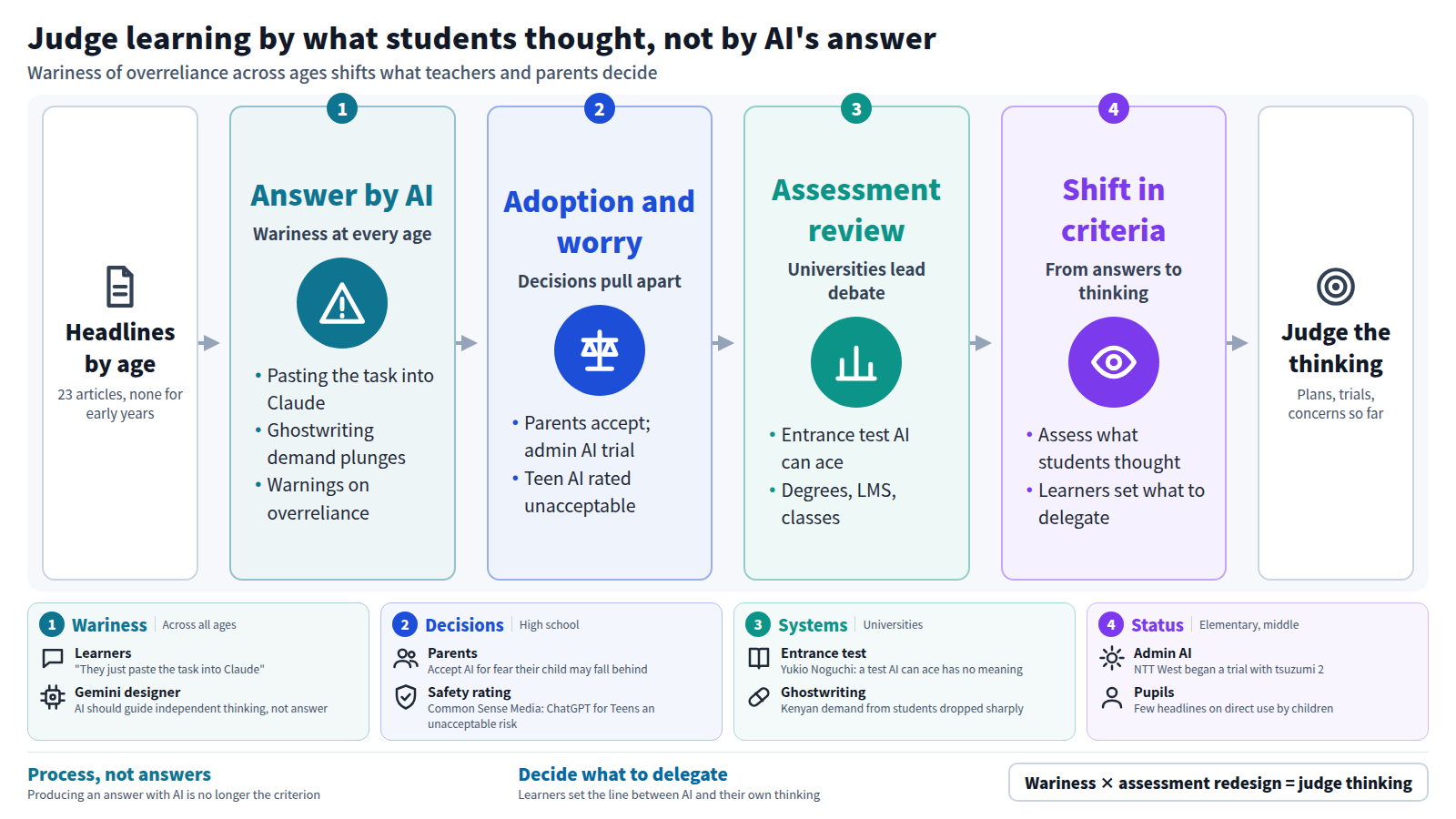
Debate over AI literacy and over weaker independent thinking is running across several life stages, from schools to universities. In Japan, teacher-focused contests and the start of a school administrative AI demonstration were reported for elementary and middle schools, and assessment and coursework were discussed for universities. No headlines appeared for early childhood education.
AI literacy
- MSU Denver was recognized for preparing students for an AI-enabled future (MSU Denver - Early Bird). - Kseniia Lukina spoke about teaching AI like a second language. The headline says "People Have Stopped Learning — They Just Paste the Task into Claude" (TechBullion). - A report said the designer of Google's Gemini Notebook argues AI should not give answers directly but should guide people's independent thinking (BigGo Finance). - Vietnam.vn reported a debate over the appropriate age at which pupils should start using IT, as AI is introduced into schools (Vietnam.vn). - In Japan, Okinawa Times described AI in classrooms as a double-edged sword, with hopes for learning effects alongside concern about weaker thinking skills (Okinawa Times).
Early childhood education
No notable developments.
Elementary school
- Hong Kong Police are taking an AI platform to schools (streamlinefeed.co.ke). - In Japan, a PR TIMES release announced an event on October 17 and 18 at Shinobazu Pond in Ueno, where elementary school children sell picture books and crepes they made themselves in the real world. It is billed as an "economic Boy Scouts" experience of earning money in the AI era (PR TIMES). - In Japan, the "AI Utilization Practice Contest 2026" for teachers has an October 16 application deadline (Koubo). The second contest on AI use in schools is also accepting teachers' practice cases, and registration is open for free viewing of the "Education AI Summit ONLINE" on November 14 (Jiji Press, Dellows News). These are plans and calls for entries; no results were reported.
Middle school
- In Japan, NTT West has begun what it calls the first nationwide demonstration of school administrative AI for elementary and middle schools, using a domestically developed LLM, "tsuzumi 2" (NTT West, Business Network). The headlines describe the start of a demonstration, not confirmed effects.
High school
- A report explained why parents are accepting AI in schools, citing worry that their child may fall behind (Il Sole 24 ORE). - Common Sense Media rated OpenAI's ChatGPT for Teens an unacceptable risk (Startup Fortune). - Vietnam.vn reported that AI applications are supporting innovation in primary education management (Vietnam.vn). - In Japan, Otemon Gakuin University published a special website on Japanese-language learning needed in the AI era (ICT Education News).
University students
- UA Little Rock students are exploring the future through a new artificial intelligence degree (UA Little Rock). - University professors warned against overreliance on AI in education (TOLOnews). - In Kenya, AI has swept the market for essay ghostwriters, and demand from university students has dropped sharply (Asahi Shimbun). - In Japan, economist Yukio Noguchi argued that a common university entrance test on which AI can score full marks has no meaning, and pointed to the abilities future exams must test (Yahoo! News). - In Japan, a free online seminar on November 5 will explain the role of next-generation LMS in university education DX in the generative AI era (valuepress). - In Japan, the University of Tokyo's Matsuo-Iwasawa Lab AI course drew about 120,000 participants in the last three months and passed 270,000 cumulative participants (Jiji Press). - In Japan, Circlace Group is providing practical AI and data-use classes in the Faculty of Business Data Science at Kansai University (Ibaraki Shimbun Cross Eye).
Adults
- In Japan, the AICX Association is giving free print copies of the official AI Agent Strategist textbook to 100 corporations, and 20 individuals will be chosen by lottery on X (Jiji Press). - Two other headlines, a TAC corporate campaign for security talent development (PR TIMES) and Miura Kogyo's "MIURA DX Academy" with Ehime University (Miura Kogyo), concern in-company talent development and belong to the AI and employment section, so they are not covered here.
Older adults
- In Japan, an AI experience class was held in Katsuura, with the aim of helping participants use AI well in daily life (Gaibo Keizai Shimbun).
Statements by key figures
No notable developments. None of the headlines concern Sal Khan, Founder of Khan Academy. 【Integrated analysis: how lifelong learning is changing】 - Common across stages: the headlines repeatedly pair adoption with concern about weaker thinking. AI literacy, high school and university items all raise the risk of overreliance (Okinawa Times, TOLOnews, TechBullion). The Gemini Notebook designer's stance that AI should guide thinking rather than hand over answers appears to be one response (BigGo Finance). - Different by stage: for elementary and middle school, the headlines concern teachers and school operations, such as practice contests and administrative AI demonstrations, rather than direct instruction of children (Koubo, NTT West). Universities face questions about assessment and degree design (Yahoo! News, UA Little Rock). Adult and older-adult items are mostly courses and hands-on classes (Jiji Press, Gaibo Keizai Shimbun). - Where decisions change: teachers appear to be shifting from whether to allow AI to how to design tasks and tests so that students' own thinking is still required. Parents appear to weigh the fear of falling behind against safety ratings (Il Sole 24 ORE, Startup Fortune). Effects on children's learning were not confirmed in any headline.
What to watch
- Whether the teacher contests (application deadline October 16) and the "Education AI Summit ONLINE" on November 14 produce shareable school practice cases (Koubo, Jiji Press). - Whether the NTT West demonstration of school administrative AI reports results, and what they show (NTT West). - Whether universities' assessment redesign, prompted by concerns that AI can score full marks and by falling demand for ghostwriting, moves from commentary to concrete changes (Yahoo! News, Asahi Shimbun).
- MSU Denver recognized for preparing students for an AI-enabled future — MSU Denver - Early Bird10/12 23:02 UTC
- Kseniia Lukina on Teaching AI Like a Second Language: "People Have Stopped Learning — They Just Paste the Task into Claude" — TechBullion10/13 07:56 UTC
- Advancing AI a "double-edged sword" in education, with learning benefits hoped for and concern over weaker thinking — Japanese media10/12 20:00 UTC
- Introducing artificial intelligence (AI) into schools: Debate on the appropriate age for students to start using IT — Vietnam.vn10/13 09:03 UTC
- Google's Gemini Notebook designer: AI should guide independent thinking, not give direct answers — Japanese media10/13 05:36 UTC
- Hong Kong Police Take AI Platform to Schools — https://streamlinefeed.co.ke/10/13 04:23 UTC
- Elementary pupils sell self-made picture books and crepes at "economic Boy Scouts" event in Ueno on October 17-18 — PR TIMES10/13 01:10 UTC
- AI Utilization Practice Contest 2026 for Teachers Closes October 16 — Koubo10/13 06:04 UTC
- Japan's First Trial of Fully Domestic LLM for School Administration in Elementary and Junior High Schools Begins — Japanese media10/13 06:19 UTC
- ‘What if my child falls behind?’: why parents are saying yes to the use of AI in schools — Il Sole 24 ORE10/13 06:39 UTC
- Otemon Gakuin University Publishes Special Site Feature on Japanese-Language Learning Needed in the AI Era — Japanese media10/13 02:28 UTC
- AI Applications Support Innovation in Primary Education Management — Vietnam.vn10/13 06:59 UTC
- UA Little Rock students explore the future through new artificial intelligence degree — UA Little Rock10/12 17:06 UTC
- University Professors Warn Against Overreliance on AI in Education — TOLOnews10/12 16:53 UTC
- AI Can Score Full Marks on University Entrance Exam, Making It Meaningless, Says Yukio Noguchi — Japanese media10/13 01:15 UTC
- AI Sweeps Kenya's Essay-Writing Ghostwriters as Demand From College Students Plunges — Japanese media10/12 21:30 UTC
- Free Online Seminar on Next-Generation LMS and University Education DX in the Generative AI Era Set for November 5 — valuepress10/13 03:00 UTC
- University of Tokyo Matsuo-Iwasawa Lab AI Courses Draw About 120,000 Learners in Three Months, Passing 270,000 Total — Japanese media10/13 07:46 UTC
- AICX Association Offers Printed AI Agent Strategist Textbook Free to 100 Companies, Prize Draw for 20 Individuals on X — Japanese media10/13 07:46 UTC
- TAC Launches Corporate Campaign Supporting Security Talent Development in the AI Era — PR TIMES10/13 01:30 UTC
- Circlace Group Provides Practical AI and Data Utilization Classes to Kansai University's Business Data Science Faculty — Japanese media10/13 07:00 UTC
- Miura Kogyo Opens MIURA DX Academy With Ehime University's Cooperation to Train DX Talent — Japanese media10/13 03:30 UTC
- AI Experience Class in Katsuura Teaches Residents to Use AI in Daily Life — Japanese media10/12 23:39 UTC