AI, Welfare & Long-term Care News — 2026-10-09 (Fri) Morning News

Source links point to the original outlet. The AI Integrated Analysis is auto-generated from the headlines below only and is not intended to add facts beyond them. Not investment advice.
Overview
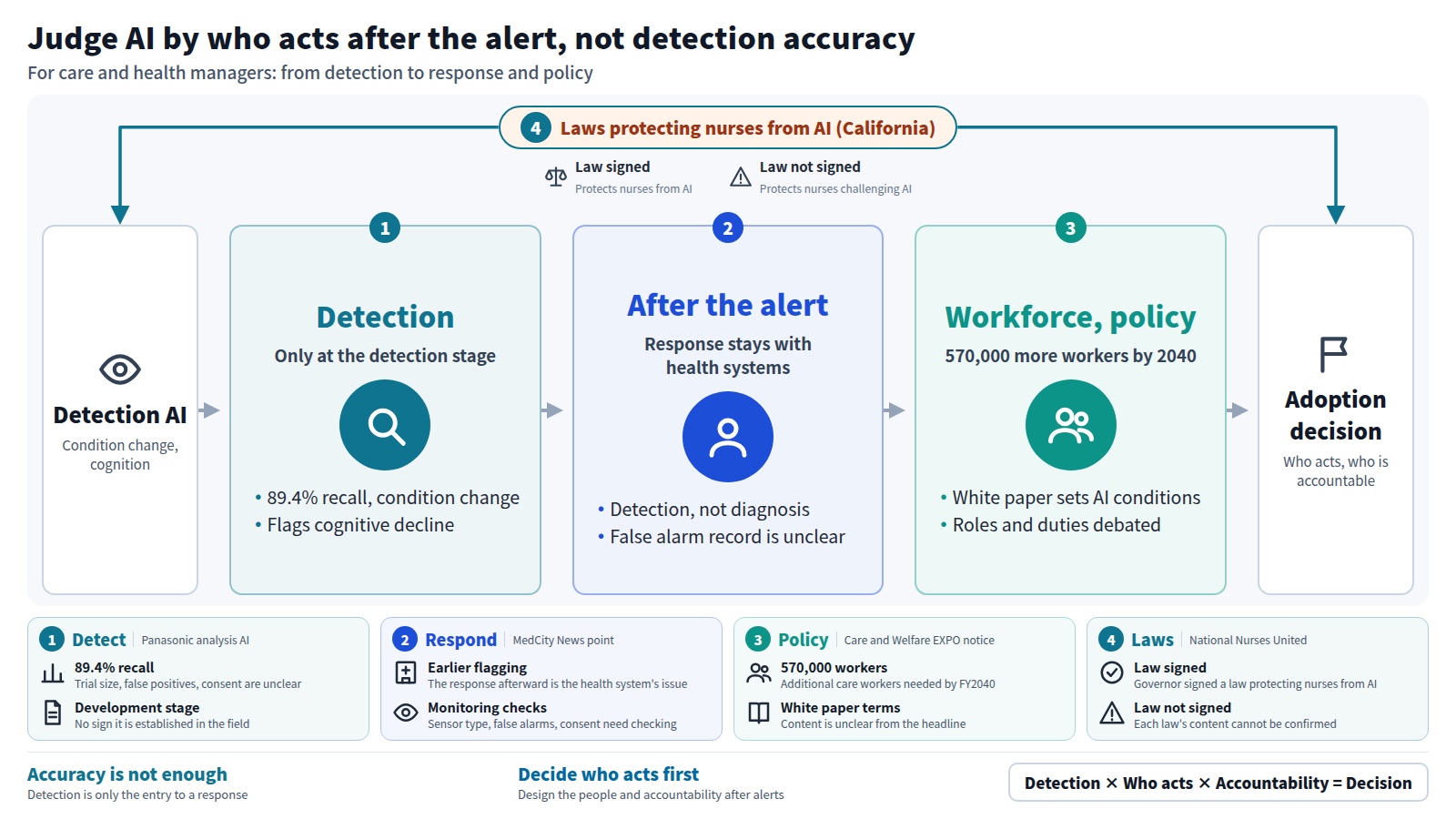
- The changes were mainly in the areas of human resources and systems. In the US state of California, there have been several reports of movement regarding a state law to protect nursing professionals from AI. - In Japan, a white paper that outlined the need to secure additional nursing care workers (approximately 570,000 by 2040) and the "conditions" for utilizing AI became a hot topic. - On-site technologies include AI for analyzing changes in physical condition (Panasonic) and detection of cognitive decline, both of which remain at the "detection" stage in the headline.
AI in nursing care settings
- There are no headings that specifically indicate reductions in man-hours for records, billing, shifts, and care plans. - Economics Observatory "Unemployment from AI disruption: could it solve the care crisis?" is an article that discusses whether unemployment caused by AI can solve the nursing care shortage. The actual value of the effect or the level of evidence cannot be gleaned from the headline.
Labor shortage and workers
- National Nurses United announced that California Governor Newsom signed landmark legislation to protect nurses from AI. Meanwhile, in another headline, the group criticizes the governor for refusing to sign legislation that protects nurses who challenge unsafe AI. From the headlines, it appears that there are laws that were signed and laws that were not signed, but the content of each law cannot be determined from the headlines. - Lost Coast Outpost reports that "Labor got only a fraction of what it asked for." - Stock Titan headline claims Ruko used AI to process more than 3,000 inquiries in six months, reducing ticket wait times from about two hours to less than 10 minutes. It's a company announcement, and it's unclear from the headline whether it's a nursing care facility or not. The design and continuity of the comparison are also unclear. - There are no headings regarding foreign human resources, staffing standards, or turnover rates. The headlines also do not distinguish between jobs that AI will replace and those that will not.
Dementia care
- MedCity News, "AI Can Flag Cognitive Decline Earlier — Health Systems Still Own What Happens Next" points out that while AI can "flag" cognitive decline early, the subsequent response remains a challenge for health systems. We are dealing with detection, not diagnosis. - There are no headlines about dealing with BPSD or the burden on families. The level of evidence is also unclear from the headline.
Home care/monitoring
- Fox 10 News introduces "Gracepoint Home Care Sensi AI Program." The headline alone does not confirm the type of sensor, track record of false alarms or oversights, user consent or privacy practices. Since monitoring is both support and monitoring, these require separate confirmation.
Care robots/equipment
- There are no headlines regarding the number or continuation rate of transfer support, rehabilitation, and communication robots introduced. - Relatedly, it has been announced that smart glasses, monitoring AI, digital therapy, etc. will be gathered at the 9th Nursing Care and Welfare EXPO (from October 7th at Makuhari Messe) (PR TIMES). This is an announcement of the exhibition, not a track record of its introduction or establishment. - In the field of disability welfare, it was reported that Meta donated 1,000 AI glasses to an organization for the disabled in Singapore (The Tech Buzz). This is the number of units distributed, and does not indicate the rate of continued use or effectiveness.
System/Insurance
- ITmedia reports that the Ministry of Health, Labor and Welfare has set out ``conditions'' in a white paper regarding the differences between companies that achieve results with AI investment. The content is unclear from the headline, and it is not possible to confirm whether the story is limited to the nursing care field. - There are no headings regarding long-term care fees, comprehensive community care, and local government verification.
Japanese movements
- Panasonic develops "health status change analysis AI" for nursing care facilities. The reproduction rate for signs of changes in physical condition is said to be 89.4%. From the headline, it is unclear how large the trial will be, how many facilities will be covered, the rate of false positives, and how resident consent will be treated. This is an announcement at the development stage, and there is no indication that it will be established in the field. - An announcement at the Nursing Care and Welfare Expo indicates that approximately 570,000 additional nursing care workers will be needed by 2040 (PR TIMES). - Nursing care news Joint covers ``what to entrust to nursing care AI'' and ``human roles and responsibilities'' in a conversation between ND Software and BOS (Part 1). It presents the points at issue, and the actual measured data cannot be understood from the headline.
Remarks from VIPs
- The list of important people to be tracked is empty and there are no relevant statements. - FYI, Gavin Newsom (Governor of California) reportedly signed a law to protect nurses from AI (and refused to sign another law). However, the content of the statement is not in the headline.
- Unemployment from AI disruption: could it solve the care crisis? — Economics Observatory10/08 14:03 UTC
- Nurses celebrate historic victory as Gov. Newsom signs landmark A.I. protection into law — National Nurses United09/30 23:48 UTC
- Governor Newsom fails Californians by refusing to sign law protecting nurses who challenge unsafe A.I. — National Nurses United10/01 03:04 UTC
- AI handled more than 3,000 questions in six months as Ruko cut ticket waits from about two hours to under 10 minutes. — Stock Titan09/29 11:00 UTC
- AI Can Flag Cognitive Decline Earlier — Health Systems Still Own What Happens Next — MedCity News10/08 13:56 UTC
- Gracepoint Home Care Sensi AI Program — Fox 10 News09/30 16:09 UTC
- What is the difference between companies that achieve results with AI investment? “Conditions” stated in the Ministry of Health, Labor and Welfare’s white paper: AI News Pickup — ITmedia09/30 22:00 UTC
- Approximately 570,000 additional nursing care workers will need to be secured by FY2040. Can AI compensate for the labor shortage? The 9th Nursing Care and Welfare EXPO brings together the latest technologies such as smart glasses, monitoring AI, and digital therapy to be held at Makuhari Messe from October 7th. — PR TIMES10/01 02:00 UTC
- In-Depth Dialogue: What to Entrust to Care AI, and Questions of Human Role and Responsibility, Part 1 — Japanese media09/30 20:40 UTC