AI & Economy News — 2026-10-09 (Fri) Evening News
Source links point to the original outlet. The AI Integrated Analysis is auto-generated from the headlines below only and is not intended to add facts beyond them. Not investment advice.
Overview
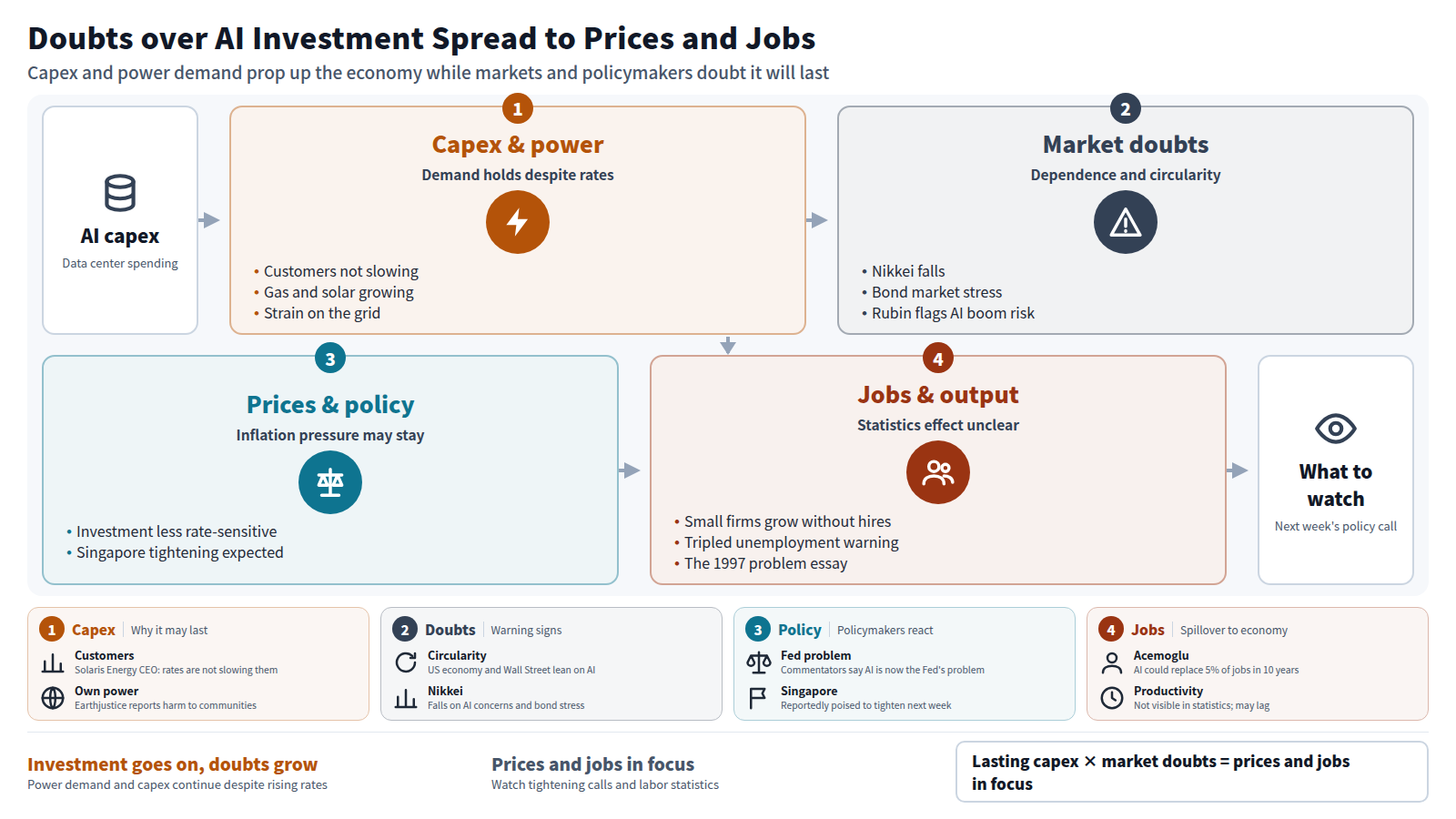
Concerns about economic and market dependence and overheating regarding AI are increasing, with concerns about ``cyclicality'' (World Socialist Web Site), the drop in Nikkei and stress in the global bond market (The Economic Times), and former Treasury Secretary Rubin pointing out the risks of the AI boom (TBS NEWS DIG). On the other hand, the view was expressed that electricity demand and capital investment for data centers will continue despite rising interest rates (Stocktwits). Daron Acemoglu has warned that AI could replace 5% of jobs in the next 10 years, tripling the unemployment rate (NewsBytes).
Macroeconomic/growth trends
The US economy and Wall Street are becoming increasingly dependent on AI, raising concerns about circularity (World Socialist Web Site). Some commentators say that AI has become a "Fed problem" (The Tech Buzz). Singapore's central bank is reportedly poised to tighten the economy further next week due to the AI boom and the risk of a resurgence in inflation (BigGo Finance). Nikkei falls on AI concerns and global bond market stress (The Economic Times). Former Treasury Secretary Rubin pointed out the risks that the AI boom poses to the U.S. economy and markets (TBS NEWS DIG). Georgia Tech and Emory will invest more than $1B in AI to boost state jobs and economic growth (Newswise).
Productivity trends
An essay was published stating that ``the miracle of AI has a 1997 problem'' (The Dark Side Of The Boom). There is also an analysis that discusses AI and the US economy (Continuum Economics). In the corporate world, there is a view that CFOs can expand their finance departments without increasing headcount (CFO Dive). Jeff Bezos said AI would "liberate" people from work, but the reaction online was muted (Dawn Images). It is not possible to confirm from the headlines whether productivity improvements are reflected in statistics or the economy as a whole.
Trends in employment and labor market
AI surveillance startup Flock Safety is reportedly cutting hundreds of jobs following backlash (Reuters). New data shows small businesses are using AI to grow without hiring (PYMNTS.com). California has a new bill related to AI employment, with explanations for employers (Daily Journal). Legal risk management of recruitment and personnel decisions using AI is also a topic of discussion (McDermott Will & Schulte). Mr. Acemoglu's warning is listed in 6.
Trends in energy/power demand
Power demands from AI data centers are driving growth in natural gas and solar, straining the power grid (The Athens Messenger). "Bring Your Own Power" projects for data centers will cause serious harm to local communities and the environment, Earthjustice has released a report. Solaris Energy CEO says rising interest rates aren't slowing down AI data center customers (Stocktwits). Dmitri Mehlhorn argued that the United States can't stop the expansion of AI and data centers (NPR for Oregonians). A comprehensive list of the latest trends is also available (The Verge).
Remarks by central banks, international organizations, and VIPs
Daron Acemoglu (MIT economist / Nobel laureate) said AI could replace 5% of jobs in the next 10 years (NewsBytes), and another report warned that AI could triple the unemployment rate within 10 years (NewsBytes). The World Bank said in a report that AI could expand access to expertise and improve service delivery in developing countries (ET Telecom). The outlook for Sub-Saharan Africa has improved, but downside risks remain, and the company plans to utilize AI for growth (Forbes Africa). World Bank recognized Saudi Arabia's experience in data governance and AI development (ASHARQ AL-AWSAT English). Vaishnaw of the Indian government showed the achievements of AI in agriculture and medicine (Indian Television Dot Com). Statements by Christine Lagarde, Kazuo Ueda, Andrew Bailey, Kristalina Georgieva, Mathias Cormann, Ajay Banga, and Erik Brynjolfsson are not found in the headlines.
Trends in corporate capital investment
Principal officials shared their views on AI-related capital investment cycles and markets on Bloomberg (Bloomberg.com). Martin Sorrell of S4 Capital also mentioned the AI capital investment boom (CNBC). It has been pointed out that AI capital investment and rising real interest rates are changing portfolio construction (InvestmentNews). An analysis has also found that the AI effect is having a ripple effect on stock prices, profits, and cash flow (Investing.com). Alibaba is credited with AI cloud growth offsetting e-commerce pressure (TradingView).
Trade and industrial policy
China's AI data center investment is moving to Inner Mongolia, where cheap power and semiconductor subsidies are attracting compute resources from Huawei, Alibaba and ByteDance (Dealroom). NIST participated in the "Genesis Mission" to accelerate AI innovation (JST CRDS). The trade agreement is in a state of uncertainty, and "excessive" tax benefits have also been talked about (Yahoo! Finance Canada). The growth ladder of East Asia's manufacturing industry is slowing down, and there is commentary that AI alone cannot restart it (Lowy Institute). AI is redirecting corporate IT spending, pushing healthcare back (Procurement Magazine).
Integrated analysis: What is happening now
The headline suggests that while capital investment and electricity demand are supporting the economy, doubts about their sustainability are spreading among markets and policy makers. In the US, a combination of concerns about AI dependence and cyclicality, a drop in Nikkei, and stress in the bond market are coexisting with the view (Stocktwits) that demand for data centers will continue even as interest rates rise. This combination suggests that inflationary pressures may remain as real investment is less responsive to interest rates, and is consistent with Singapore's forecast for tightening (BigGo Finance). In terms of productivity, while examples of on-site efficiency improvement (CFO Dive, PYMNTS.com) are ahead, the effect on macro statistics is unclear, and as the discussion of the ``1997 problem'' shows, there may be a time lag. In terms of employment, Acemoglu's warning is expected to intensify the debate, with growth constrained by recruitment and layoffs. In the area of electric power, criticism of self-generated power sources may generate political friction in regional and environmental areas. In terms of policy, there is a contrast between China's location guidance through subsidies and the US' public-private research collaboration, with the World Bank encouraging its use in developing countries.
Future points of interest
- How will Singapore's central bank's policy decisions next week factor in the AI boom and the risk of a resurgence of inflation? - How stress in the bond market and concerns about the cyclicality of AI capital investment will spill over into the stock market and funding environment. - Will AI employment-related regulations (California) and moves toward layoffs be reflected in labor market statistics?
- US economy and Wall Street increasingly dependent on AI amid concerns over circularity — World Socialist Web Site10/09 04:13 UTC
- Georgia Tech and Emory Invest More Than $1B in AI to Drive State's Jobs, Economic Growth — Newswise10/08 21:50 UTC
- AI Is Now the Fed's Problem... and Yours — The Tech Buzz10/09 09:03 UTC
- Singapore Central Bank Poised for Additional Tightening Next Week on AI Boom and Inflation Resurgence Risks — BigGo Finance10/09 06:55 UTC
- Global Market: Japan's Nikkei falls as AI concerns, global bond market stress weigh — The Economic Times10/09 03:41 UTC
- AI can help CFOs expand finance without adding staff: Prophix CEO — CFO Dive10/09 01:58 UTC
- AI and The U.S. Economy — Continuum Economics10/09 08:15 UTC
- AI's Miracle Has a 1997 Problem — The Dark Side Of The Boom10/09 08:03 UTC
- Will AI kill us all? Political Economy alumnus and AI executive Andy Barkett says a 10% chance is misleading. — University of California, Berkeley10/08 22:53 UTC
- Tech billionaire Jeff Bezos thinks AI will 'set us free' from work but the internet isn't buying it — Dawn Images10/09 08:12 UTC
- EXCLUSIVE: AI surveillance startup Flock Safety to cut several hundred jobs amid backlash, sources say — Reuters10/09 00:05 UTC
- Managing Legal Risk in AI-Driven Employment Decisions — McDermott Will & Schulte10/08 21:37 UTC
- Why JPMorgan Is the Most AI-Advanced Bank — Bloomberg.com10/09 08:57 UTC
- New Data Shows Small Businesses Use AI to Grow Without Hiring — PYMNTS.com10/09 08:03 UTC
- Protecting Who? "Bring Your Own Power" Projects for AI Data Centers Would Wreak Havoc on Communities and the Environment, New Report Finds — Earthjustice10/08 22:21 UTC
- Dmitri Mehlhorn on AI, data centers and why the U.S. can't hit pause — NPR for Oregonians10/08 21:24 UTC
- Higher Interest Rates Aren't Slowing AI Data Center Customers: Solaris Energy CEO — Stocktwits10/09 02:21 UTC
- Coupa BSI: AI Reshapes Tech Spend as Healthcare Retreats — Procurement Magazine10/09 08:37 UTC
- China's AI data-centre race moves to Inner Mongolia, where cheap power and chip-friendly subsidies draw Huawei, Alibaba and ByteDance's compute — Dealroom10/09 07:56 UTC
- News of the day: Trade deal in limbo, 'excessive' tax breaks, AI threats, giving up homeownership, business debt and more — Yahoo! Finance Canada10/08 21:26 UTC
- Alibaba: Nomura retains 'Buy', target price of $178 as AI cloud growth offsets ecommerce pressures — TradingView10/09 06:23 UTC
- Morning Bid: Feeding the AI beast — Yahoo Finance10/09 04:35 UTC
- Sub-Saharan Africa Outlook Improves, But Risks Tilt Downwards; World Bank Taps AI For Future Growth — Forbes Africa10/09 05:35 UTC
- East Asia's manufacturing escalator has slowed – AI alone will not restart it — Lowy Institute10/09 00:06 UTC
- World Bank Praises Saudi Arabia's Experience in Data Governance and AI Development — ASHARQ AL-AWSAT English10/09 04:35 UTC
- AI can widen access to expertise, improve service delivery in developing economies: World Bank report — ET Telecom10/09 02:33 UTC
- India showcases AI gains in farming and healthcare as World Bank launches report: Vaishnaw — Indian Television Dot Com10/09 03:04 UTC
- Watch Principal's Shah on AI Capex Cycle, Markets — Bloomberg.com10/09 01:54 UTC
- S4 Capital's Martin Sorrell on sports, the experience economy and the AI capex boom — CNBC10/09 04:22 UTC
- AI capex and rising real yields are reshaping portfolio construction — InvestmentNews10/09 00:50 UTC
- Stock Prices, Earnings and Cashflows: The AI Effect Plays Through — Investing.com10/09 07:11 UTC
- AI may be keeping Bitcoin's biggest macro headwind alive after the Fed stops hiking — CryptoRank10/09 05:35 UTC
- Column: Economics in the AI Era, Part 3 – Saving and Investment in a Fully Automated Society — Japanese media10/09 07:01 UTC
- Breakingviews Commentary: Why Europe Can Be the Real Winner in the AI Era — Reuters10/09 04:30 UTC
- Ethereum researcher warns of AI codebreaking risk, proposes moving assets preemptively — Japanese media10/09 07:55 UTC
- NIST joins the "Genesis Mission" to accelerate AI innovation — Japanese media10/09 02:22 UTC