AI & Economy News — 2026-10-09 (Fri) Morning News
Source links point to the original outlet. The AI Integrated Analysis is auto-generated from the headlines below only and is not intended to add facts beyond them. Not investment advice.
Overview
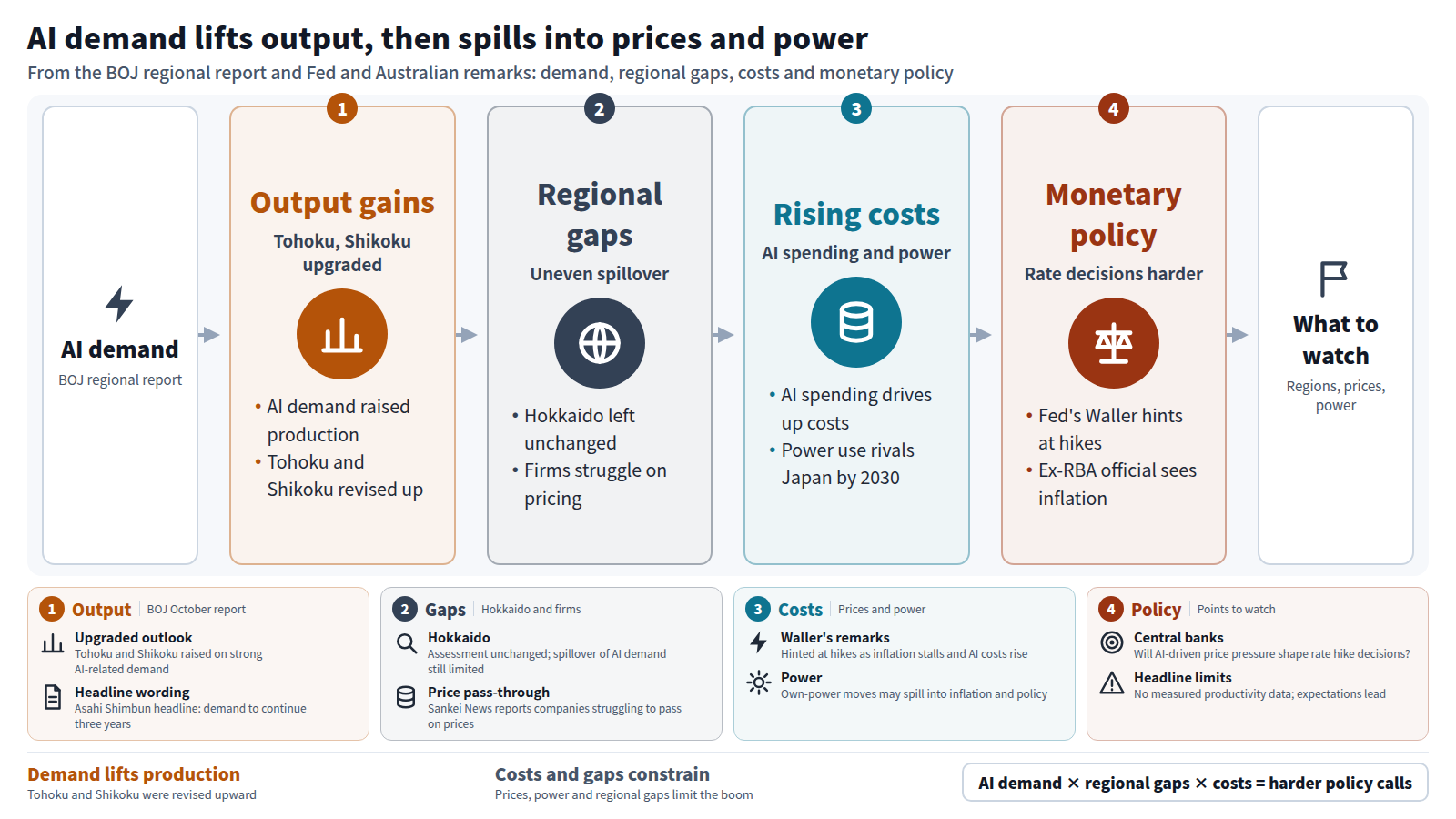
In the Bank of Japan's regional economic report (October), it was reported that the economic outlook for Tohoku and Shikoku was raised due to AI-related demand, and that AI demand had led to increased production in many regions (Asahi Shimbun, NHK News, Jiji.com, Sankei News). On the other hand, it is reported that the Fed's Waller has suggested further interest rate hikes due to stagnant inflation and rising costs due to AI spending, and AI is starting to be recognized as a pressure on prices (Anadolu Ajansı). While demand for AI is boosting production, constraints have also emerged due to regional differences in electricity demand, inflation, and spillovers.
Macroeconomic/growth trends
The Bank of Japan has revised upward its economic outlook for Tohoku and Shikoku. The reason for this is that AI-related demand continues to be strong, with a headline in the Asahi Shimbun stating that AI demand will "continue for the next three years" (Jiji.com, Asahi Shimbun). In Hokkaido, the decision was left unchanged, and it was said that the spread of AI demand was still weak. There are differences between regions (Hokkaido Shimbun Digital). Overseas, a former RBA official was reported to have said that the AI boom in Australia will spur inflation despite interest rate hikes (Rock Hill Herald). The Fed's Waller reportedly hinted at further rate hikes amid stagnant inflation and rising costs due to AI spending (Anadolu Ajansı). While the impact of tariffs is divided, there are also reports that AI investment is supporting the economy (RFD-TV).
Productivity trends
Jeff Bezos was reported to have said that AI could lead to a three-day work week and a return to single-income households due to significant productivity gains (MoneyWise.com, Business Insider Africa). Kazakhstan aims to build an economy and manufacturing industry centered on AI, and growth plans such as Astana Forum and Qazaq AI University have been reported (Euronews.com, IndexBox). The BIS was reported to have expressed the view that the impact of AI on the climate will obscure interest rate signals (Briefs Finance). There are no headlines showing actual measurements of productivity improvement, and at this stage, the focus is on future vision.
Trends in employment and labor market
The New York Fed's Liberty Street Economics has released the results of a survey of small and medium-sized business owners looking at AI adoption and employment prospects (Liberty Street Economics). An article has been published (The Washington Post) discussing support measures for workers who will lose their jobs due to AI. Triangle Jobs Summit highlighted the need for human skills as AI reshapes jobs (The Business Journals). In Missouri, the balance between innovation and risk and cost is being debated following the Trump administration's deregulation of AI (Missouri Independent). There are no headlines showing specific figures for job cuts or hiring numbers.
Trends in energy/power demand
Data center power demand is expected to rival Japan's power usage by 2030, and researchers have pointed out that software could be the easiest solution (Tom's Hardware). The risks and implications of Bring Your Own Power, centered on gas-fired power, were discussed by Earthjustice. A West Virginia lawmaker likened the impact of data centers to a steel mill, but said the impact would be smaller (WTOV). There is also an article (Columbia University) that considers setting up data centers in space as the next frontier.
Remarks by central banks, international organizations, and VIPs
Andrew Bailey (Bank of England Governor) gave the keynote speech in a session entitled 'Artificial Intelligence and the Global Economy: Opportunities and Risks'. The content of the statement cannot be confirmed from the headline (Forex Factory). The World Bank has expressed the view that AI presents historic opportunities for developing countries (Rediff). The IMF has warned the world economy against energy shocks and AI demand (VOV World). The BIS was reported to have noted that the climate impact of AI would obscure interest rate signals (Briefs Finance). The Bank of Japan raised its economic outlook for Tohoku and Shikoku in its regional economic report due to demand for AI (Asahi Shimbun, Jiji.com). Individual statements by Christine Lagarde, Kazuo Ueda, Kristalina Georgieva, Mathias Cormann, Ajay Banga, Daron Acemoglu, and Erik Brynjolfsson are not found in the headlines.
Trends in corporate capital investment
Meta is reportedly looking to offset rising infrastructure spending by monetizing social engagement (Benzinga). Emory and Georgia Tech will invest over $1B in AI to boost state jobs and economic growth (Emory News). In Japan, regional economic reports confirmed an increase in production due to demand for AI (NHK News). There are no headings indicating the amount of capital investment by other companies.
Trade and industrial policy
While the impact of tariffs is divided, AI investment is said to be supporting the economy (RFD-TV). There are reports that the AI boom is changing trans-Pacific trade and logistics (Yahoo Finance). DHL pointed out that the AI race is giving strong momentum to global trade (Freightweek). The race for AI supremacy in Latin America was discussed (Americas Quarterly). In the United States, the Trump administration's move to deregulate AI has become a point of contention at the state level (Missouri Independent).
Integrated analysis: What is happening now
While the Bank of Japan's regional report shows the real effects of AI demand boosting production, there is little ripple effect in Hokkaido, and regional differences are noticeable. In addition, the Sankei News headline reports that there are companies struggling to pass on prices. In the US and Australia, AI spending is expected to drive up costs and inflation, making monetary policy more difficult as interest rates rise (Anadolu Ajansı, Rock Hill Herald). On the power side, the surge in data center demand and the move toward self-sufficient power sources could spill over into both inflationary pressures and energy policy (Tom's Hardware, Earthjustice). Productivity improvements are expected from Bezos' statements, and actual measured data cannot be confirmed from the headlines. On the trade front, the rise in AI-related logistics and trade may partially offset the impact of tariffs.
Future points of interest
① How will the differences in the spread of AI demand between regions and companies and the progress of price pass-through be reflected in the Bank of Japan's economic judgment? ② The impact of inflationary pressure from AI spending on interest rate hike decisions by the Fed and other central banks. ③ The impact of the expansion of data center power demand and in-house power sources on the energy market and environmental regulations.
- Emory and Georgia Tech invest over $1B in AI to drive state's jobs, economic growth — Emory News10/08 13:10 UTC
- Fed's Waller signals further rate hikes as inflation stalls, AI spending drives up costs — Anadolu Ajansı10/08 12:34 UTC
- AI boom to fuel Australia inflation despite higher rates, ex-RBA official says — Rock Hill Herald10/08 11:27 UTC
- AI Beyond Tech: How Artificial Intelligence Is Reshaping The Economy — Seeking Alpha10/08 15:45 UTC
- Most Important Facts About AI and the Economy — RealClearPolicy10/08 15:43 UTC
- Kazakhstan seeks to build an AI-powered economy and manufacturing sector — Euronews.com10/08 12:10 UTC
- BIS: AI's climate impact clouds rate signals — Briefs Finance10/08 16:02 UTC
- Jeff Bezos says AI could power a return to single-earner households as it turbocharges productivity — Business Insider Africa10/08 16:48 UTC
- Kazakhstan's AI Economy Strategy: Astana Forum, Qazaq AI University & Growth Plans — IndexBox10/08 12:51 UTC
- AI Adoption and Employment Expectations: Evidence from a Survey of Small Business Owners — Liberty Street Economics10/08 11:01 UTC
- Here's an idea to help workers displaced by AI — The Washington Post10/08 17:12 UTC
- Experts at Triangle Jobs Summit stress need for human skills as AI reshapes work — The Business Journals10/08 14:30 UTC
- Commentary: As Trump pushes to deregulate AI, Missouri must weigh innovation, risks and cost — Missouri Independent10/08 10:52 UTC
- AI Data Centers: Is Space the Next Frontier? — Columbia University10/08 14:15 UTC
- W.Va. lawmaker likens AI data centers' footprint to steel mills, says impacts are less — WTOV10/08 15:25 UTC
- The AI Gas Rush: Risks and Implications of "Bring Your Own Power" — Earthjustice10/08 09:10 UTC
- Software could be the easiest fix for hyperscalers' AI power squeeze, researchers say — data center demand is expected to rival Japan's electricity usage by 2030 — Tom's Hardware10/08 14:00 UTC
- Tariff Effects Differ As AI Investment Supports Economy — RFD-TV10/08 11:11 UTC
- AI gold rush transforms trans-Pacific trade and logistics — Yahoo Finance10/08 14:52 UTC
- The Battle for Latin America’s AI Future — Americas Quarterly10/08 11:02 UTC
- DHL finds the race for AI is giving world trade strong momentum — Freightweek10/08 11:29 UTC
- Bank of Japan Upgrades Economic Assessments for Tohoku and Shikoku on AI-Driven Production Strength — BigGo Finance10/08 13:06 UTC
- AI Monetization Moat: Meta Leverages Social Engagement to Offset Rising Infrastructure Spending — Benzinga10/08 16:07 UTC
- Hokkaido Economic Assessment Unchanged in BOJ October Report; AI Demand Spillover Still Limited — Japanese media10/08 11:53 UTC
- Bailey: Keynote Speech & Session 3: Artificial Intelligence and the Global Economy: Opportunities and Risks — Forex Factory10/08 11:19 UTCAndrew Bailey / Bank of England Governor