AI & Economy News — 2026-10-08 (Thu) Evening News
Source links point to the original outlet. The AI Integrated Analysis is auto-generated from the headlines below only and is not intended to add facts beyond them. Not investment advice.
Overview
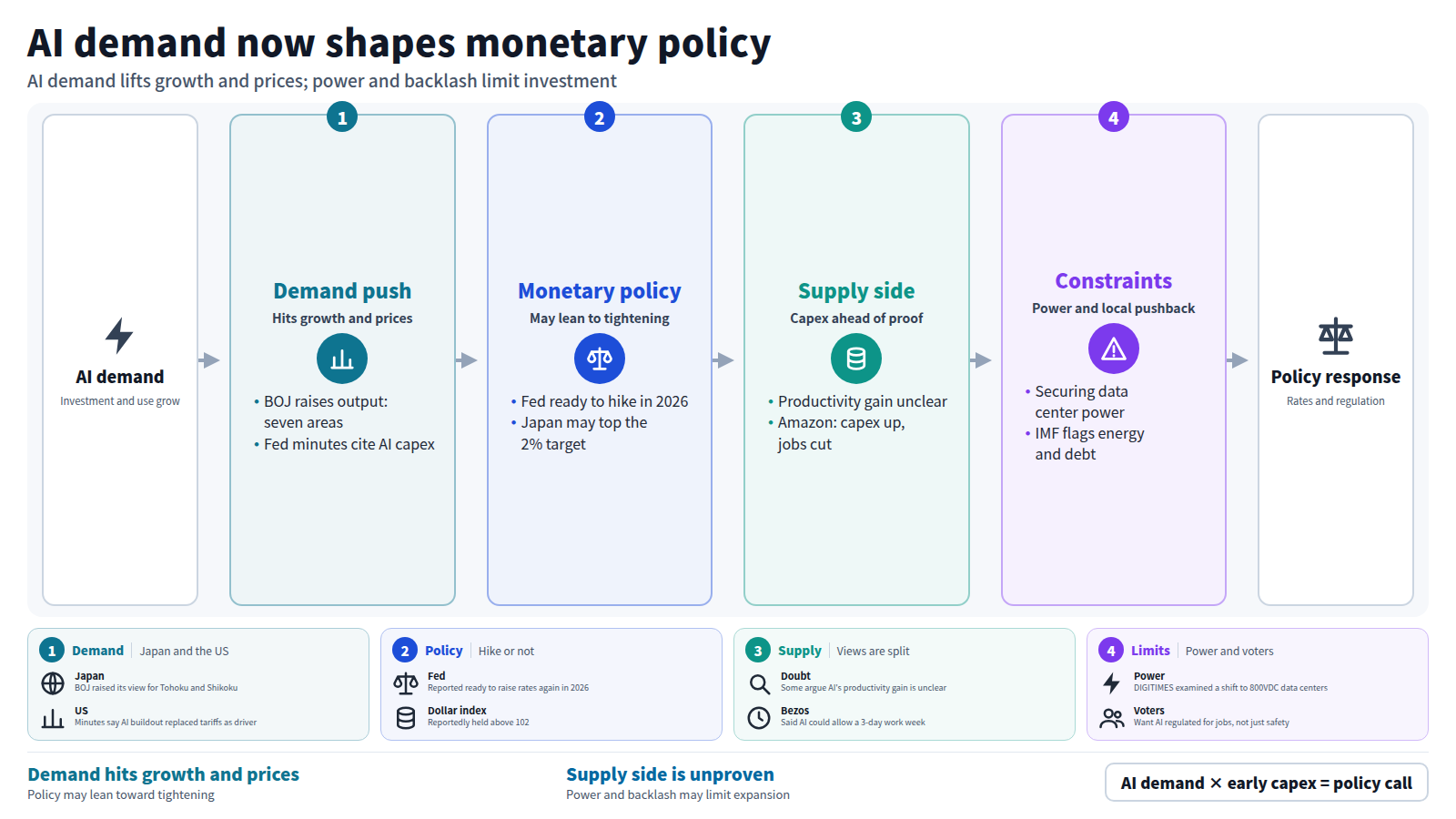
AI demand is becoming a deciding factor for monetary policy in terms of both prices and the economy. The Bank of Japan raised its production decisions in seven regions, including Tohoku and Shikoku, due to demand for AI, and the FOMC minutes suggested that increased AI-related investment was the main cause of core inflation (Reuters, Nihon Keizai Shimbun, Kitco). The IMF simultaneously warned of AI boom, energy shock, and debt risks, and Amazon accelerated capital spending and cut jobs in parallel (Asia News Network, BW People).
Macroeconomic/growth trends
The Bank of Japan's economic outlook was raised in Tohoku and Shikoku, supported by AI demand, and its "production outlook" was raised in seven regions. Some companies believe that AI-related demand will continue (Reuters, Nihon Keizai Shimbun, Kyodo News, TBS NEWS DIG). TradingView reported that AI demand could push Japan's inflation rate above the 2% target, influencing policy (TradingView). Regarding the US FOMC minutes, it was reported that the Fed was prepared to raise interest rates again in 2026, and that increased AI-related investment had replaced tariffs as the main factor pushing up core prices. The dollar index reportedly remained above 102 (Kitco, VT Markets). Former Treasury Secretary Rubin pointed out the risks the AI boom poses to the U.S. economy and markets (Bloomberg.com).
Productivity trends
Evaluation of the effect on productivity is mixed. Steven Rattner presented six charts showing the need for AI (New York Times). On the other hand, some authors argue that it is unclear whether AI really increases productivity (Walter Bradley Center for Natural and Artificial Intelligence). Jeff Bezos said AI could make it possible to work three days a week (Firstpost). Some commentators have argued that AI will appear as capital (Struggle-La Lucha).
Trends in employment and labor market
Amazon has announced new layoffs. The cuts come at a time when spending on AI infrastructure is accelerating (BW People). The use of AI is expanding in the construction industry (FOX 13 Tampa Bay). Young people are moving toward jobs that are less likely to be replaced by AI (Fast Company). Voters want AI to be regulated not only for safety but also for employment (Social Europe). Discussions around the impact on jobs and human resource development continue across the country (The Jerusalem Post, Brookdale Community College).
Trends in energy/power demand
DIGITIMES examined the migration of data centers to an 800VDC system, stating that the next infrastructure issue for AI is power (PR Newswire). Apollo has to respond to local backlash against AI data centers (Briefs Finance). The IMF has warned of the risk of both an AI boom and an energy shock, with power constraints becoming a point of contention (Asia News Network).
Remarks by central banks, international organizations, and VIPs
- Kristalina Georgieva, IMF Managing Director, urged urgent action to address debt and inequality amid shocks from AI boom and war. Ahead of the Bangkok talks, he also warned of risks in debt, energy and AI (Mid-Day, Nation Thailand, Asia News Network). - Daron Acemoglu (MIT economist / Nobel laureate): It will take 10 years to replace workers with AI, and the loss of jobs will be only 5% (CXOToday.com). - World Bank: Urged developing countries to apply and utilize AI instead of investing huge sums of money to build it from scratch. Nigeria has been rated as emerging as one of Africa's AI hubs (Open Magazine, MarketForces Africa). - Bank of Japan: Upgraded the economic outlook for Tohoku and Shikoku in the Sakura Report (Nihon Keizai Shimbun, TBS NEWS DIG). - Fed: Director Lisa Cook analyzed the impact of AI on the economy and policy (Israel Defense). - Christine Lagarde, Kazuo Ueda, Andrew Bailey, Ajay Banga, Mathias Cormann, and Erik Brynjolfsson are not confirmed in this headline.
Trends in corporate capital investment
Amazon announces new job cuts as spending on AI infrastructure accelerates (BW People). Apollo responds to local backlash over data centers for AI (Briefs Finance) Chey Tae-won (SK) appealed for a new AI-driven capitalism and solidarity between Japan and South Korea (Chosunbiz).
Trade and industrial policy
AI is driving growth in global trade, including air cargo (Air Cargo News, STAT Times). California's vote on AI governance was described as not only a policy decision but also a signal to the market (Forkast News). There are also reports that voters are calling for AI regulation in employment (Social Europe).
Integrated analysis: What is happening now
It appears that AI has begun to simultaneously affect the economy and prices as a factor pushing up the demand side. In Japan, this has led to improvements in regional economic judgment, and in the United States, there is a view that there will be upward pressure on core prices, and monetary policy may lean toward tightening (Reuters, Kitco, TradingView). On the supply side, capital investments are being made ahead of time without any proof of productivity improvement. In the case of Amazon, accelerated investment is paralleled by job cuts (BW People, Walter Bradley Center for Natural and Artificial Intelligence). Power and local opposition could be constraints on expansion, with room to combine with energy and debt risks cited by the IMF. While Acemoglu sees a limited impact on employment, public opinion is calling for regulation, and policy responses will likely be the focus (CXOToday.com, Social Europe, Asia News Network).
Future points of interest
- The Bank of Japan and the Fed's policy decisions regarding the impact of AI demand on prices (including whether to raise interest rates). - How will securing power for data centers and local opposition affect the progress of capital investment? - Will the parallel acceleration of AI investment and personnel reductions spread to other companies, or will the productivity verification progress?
- FOMC minutes show the Fed ready to hike again in 2026 as AI buildout replaces tariffs as main driver of core prices — Kitco10/07 22:41 UTC
- Fed minutes signal further tightening as AI demand risks stoke inflation, dollar index holds firm above 102 — VT Markets10/08 03:50 UTC
- Fed Governor Lisa Cook Analyzes the Economic and Policy Impacts of AI — Israel Defense10/08 08:37 UTC
- Chey Tae-won urges AI-driven new capitalism, pushes Korea-Japan solidarity — Chosunbiz10/08 06:29 UTC
- Is AI really making us more productive? That’s unclear — Walter Bradley Center for Natural and Artificial Intelligence10/08 03:11 UTC
- Amazon founder Jeff Bezos says AI could let people work just 3 days a week — Firstpost10/08 06:25 UTC
- AI comes into being as capital — Struggle-La Lucha10/07 22:38 UTC
- Construction companies using more AI — FOX 13 Tampa Bay10/08 03:12 UTC
- Voters Want AI Regulated for Jobs, Not Just Safety — Social Europe10/08 05:00 UTC
- Will AI replace traditionally Jewish jobs? - opinion — The Jerusalem Post10/08 05:35 UTC
- Free Brookdale Program Explores AI, Careers and the Changing Workforce — Brookdale Community College10/07 23:21 UTC
- Young workers are turning toward AI-proof jobs — Fast Company10/08 00:11 UTC
- AI's Next Infrastructure Challenge Is Power: DIGITIMES Examines the Shift Toward 800VDC Data Centers — PR Newswire10/08 02:00 UTC
- Apollo Navigates Local Pushback on AI Data Centers — Briefs Finance10/08 05:41 UTC
- AI drives global trade as well as air cargo — Air Cargo News10/08 08:34 UTC
- AI drives global trade growth — STAT Times10/08 06:34 UTC
- Nigeria Emerging As One Of Africa’s AI Hubs – World Bank — MarketForces Africa10/08 08:22 UTC
- Amazon Announces Fresh Layoffs As AI Infrastructure Spending Accelerates — BW People10/08 07:28 UTC
- Bank of Japan raises production decisions in seven regions to benefit from expanding AI demand — Reuters10/08 05:23 UTC
- BOJ raises October economic assessment for Tohoku and Shikoku, as AI demand supports economy — 日本経済新聞10/08 07:45 UTC
- Former Treasury Secretary Rubin points to risks the AI boom poses to US economy and markets — Bloomberg.com10/08 02:57 UTC