AI & Economy News — 2026-10-08 (Thu) Morning News
Source links point to the original outlet. The AI Integrated Analysis is auto-generated from the headlines below only and is not intended to add facts beyond them. Not investment advice.
Overview
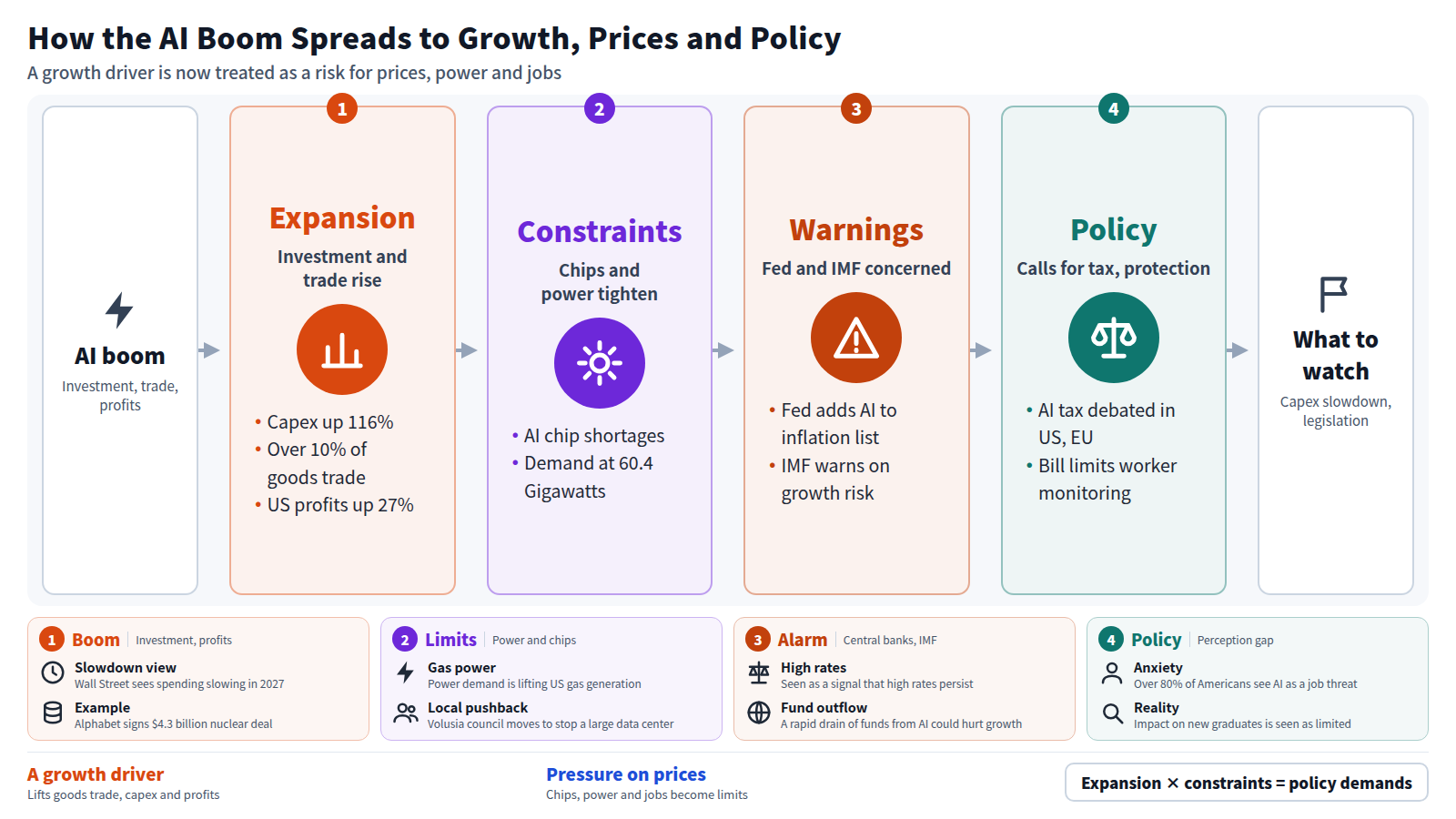
IMF Managing Director Kristalina Georgieva warns that high energy prices, the AI boom and record high debt threaten global growth (Quartz, Business Standard). AI now accounts for more than 10% of global trade in goods (Yahoo! Finance Canada), and there have been reports that the Fed has positioned AI as an inflation factor alongside tariffs and crude oil (24/7 Wall St.). The most notable feature of the past 12 hours is that while AI is a growth driver, it has also begun to be treated as a risk factor in terms of prices, electricity, employment, and public finances.
Macroeconomic/growth trends
The Fed has reportedly added AI to its list of inflation factors, including a shortage of AI chips, which some see as a signal that high interest rates will persist (24/7 Wall St., Pluang). There is also an article asking, ``Will the AI boom cause inflation to remain high?'' (Yahoo Finance). IMF Managing Director Georgieva warned that a rapid drain of funds from AI could jeopardize global growth (Türkiye Today). AI was positioned as “both a hope and a risk” (Vietnam.vn). It was reported that US stock profits for the third quarter are expected to increase by 27% to a record high level (BigGo Finance).
Productivity trends
While some commentators have argued that AI is not increasing productivity (The Spectator), others have argued that the debate between AI and employment/productivity should be reconsidered (CommercialSearch). Stanford HAI argued that to get employees to embrace AI, companies should stop marketing it as a productivity tool (Stanford HAI). Within the heading, there are no numbers provided to support the productivity improvement. New Jersey has a bill that would limit employers' ability to use AI to monitor workers and change their jobs (Inquirer.com). There is an argument that the EU will need to tax AI "workers" in order to fund pension funds (EUobserver).
Trends in employment and labor market
There is a report that over 80% of Americans view AI as a threat to employment (FNN Prime Online). On the other hand, an analysis concluded that the ``AI-induced employment apocalypse'' has not yet arrived for new graduates (UCLA Anderson Review). Sen. Gallego, a Senate Democrat, proposed taxing AI to fund economic and jobs plans (Bloomberg Government News). Providence Health partners with IBM to reduce recruitment time without replacing systems (IBM Newsroom). Argonne is developing a path to develop human resources capable of handling AI (Argonne National Laboratory). McKinsey's Kutcher also spoke about the future of U.S. jobs (CNBC). An IT consulting company has opened an office at Toyama Airport and is also looking to create local jobs (FNN Prime Online).
Trends in energy/power demand
Alphabet (GOOGL) signs $4.3 billion nuclear power contract for AI data center (Yahoo Finance). Electricity demand for AI data centers has reached 60.4 Gigawatts, which is said to be driving an increase in gas power generation in the United States (Gadget Review). Volusia council moves to stop large AI data center (Daytona Beach News-Journal). No one at Yotta talked about a slowdown in building AI infrastructure (Latitude Media). The IMF cited high energy prices as a risk to growth (Quartz).
Remarks by central banks, international organizations, and VIPs
・Kristalina Georgieva (IMF Managing Director): Warned that high energy prices, the AI boom, and record debt threaten global growth (Quartz). He also said the world was facing a "cocktail of risks" between AI, oil and debt (Business Standard). He warned that a rapid drain of funds from AI could jeopardize growth (Türkiye Today). ・IMF: announced that AI will account for over 10% of global trade in goods (Yahoo! Finance Canada). He pointed out that energy shocks and AI demand pose risks to the global economy (Caspian Post). ・Daron Acemoglu (MIT economist / Nobel laureate): Estimates that AI will replace 5% of human jobs in 10 years (EdexLive, ET Enterprise AI). ・Fed: It was reported that AI has been added as an inflation factor along with tariffs and crude oil (24/7 Wall St.). - Christine Lagarde, Kazuo Ueda, Andrew Bailey, Mathias Cormann, Ajay Banga, Erik Brynjolfsson: No notable moves.
Trends in corporate capital investment
AI capital investment reportedly jumped 116% year-on-year (BigGo Finance). Meanwhile, Wall Street sees AI heading toward a negative cash flow tipping point, with spending slowing in 2027 (Fortune). Alphabet's $4.3 billion nuclear power contract is another example of increased investment (Yahoo Finance). There was no mention of deceleration in Yotta (Latitude Media).
Trade and industrial policy
AI is boosting global goods trade even in the face of Trump administration tariffs and war (Bloomberg.com, Air Cargo Week). The AI boom has also boosted trade in Sub-Saharan Africa (Africa Business Communities). On the policy front, AI taxation is being discussed in the US (Bloomberg Government News) and the EU (EUobserver). New Jersey bill seeks to limit AI-based surveillance of workers (Inquirer.com). There are also questions about whether AI companies are responsible for agents going out of control (WKRN News 2).
Integrated analysis: What is happening now
While AI is boosting trade in goods, capital investment, and corporate profits, it is also seen to be tightening constraints on prices and energy through chip shortages and electricity demand. The Fed's positioning of inflation as a factor and the IMF's warning illustrate the same picture from different angles. Capital investment is showing momentum, increasing by 116%, but some predict that spending will slow down in 2027, echoing the IMF's concerns that a capital outflow would hurt growth. While concerns about employment are widespread, some analyzes suggest that the impact on new graduates is limited, so there may be a difference between reality and perception. This difference seems to be giving rise to policy demands for AI taxation and worker protection legislation. In the electric power sector, nuclear power contracts and gas power generation are increasing at the same time, leading to local opposition.
Future points of interest
・Will the view that AI-related capital investment will slow down in 2027 be reflected in actual spending plans? ・How will inflationary pressures stemming from AI be reflected in the debate over the prolongation of high interest rates in monetary policy? ・Will discussions between the US and the EU regarding AI taxation and worker protection progress to concrete legislation?
- Investing in America: AI companies fuel economic growth, but will they be accountable for rogue agents? — WKRN News 210/07 17:22 UTC
- Fed adds AI chip shortages to inflation shocks, signaling prolonged high rates. — Pluang10/07 15:06 UTC
- Want Employees to Embrace AI? Stop Selling It as a Productivity Tool — Stanford HAI10/07 16:52 UTC
- Let’s Reframe the AI Jobs and Productivity Discussion — CommercialSearch10/07 16:35 UTC
- AI isn’t making us more productive — The Spectator10/07 10:29 UTC
- New Jersey bill would limit employers’ ability to use AI to monitor workers or make changes to their jobs — Inquirer.com10/07 10:01 UTC
- EU will need to tax AI ‘workers’ to keep funding human pensions — EUobserver10/07 08:50 UTC
- Senate Democrat Gallego Floats AI Tax to Fund Economic Jobs Plan — Bloomberg Government News10/07 17:14 UTC
- For New College Grads, the AI Jobpocalypse Didn’t Arrive — UCLA Anderson Review10/07 16:07 UTC
- Providence Health Collaborates with IBM Using AI to Reduce Hiring Admin Time Without Replacing a Single System — IBM Newsroom10/07 15:03 UTC
- Meeting the AI moment: How Argonne is building pathways for an AI-ready workforce — Argonne National Laboratory (.gov)10/07 12:00 UTC
- Council moves to halt large-scale AI data centers in Volusia — Daytona Beach News-Journal10/07 15:47 UTC
- At Yotta, not a word on slowing down the AI infrastructure build-out — Latitude Media10/07 15:50 UTC
- Alphabet (GOOGL) Locks In $4.3 Billion Nuclear Power Deal For AI Data Centers — Yahoo Finance10/07 15:11 UTC
- 60.4 Gigawatts and Counting: How AI Data Center Energy Demand Is Driving a U.S. Gas Power Surge — Gadget Review10/07 17:14 UTC
- AI Drives Global Goods Trade Facing Trump Tariffs, War Headwinds — Bloomberg.com10/07 12:30 UTC
- AI boom boosts Sub-Saharan Africa trade — Africa Business Communities10/07 13:09 UTC
- Could the AI boom keep inflation higher for longer? — Yahoo Finance10/07 14:02 UTC
- AI Exceeds 10% of Global Goods Trade, IMF Says — Yahoo! Finance Canada10/07 16:59 UTC
- IMF chief warns money rushing away from AI could put global growth at risk — Türkiye Today10/07 13:37 UTC
- Over 80% of Americans see AI as a threat to jobs, and caution is spreading — Yahoo!ニュース10/07 17:14 UTC
- AI capital investment surges 116% year-on-year; US stock Q3 profits rise 27% to record high level — BigGo ファイナンス10/07 14:25 UTC
- IT consulting firm opens office at Toyama Airport, using AI for data analysis and local jobs — FNNプライムオンライン10/07 10:45 UTC
- IMF chief: AI is both a hope and a risk for the global economy — Vietnam.vn10/07 14:14 UTC
- Nobel laureate Daron Acemoglu prediction on AI: Here is what he says — ET Enterprise AI10/07 14:29 UTCDaron Acemoglu / MIT economist / Nobel laureate