AI & Economy News — 2026-10-07 (Wed) Evening News
Source links point to the original outlet. The AI Integrated Analysis is auto-generated from the headlines below only and is not intended to add facts beyond them. Not investment advice.
Overview
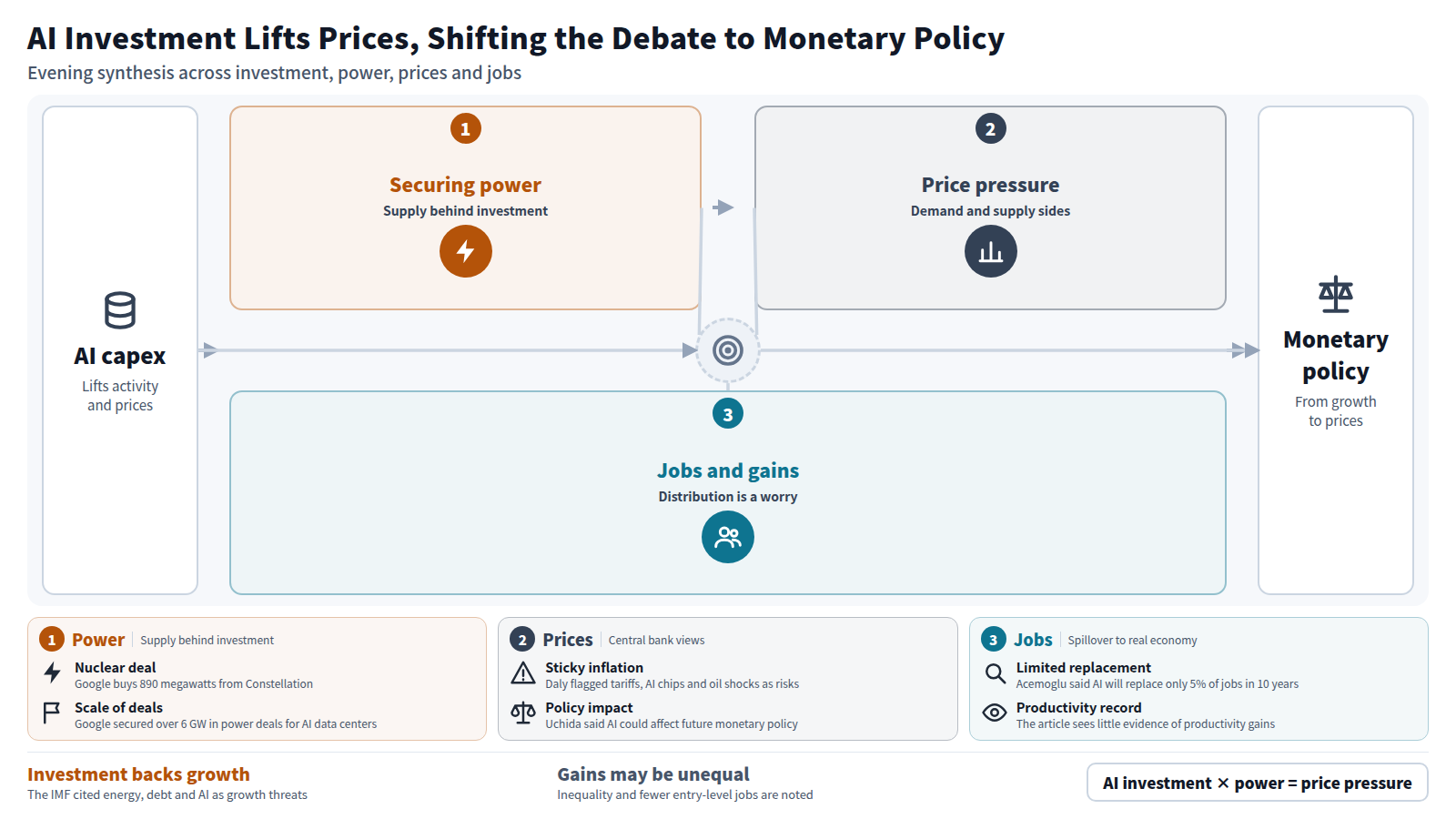
IMF Managing Director Kristalina Georgieva has warned that high energy prices, debt, and AI risks threaten global growth, and newspapers have argued that while AI will boost growth, it could also fuel inflation and inequality (Reuters, CNBC, Arab News PK). In the United States, Federal Reserve officials were reported to be wary of AI as a new factor pushing up prices (NAI500, VT Markets). In Japan, Bank of Japan Deputy Governor Uchida was reported to have said that AI will put upward pressure on the economy and prices (TBS NEWS DIG).
Macroeconomic/growth trends
The head of the IMF has warned that energy shocks, rising debt and AI risks threaten global growth (Reuters, Yahoo Finance). There is a headline that says, ``AI will promote growth, but it will also lead to an inflation crisis,'' and AI is being factored into both growth and prices (The Tech Buzz). There are reports that AI is reshaping the US economy in unexpected ways (The Washington Post). Mr. Daly pointed out the risk that tariffs, AI semiconductors, and oil shocks would lead to sticky inflation, and is said to have mentioned the possibility of further tightening (VT Markets).
Productivity trends
There are few headlines regarding productivity figures or results, and there are no notable developments. In a related move, California Governor Gavin Newsom signed legislation to protect workers from misuse of AI (LA Focus). Daron Acemoglu was quoted as saying that AI will replace only 5% of human jobs in the next 10 years (ANI News). This view appears to have cautious implications for the scale of productivity gains from AI.
Trends in employment and labor market
It has been reported that companies are cutting staff as they shift investment to AI (Reuters). AI is reducing entry-level job openings and changing career paths (Lehigh Valley Business). Skills gaps and workplace responsiveness are reshaping hiring (Business Journal Daily). Meanwhile, a study found that AI-related jobs are expanding in cities in South Carolina (The State).
Trends in energy/power demand
Google steps into nuclear power for its data centers with a deal to buy 890 megawatts of power from Constellation (SiliconANGLE). Google reportedly secured over 6 GW of power contracts for its AI data center (THE ELEC). There are plans to roughly triple gas-fired power generation in the United States due to the AI boom (www.trendingtopics.eu). The issue of locating data centers in southeast Florida has also been raised (Sierra Club).
Remarks by central banks, international organizations, and VIPs
- Kristalina Georgieva, IMF Managing Director: AI is both a hope and a danger for world leaders (CNBC). He warned of energy shocks, debt and AI risks (Reuters) and urged countries to curb debt and regulate AI (Yahoo Finance, The Business Standard). Warned that AI will increase economic inequality (Arab News PK, UA.NEWS). - Bank of Japan Deputy Governor Uchida (Bank of Japan): Said that AI will put upward pressure on the economy and prices, and could have an impact on future monetary policy (TBS NEWS DIG). - Daron Acemoglu (MIT economist / Nobel laureate): AI will replace only 5% of human jobs in the next 10 years (ANI News). - World Bank: advised sub-Saharan Africa to build small-scale AI rather than state-of-the-art systems (iAfrica.com). - Fed officials: Warned that AI is becoming a new source of inflation (NAI500). Mr. Daly mentioned the possibility of further tightening (VT Markets). - Christine Lagarde, Kazuo Ueda, Andrew Bailey, Mathias Cormann, Ajay Banga, Erik Brynjolfsson: No applicable statements.
Trends in corporate capital investment
There is analysis that AI-related capital investment is pushing up both activity and prices (Carson Group). LinkedIn co-founder defends massive AI infrastructure investment, saying AI capital is "the only reason we're not in a recession" (Yahoo Finance). Sigurd is raising prices, signing long-term AI capacity contracts and looking to increase capital spending in 2026 (digitimes).
Trade and industrial policy
The US advanced semiconductor packaging market is expected to expand to USD 11.7 billion due to AI, 5G, CHIPS Act, and reshoring (Supply Chain Digital). Tariffs and AI semiconductors are cited as inflationary pressures (VT Markets). In Vietnam, the prime minister is said to be scheduled to hold talks with young people about entrepreneurship, artificial intelligence and employment (Vietnam.vn). New developments regarding export restrictions and subsidies cannot be confirmed from the headlines.
Integrated analysis: What is happening now
Each heading shows how AI will push up prices from both the demand and supply sides. Capital investment is pushing up activity and prices (Carson Group), and progress is being made in securing electricity, gas-fired power, and nuclear power to support that investment (SiliconANGLE, www.trendingtopics.eu), and tight energy supply and demand has been cited by the IMF as a growth risk (Reuters). With Federal Reserve officials and the Bank of Japan's deputy governor positioning AI as a source of upward pressure on prices, AI appears to be moving from an issue of growth to an issue of monetary policy. On the other hand, there is little evidence of productivity improvements, and on the employment front, there is a decline in entry-level job openings and layoffs (Lehigh Valley Business, Reuters). There is a possibility of a structure in which investment supports growth, but the distribution of the fruits is accompanied by concerns about widening inequality. Acemoglu's ``5%'' theory seems to suggest that there may be a difference between the scale of this investment and its impact on the real economy.
Future points of interest
- To what extent will central banks in Japan and the United States factor AI-derived price pressure into their policy decisions? - Impact of expansion of power contracts and power generation investment for AI on power prices and inflation. - How will the decline in young and entry-level employment due to AI be reflected in the statistical labor market?
- Why AI is both the hope and the hazard for world leaders, according to IMF chief Georgieva — CNBC10/07 06:16 UTC
- The unexpected ways that AI is reshaping the U.S. economy — The Washington Post10/07 09:03 UTC
- IMF chief warns energy shock, growing debt and AI risks threaten global growth — Reuters10/07 06:06 UTC
- IMF Chief: AI Drives Growth But Fuels Inflation Crisis — The Tech Buzz10/07 07:05 UTC
- Companies cutting jobs as investments shift toward AI — Reuters10/07 08:53 UTC
- AI job opportunities are expanding in this SC city, a new study says. Here’s why — The State10/07 09:03 UTC
- AI reduces entry-level jobs and reshapes career paths — Lehigh Valley Business10/07 04:14 UTC
- AI, Skill Gaps and Workplace Readiness Are Reshaping Hiring — Business Journal Daily10/07 09:02 UTC
- Are AI Data Centers in SE Florida’s Future? — Sierra Club10/07 07:58 UTC
- Google goes nuclear to power its AI data centers, committing to buy 890 megawatts of energy from Constellation — SiliconANGLE10/07 02:02 UTC
- Google Secures More Than 6 GW in Power Deals for AI Data Centers — THE ELEC, Korea Electronics Industry Media10/07 06:27 UTC
- A.I. Boom Drives U.S. Plans for Nearly Triple the Gas Power — www.trendingtopics.eu10/07 06:43 UTC
- US Advanced Semiconductor Packaging Market - Size, Strategic Insights, and Forecasts, 2026-2031 | AI, 5G, CHIPS Act, and Reshoring Drive Growth to USD 11.7 Billion — Supply Chain Digital10/07 00:17 UTC
- Daly Flags Potential Further Fed Tightening as Tariffs, AI Chips and Oil Shocks Risk Sticky Inflation — VT Markets10/07 03:51 UTC
- AI ‘widening economic inequality’, warns IMF boss — Arab News PK10/07 06:32 UTC
- World Bank Tells Sub-Saharan Africa to Build Small AI, Not Frontier Systems — iAfrica.com10/07 08:42 UTC
- The AI Capex Boom Is Boosting Activity and Prices — Carson Group10/06 22:06 UTC
- Sigurd raises prices, signs long AI capacity contracts, eyes higher 2026 capex — digitimes10/07 07:35 UTC
- IMF managing director warns of high energy costs, debt and AI risks — Reuters10/07 08:33 UTC
- BOJ Deputy Governor Uchida says AI puts upward pressure on economy and prices — TBS NEWS DIG10/07 04:43 UTC
- Prime minister to hold dialogue with young people on startups, AI and jobs — Vietnam.vn10/07 07:15 UTC
- AI may replace only 5% of human work over next decade, says Nobel laureate Acemoglu — ANI News10/07 04:31 UTCDaron Acemoglu / MIT economist / Nobel laureate