AI and Cancer Research ── Brain ── 2026-10-08
Brain tumours: treatment, trials and AI
- Abstract
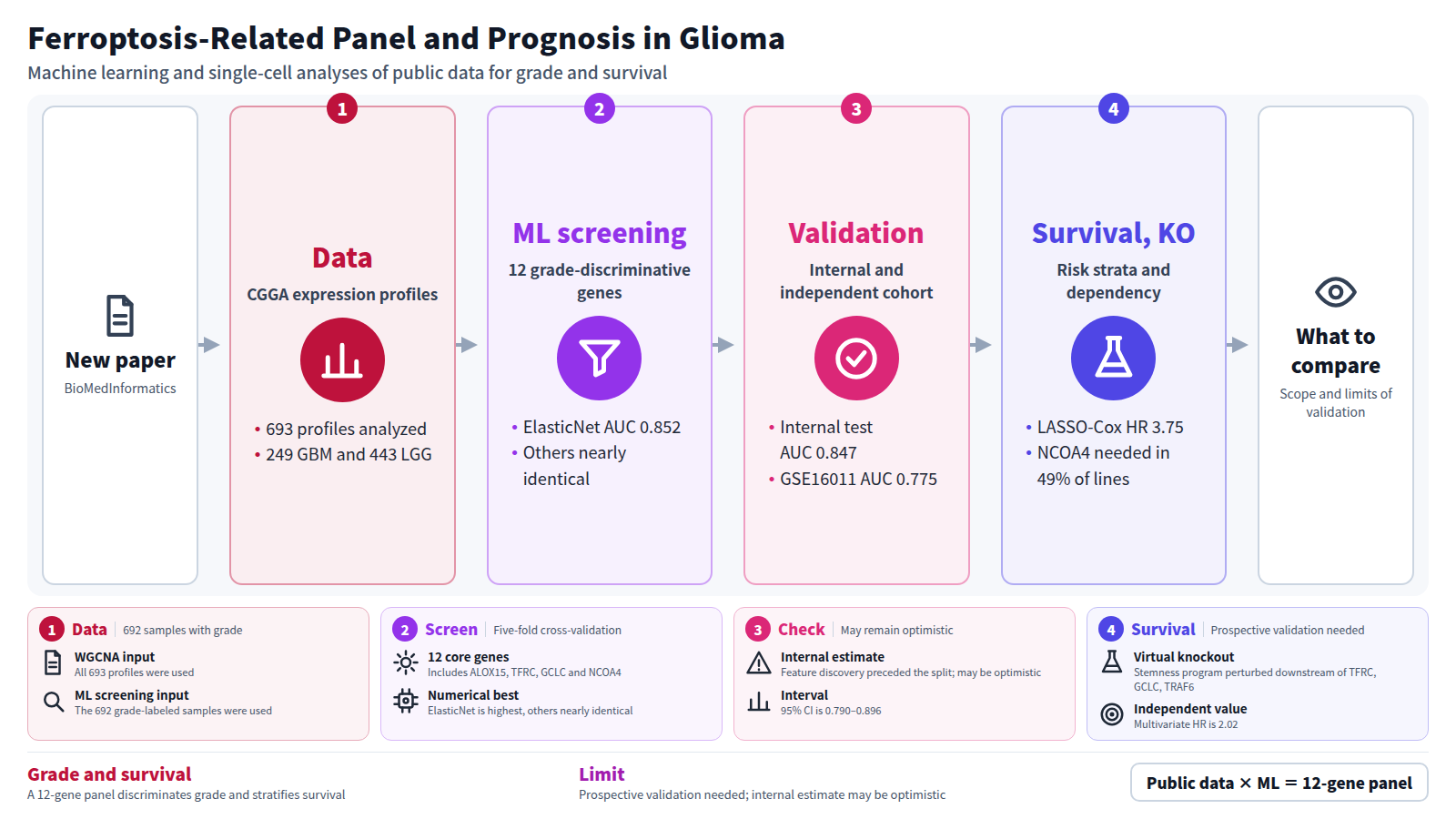
Glioma is the most common primary malignant brain tumor, with glioblastoma (GBM) carrying a 5-year survival rate below 10%. We analyzed 693 CGGA expression profiles, including 692 samples with available WHO grade (249 GBM and 443 lower-grade glioma [LGG]). WGCNA used all 693 profiles, whereas grade-dependent differential expression and machine-learning screening used the 692 grade-labeled samples. Screening-stage five-fold cross-validation identified ElasticNet as the numerically highest-performing reference model (AUC = 0.852), although Random Forest and Ridge performed nearly identically and yielded 12 core grade-discriminative biomarkers (ALOX15, TFRC, GCLC, DPP8, MBOAT2, NCOA4, NOX5, PIK3CB, CISD2, AMD1, TFR2, TRAF6). After panel selection, a 12-gene ElasticNet model fitted only in a reproducible stratified training set (n = 486) achieved an AUC of 0.847 (95% CI 0.790–0.896) in the internal test set (n = 206); because upstream feature discovery preceded the split, this internal estimate may remain optimistic. The fixed cross-platform subset achieved an AUC of 0.775 in the independent GSE16011 cohort. Virtual knockout (scTenifoldKnk) identified convergent perturbation of a stemness-associated program (SOX2, NES, PTPRZ1, TCF4) downstream of TFRC, GCLC, and TRAF6, and reanalysis of public CRISPR-Cas9 screening data (DepMap, 67 glioma cell lines) showed dependency signals for NCOA4 (49% of lines) and TFRC (24%). A LASSO-Cox risk score stratified patients with significant survival differences (HR = 3.75; time-dependent AUC 0.741–0.791) and independent prognostic value (multivariate HR = 2.02). These results support a biologically coherent ferroptosis-related panel while emphasizing the need for prospective validation.
Journal IF-equivalent: 7.1 (OpenAlex 2-year mean citedness, value as of 2026-10-07, retrieved 2026-10-08; not the official Clarivate IF)Reference: Wang M, Wu T, Wang D. Identification of Ferroptosis-Related Grade-Discriminative Biomarkers and a Prognostic Signature in Glioma via Integrative Machine Learning and Single-Cell Analyses. BioMedInformatics. 2026 Oct 6;6(5):87. doi:10.3390/biomedinformatics6050087.Checked: Abstract only