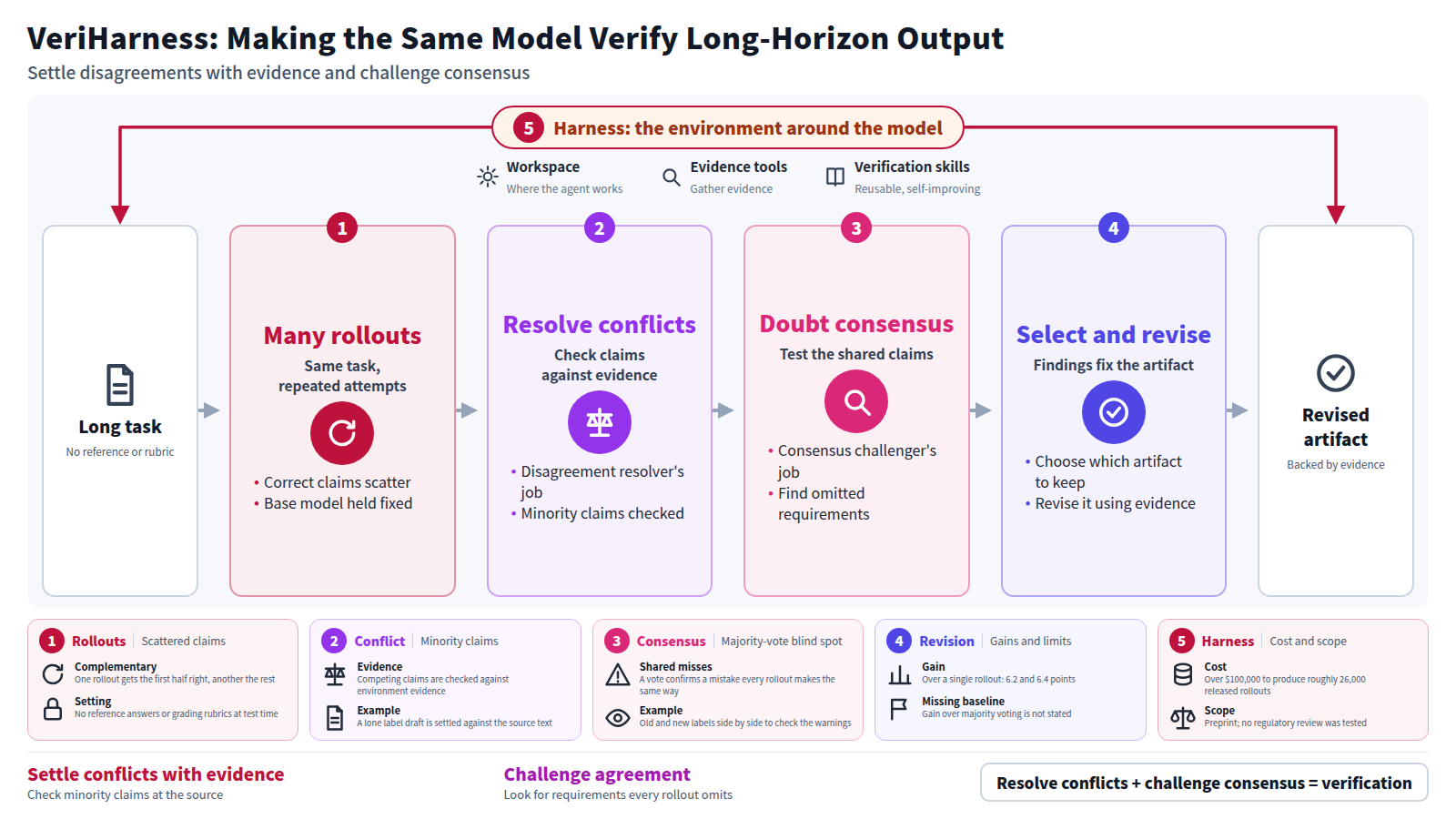
1. Who checks the output of a long-horizon task, and how?
LLM agents now read files, call tools, and work through many steps before producing a single artifact: a research memo, a summary table, an edited configuration. The longer the chain of work, the more room there is for a requirement to be dropped somewhere along the way, or for an unsupported claim to slip in.
For short problems, you compare the answer against a known solution. Real long-horizon work usually has no reference answer, and writing a rubric in advance is often impractical. That is exactly the setting the authors choose: no reference answers and no grading rubrics at test time, with the base model held fixed. The question is whether verification can still be made stronger under those constraints.[1]
One resource is repetition. If the agent attempts the same task several times, the resulting rollouts can contain complementary correct claims: one gets the first half right, another gets the second half right. What is missing is a reliable way to decide which claims to trust. The source is an arXiv preprint and has not yet been through peer review.
2. The core idea: turn the generator's own model into an equipped verifier
The core of VeriHarness can be stated in one sentence. The same LLM that generated the artifacts is given a workspace, evidence-gathering tools, and reusable verification skills, and is run as an agent whose job is to verify. Nothing new is trained. The gain is sought in the harness, the working environment around the model, rather than in the weights.
The verifier has two roles. A disagreement resolver takes the points where rollouts contradict each other and checks the competing claims against evidence from the environment. A consensus challenger takes the points where rollouts agree, tests those shared claims, and searches for requirements that every rollout may have omitted.
The findings from both roles then guide two decisions: which artifact to select, and how to revise it. Revision is grounded in the evidence the verifier collected, so the final output is not just the best of the candidates but a corrected version of it.
3. What the abstract reports
The design rests on two observations. Disagreement often exposes correct alternatives, and consensus can conceal errors. Put plainly, a majority vote cannot catch a mistake that every rollout makes in the same way, because the vote will simply confirm it.
The evaluation covers five long-horizon workspace benchmarks and two frontier models. According to the authors, VeriHarness achieves the highest selection scores among the baselines they evaluated. Adding evidence-backed revision raises average performance further, bringing the gain over a single rollout to 6.2 points with Gemini 3.5 Flash and 6.4 points with Claude Opus 4.8.
The authors also report that the verification skills can improve themselves from failure feedback. They release the full pool of roughly 26,000 rollouts across all five benchmarks and both models, and state that producing them cost more than $100,000. The implementation is public on GitHub.[3]
4. A worked example: merging several drafts of a regulatory summary
Suppose an agent is asked to summarize, for internal use, what changed in a revised product label. It is run several times on the same request, and the drafts largely agree.
Staff member: Every draft reaches the same conclusion. Only the dosing text changed; the warnings section is untouched. Since they all agree, I think we can finalize.
Reviewer: Agreement is not evidence. If every draft read the same outdated version of the document, they would all miss the same thing. Did anyone put the old and new labels side by side and check the warnings section?
Staff member: No. Actually, one draft said there was also an addition to the interactions section. It was the odd one out, so I set it aside.
Reviewer: That draft is exactly the one to settle against the source text. Where the drafts disagree, decide with evidence. Where they agree, check them precisely because they agree.
The two moves in this exchange correspond to the two roles in the paper. Checking the minority claim against the source is the disagreement resolver. Questioning the shared conclusion and looking for a missed requirement is the consensus challenger. In both cases the decision rests on evidence, not on a count of votes.
5. What is not new, and what the abstract does not tell us
Sampling several answers and choosing among them is an old idea. Majority voting and selecting the best attempt with a separate scoring model are both widely used. Giving an agent tools so it can check its own claims is also familiar in agent research. The contribution here, as far as the abstract shows, is to assign an explicit role to challenging consensus and to build that into verification for long-horizon tasks.
The limits are substantial. First, the abstract does not describe what the five benchmarks ask for or how the selection score is defined. Second, the headline gains are measured against a single rollout; how much VeriHarness adds over majority voting or other selection methods is not stated in the abstract. Third, the approach is expensive: many rollouts per task, plus a verifier agent on top. The authors' own figure of more than $100,000 to produce the released rollouts gives a sense of the scale. Fourth, the abstract does not say how many failures the self-improving skills learned from, or how well those skills transfer.
The abstract closes by calling the method novel and critical. That is the authors' assessment. Novelty and importance are for peer review and independent replication to judge.
6. Why this topic is clustering now
The paper drew 48 upvotes on Hugging Face Daily Papers, and its public repository has 39 stars.[2] In this site's selection, three independent signals fired: reader votes, implementer stars, and a cluster of papers on the same question. Upvotes and stars measure attention, not correctness, and they say nothing about whether the method works as claimed.
The cluster has 2 papers. The other one revisits infrastructure for agentic systems that automate chip design verification.[4] The domains differ, but the question is shared: on what grounds should we trust a result that an agent produced? It is being asked at the same time for general long-horizon work and for semiconductor verification.
The cluster keywords include verification, long-horizon, scaling, and rethinking infrastructure. As agents take on longer jobs, the debate is shifting from how well they generate toward how their output gets checked. Still, two papers are a thin cluster, not evidence of a broad movement.
7. What connects to pharma and regulatory work
In pharmaceutical document work, teams are starting to generate several AI drafts and compare them. The tempting shortcut is to conclude that a point is correct because every draft says it. This paper's observation cuts against that shortcut. Drafts written from the same material under the same assumptions tend to miss the same things in the same places.
Two practices follow. One is to treat a minority claim as something to check against the source, not something to discard; the outlier may be the correct alternative. The other is to add a step that inspects points of agreement for missing requirements. Building a check on consensus itself into a regulatory review procedure is worth doing whether or not AI is involved.
At the same time, the evidence comes from workspace benchmarks, not from regulatory review, and the method needs many rollouts every time it runs. A sensible first step for any team would be to run a verifier on its own documents and record what it caught and what it missed. This review, too, is limited to what the preprint's abstract states.