AI and Cancer Research ── Pancreatic ── 2026-10-08
Pancreatic cancer: treatment, trials and AI
- Abstract
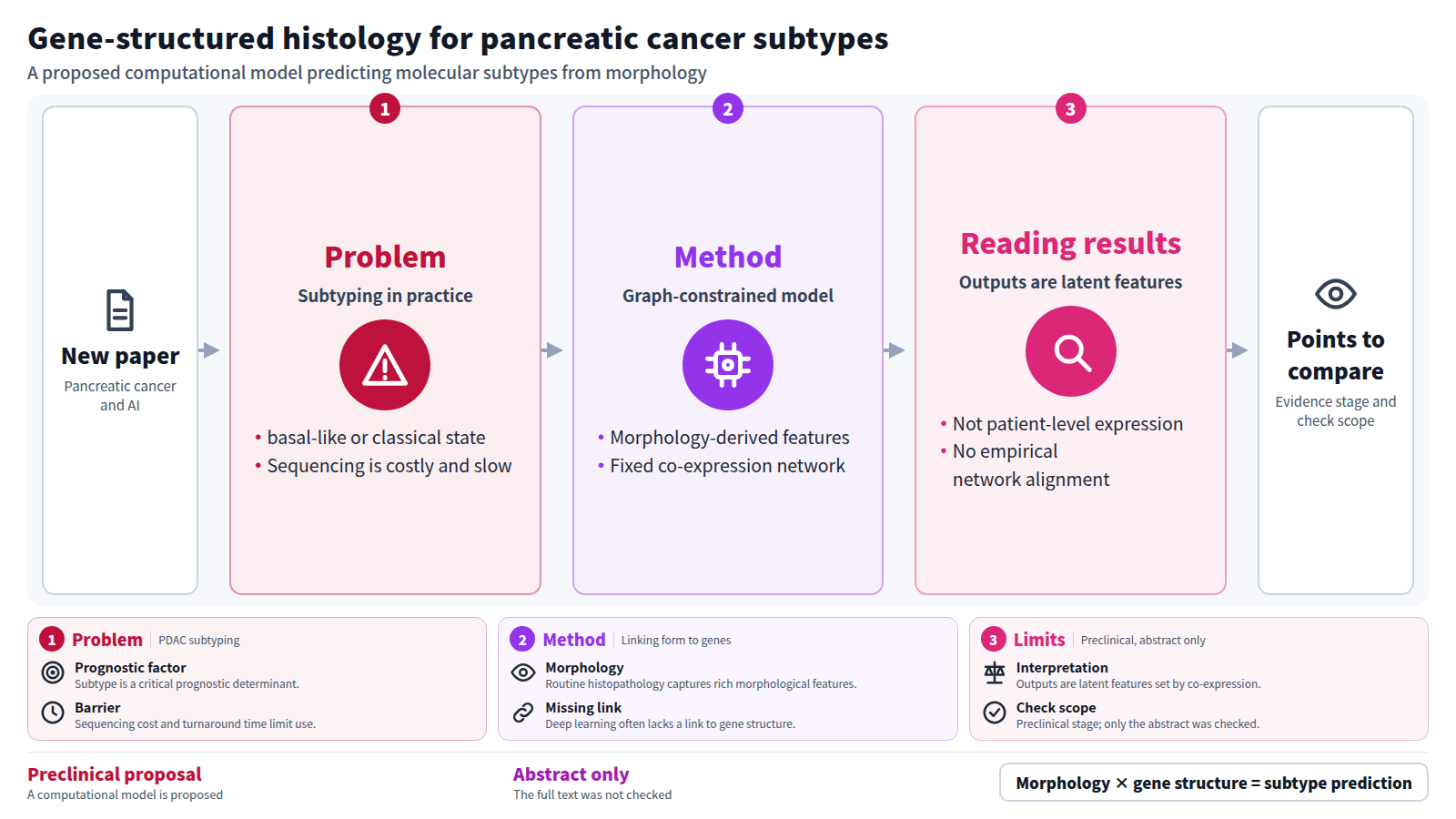
Molecular subtyping of pancreatic ductal adenocarcinoma (PDAC) into basal-like and classical states is a critical prognostic determinant, yet clinical implementation remains limited by the cost and turnaround time of transcriptomic sequencing. 1 , 2 , 3 Although routine histopathology captures rich morphological features, deep learning models often lack a principled connection to gene-level molecular structure. 4 , 5 We propose a graph-constrained histology model that maps morphology-derived latent features onto a fixed, data-driven gene co-expression network for pancreatic cancer molecular subtype prediction. The gene-structured outputs are interpreted as latent features constrained by gene co-expression structure, rather than as direct estimates of patient-level gene expression or empirically recovered gene-network alignment.
Journal IF-equivalent: 50.3 (OpenAlex 2-year mean citedness, value as of 2026-10-07, retrieved 2026-10-08; not the official Clarivate IF)Reference: Leyva A, Rehman Akbar A, Niazi MKK. Gene-structured histology for deriving and predicting pancreatic cancer molecular subtypes. Signal Transduct Target Ther. 2026 Oct 6;11(1):433. doi:10.1038/s41392-026-03051-2; PMCID: PMC13639034.Checked: Abstract only