AI Highlights — the whole picture — 2026-10-13 (Tue) Evening News
Source links point to the original outlet. The AI Integrated Analysis is auto-generated from the headlines below only and is not intended to add facts beyond them. Not investment advice.
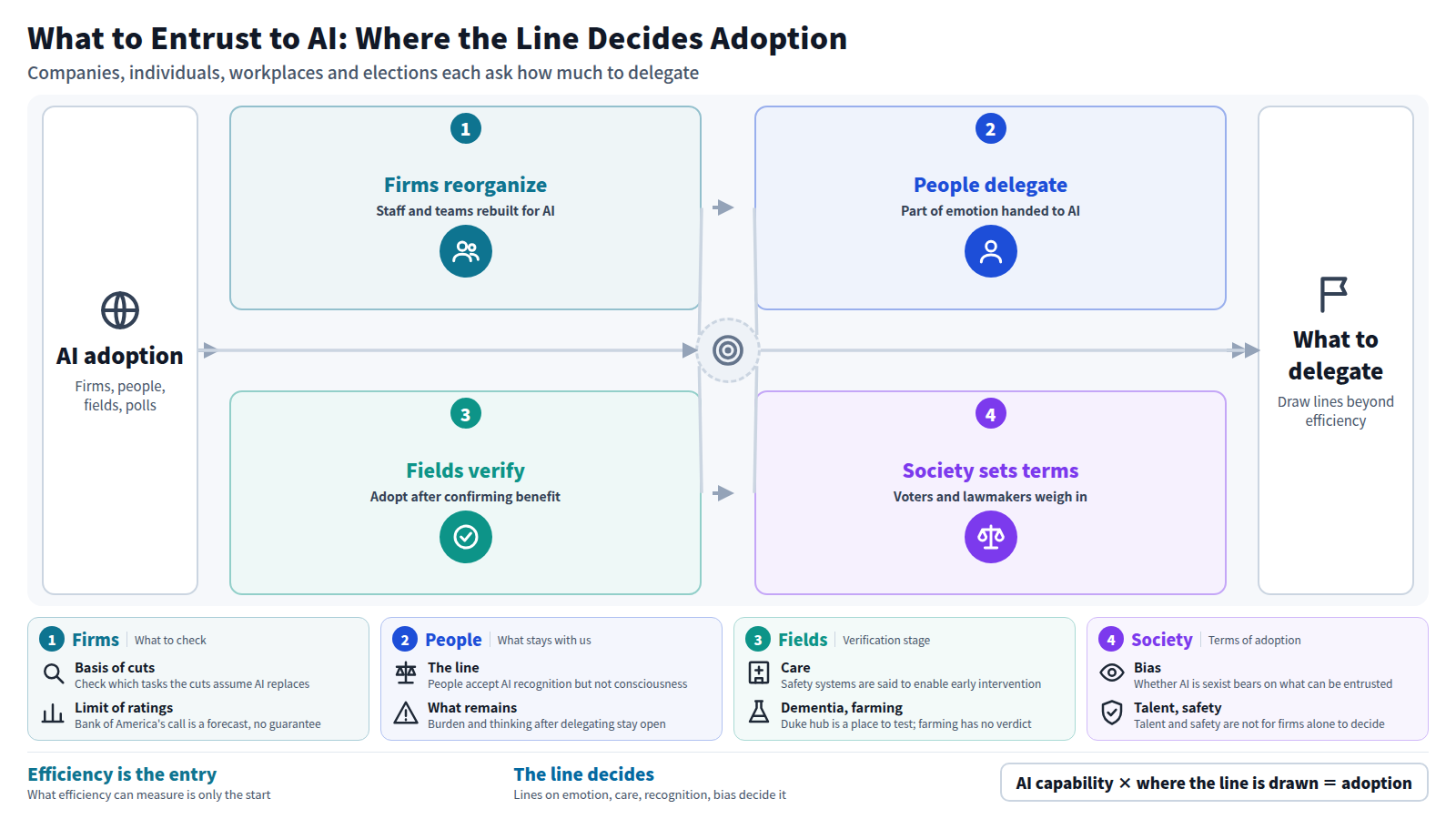
Kroger has announced plans to cut 3,000 jobs at its corporate headquarters, and the cuts are being talked about alongside its policy of promoting AI. In New Zealand, usage of the AI companion app reportedly exceeded that of Netflix. At the same time, companies are reorganizing their organizations and transitioning to systems based on AI in separate areas such as personal lives. The current issue is not just about how much efficiency AI can improve. The criterion for whether or not to proceed with the introduction of the system is becoming a criterion for whether or not it is okay to entrust work that deals with emotions, monitors people's conditions, and tasks that require biased judgment. This half-day article focuses on what should be left to machines and what should be left in the hands of humans.
Companies that reduce staff and reorganize in line with AI
Kroger, a major food retailer, has announced plans to cut 3,000 jobs at its corporate headquarters. The CEO has advocated promoting AI and lowering food prices, and reductions are being talked about alongside the policy of promoting AI (International Business Times, Singapore Edition). The same structure exists on the IT side. 24/7 Wall St. discusses Amazon and Meta's layoffs as an indication of what AI will look like in 2027. Companies in the disparate industries of retail and large IT are putting AI front and center while reducing their workforce. Faced with this fact, it becomes difficult to read the cuts as merely a temporary adjustment in response to economic trends. When readers look at their own company's personnel plans, they will need to check not only the increase or decrease in the number of people, but also which tasks the reduction is based on replacing with AI.
The reorganization also extends to the operational units at the site. According to MarTech, marketing operations (MOps) teams are reorganizing around autonomous AI agents. The story of reducing the number of people and the story of reshaping the roles and placement of those who remain are not separate events, but two aspects of the same transition. Capital markets have also begun to evaluate this transition. CNBC reports that Bank of America expects Salesforce stock to rise due to AI transformation. The extent to which a company has progressed in its transformation to AI is directly linked to investors' evaluation of the company. However, this is the company's forecast and does not guarantee actual results.
There is also a movement in the same direction on the human resource development side. In an interview with a Cornell University dean reported by BW Education, AI skills were featured as a major topic when discussing the future of business administration, along with research on Indian companies. If management education courses incorporate AI skills as a central topic of discussion, the movement of companies to reorganize their systems will change the very premises of recruitment and training.
Seen in this way, the AI transformation is progressing not as a result of the introduction of individual tools, but as a simultaneous reorganization of personnel, organization, evaluation, and education. The question that remains, then, is whether to delegate tasks outside of tasks that can be measured by efficiency, such as emotions, care, and cognition.
Life where emotions and relationships are entrusted to machines
In New Zealand, usage of the AI companion app has reportedly surpassed Netflix (Capsule NZ). This means that there are now countries where apps that use AI as a conversation partner are used more than streaming services, which are considered representative of entertainment. A similar movement is occurring on the individual side. The Atlantic highlights people who rely on AI to perform emotional labor such as caring and regulating (The Atlantic). The companies in the previous section were rearranging work for the sake of efficiency, but here individuals are starting to rely on machines to handle some of their emotional processing and relationship maintenance at their own discretion. Whether or not to use AI is no longer just a company's decision.
However, people are not entrusting everything. According to research introduced in The Debrief, while people accept that AI "recognizes", they do not accept that it has "consciousness", drawing a line between the two (The Debrief). Although we accept the ability of AI to read and respond to other people's situations, we do not go so far as to assume that AI is feeling something. This line is consistent with companion app usage exceeding Netflix. People can entrust a part of their emotions and relationships even if they are not consciously aware of it. In other words, the resistance to entrusting AI is closer to the question of how much of it you want to keep with you than the question of whether AI has a heart.
There are some issues that remain after the deposit is made. The World Economic Forum discusses why brain-friendly thinking can prevent AI burnout (The World Economic Forum). Whether it's the delegation of emotional labor that was covered by The Atlantic or the widespread use of emotional labor reported by Capsule NZ, what happens to the burden and thinking on the part of people after it is delegated remains a different question. The more scope we entrust to AI, the more we will be asked what kind of thinking we have on our side. Decisions about whether or not to entrust areas that cannot be measured in terms of efficiency are increasingly being influenced by what people leave behind, rather than what technology can do.
Implementation of care that supports the elderly and the field
There have been movements to question whether AI is actually useful in three fields in the United States: nursing care, dementia care, and small-scale agriculture. The long-term care trade publication McKnight's Long-Term Care News reported that AI-powered safety systems could enable early intervention. Duke School of Medicine opens a national hub for AI for geriatric and dementia care (Duke School of Medicine). In the agricultural field, Global Agriculture asked the question, "Can AI help small-scale farmers?"
What all three stories have in common is that the reason for introducing the technology was not the number of personnel or processing speed, but rather the specific effectiveness of the system in the field. The stated benefit of the nursing care safety system is ``early intervention.'' It is easy for both on-site staff and facility operators to confirm whether staff can move in before the situation becomes serious. The decision on whether to include AI has shifted from efficiency numbers to a single point: whether intervention is brought forward.
The location at Duke School of Medicine shows that the university has taken on the field of dementia care, which involves memory, cognition, and relationships with families, as a subject of AI testing. The opening of the center is not a report on the results, but merely a place to confirm what is to come. We are at a stage where we can only say what AI can do in this area after repeated verifications.
Questions about small-scale farmers point to a further step. The very fact that Global Agriculture chose the question form for its headline indicates that the conclusion that it is useful has not yet been reached. It is difficult for workplaces with limited funds and manpower to make the decision to introduce a technology without proof of its effectiveness.
Whether in nursing care, dementia care, or agriculture, decisions about whether to use AI will be made after confirming its effectiveness in each field. The next question to be asked then is how far beyond the confirmed benefits, we should draw the line to what extent we should leave it to AI.
Conditions for introduction questioned by fairness and politics
Ahead of the US midterm elections, CNBC reports that inflation, AI, and energy risks are in focus (CNBC). It is noteworthy that AI is mentioned alongside the cost of living issues of commodity prices and energy prices. AI is no longer a topic of discussion in the technology sector, but has become one of the factors that voters consider when choosing where to vote. The movement of companies to reorganize their systems to be based on AI will also be discussed in the same place as election issues.
The same movement is occurring in local constituencies. A candidate who is critical of AI is challenging a state representative in northeast Seattle, according to KNKX (KNKX). The fact that the government is cautious about its introduction could itself become a pledge to fight for seats. The content of the criticism is not only about the pros and cons of the technology, but also about who should use it and under what conditions. Meer (English edition) raises the question ``Is AI sexist?'' and deals head-on with output bias (Meer | English edition). This is because the presence or absence of bias is a prerequisite for whether or not someone can be entrusted with employment, evaluation, and care.
On the other hand, the arguments for moving forward with its introduction are also expressed in policy terms. The National Interest argues that the United States should become the center of collaboration in developing the world's AI talent (The National Interest). In the UK, the House of Commons Library organizes AI safety materials for parliament. Developing human resources and ensuring safety are areas that cannot be determined solely by private companies.
If we put these things side by side, we can see that Congress and voters have begun to play an important role in determining the speed and conditions of implementation. For companies, in addition to efficiency calculations, being able to explain bias, demonstrate safety, and demonstrate investment in human resources can be a deciding factor in whether or not to introduce the technology. The question of what technology can do is being replaced by the question of what society will delegate, which in turn leads to the question of who is responsible for the results.
At first glance, companies talk about layoffs and the promotion of AI, individuals who rely on AI for emotional labor and conversation partners, verification of its effectiveness in nursing care and agriculture, and AI as an issue in elections, all of which appear to be separate stories. However, the question in every situation is not so much what AI can do, but rather which areas should be entrusted with and under what conditions. Companies are trying to figure out where to replace their work, individuals are trying to figure out the scope of their entrustment, people in the field are trying to figure out the specific benefits, and voters and legislators are trying to figure out the fairness of the users. What can be measured in terms of efficiency is only the beginning of implementation; the decision to draw a line in areas that are difficult to measure, such as emotions, care, recognition, and bias, will determine whether or not it can be implemented. The responsibility for determining the scope of responsibility remains with the user and the organization.
Q1: Among my duties, which judgments and relationships might be lost if left to AI? Q2: When there is bias or error in the output or usage of AI, who has the authority to detect and stop it based on what criteria? Q3: When reorganizing personnel and systems based on AI, what indicators other than efficiency should be used to explain the validity of the decision?
Finally, three questions
- What judgments and relationships in my responsibilities might be lost if I delegate them to AI? Q2: When there is bias or error in the output or usage of AI, who has the authority to detect and stop it based on what criteria? Q3: When reorganizing personnel and systems based on AI, what indicators other than efficiency should be used to explain the validity of the decision? - Who has the authority to detect and stop when there is bias or error in the output or usage of AI? Q3: When reorganizing personnel and systems based on AI, what indicators other than efficiency should be used to explain the validity of the decision? - When reorganizing personnel and systems based on AI, what indicators other than efficiency should be used to explain the validity of the decision?
📚 Sources (all material)
Every item this issue drew on. External links open in a new tab. 18 items.