AI, Love, Marriage & Breakups News — 2026-10-09 (Fri) Morning News
Source links point to the original outlet. The AI Integrated Analysis is auto-generated from the headlines below only and is not intended to add facts beyond them. Not investment advice.
Overview
Headlines from both Japan and abroad over the past 48 hours have described how AI is being used as a romantic "consultant," "facilitator," and "tool for fraud." There were warnings and restrictions on companion AI (Sherry Turkle, China), AI as a counselor between couples (Japanese TV program report), and reports of intimidation and damage caused by the use of AI-generated characters. The list of important people is blank, so it is not possible to confirm what the person being tracked said.
AI lover/companion
- The Financial Times published Sherry Turkle's strong warning against "AI-based spouse relationships" as "Artificial Intimacy." The specific basis for the warning cannot be gleaned from the headline. - Table.Briefings covers how China regulates AI companions. The content of the regulation is not clear from the headline. - Livedoor News reported that in a survey of 500 Generation Z people, the most common reason they didn't want to use AI in relationships was "I want to express it in my own words."
Encounter/matching/marriage hunting
- Deccan Herald reports that group photos can be a privacy risk in dating apps and AI. - Walker Plus published an article that examined whether ChatGPT is effective for creating profiles for dating apps by showing it to a relationship coach. The conclusion of effectiveness is not obvious from the headline.
Marriage and couples
- ABEMA TIMES reports that the entertainer Dandelion Shiratori said that she is using AI as if she were a junior with a drum. The same article also mentions the possibility that an increasing number of wives are choosing AI rather than their husbands for advice. A professor at Keio University is reported to have sounded the alarm, saying, ``AI prioritizes affirmation over correctness.'' - The au web portal reports that on the same topic, there was a cynical comment from a viewer asking, ``What does empathy solve?'' Shiratori is said to have represented the woman's true feelings, saying, ``Just being heard makes me feel satisfied.'' This is a statement made by the woman herself on the program, and is not a fact confirmed as a general trend among wives.
Separation/divorce/heartbreak
- Today's Family Lawyer reports that consumers are using AI to interpret their partner's messages and decide how to end the relationship. The detailed scale is unclear from the headline.
Love consultation/relationship worries
- The above Today's Family Lawyer article also falls under this category. - Firstpost reports that in a survey, 65% of men and 60% of women have used AI to improve their wooing skills. The subject and method of the investigation is unclear from the headline.
Romance scam and spoofing
- Frequency News covers cases where AI catfishing scams turned into real relationships. The circumstances are unclear from the headline. - RNZ reports that a man who was paid to blackmail someone by posing as an AI-generated woman through "sextortion" has taken his own life.
Research and investigation
- Survey of 500 Generation Z people (Livedoor News): The most common reason for not wanting to use AI in love is "I want to convey it in my own words." - Survey (Firstpost): 65% of men and 60% of women use AI to improve their advances. - The data compiled by Solvie, an AI consultation service originating from Japan (see below), also shows the actual usage status. - There are no headlines for academic papers this time.
Japanese love, marriage and AI
- Infoseek reports that Japan's AI consultation service "Solvie" was officially released on October 6th. There were over 13,000 consultation messages, and by category, "love" was the most common. - The aforementioned Generation Z survey and reports on AI counseling between couples are also trends in Japan.
Remarks from VIPs
- The list of VIPs being tracked is empty and not applicable. - For reference, the people who appeared in the headline are as follows. Sherry Turkle is reported to have issued a warning, and a professor at Keio University (whose name is not in the headline) is reported to have sounded the alarm, saying, ``AI prioritizes affirmation over correctness.''
Integrated analysis: What is happening now
A common theme in several headlines is that AI will play the role of ``arranging and accepting words in relationships on behalf of humans.'' Examples include love counseling (Solvie has the most love stories), assistance with advances (Firstpost survey), interpretation of messages and how to break up (Today's Family Lawyer), profile creation (Walker Plus), and alternatives to counseling your husband (ABEMA TIMES).
On the other hand, there are also concerns about the same system. A professor at Keio University points out the nature of prioritizing affirmations, Turkle warns against marital relationships themselves, and China is moving to regulate. In the Generation Z survey, the most common reason was "I want to convey my message in my own words," indicating both widespread usage and resistance.
Furthermore, there have been reports of damage caused when the person you think you are talking to is an AI (extortion using an AI-generated person, catfishing). The nature of the risk differs depending on whether the user of AI is the party involved or a third party impersonating the other party.
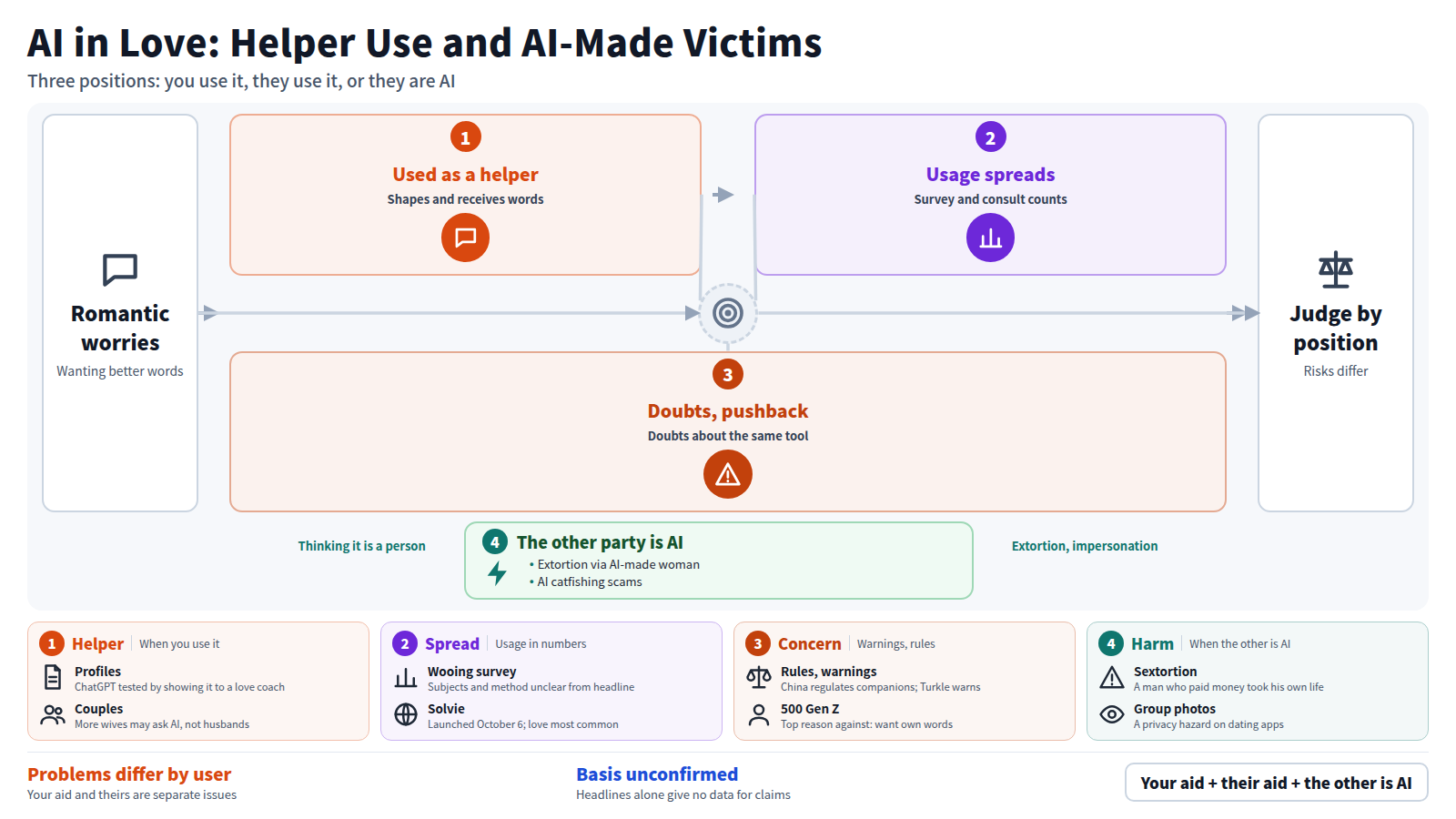
The point that may change the reader's judgment is that ``consulting with an AI'' is not a single phenomenon, but creates separate problems in three positions: the assistance you use, the assistance used by the other person, and the other person is the AI itself. However, it is not possible to confirm the supporting data for each claim just by looking at the headlines.
Future points of interest
- What are the specific details of China's AI companion regulations and whether they will have any impact on other countries? - How will the points raised regarding the nature of AI that "prioritizes affirmations" be reflected in the design and display of consultation services? - Responses to extortion and impersonation damage using AI-generated characters, and countermeasures on the platform side.
- Artificial Intimacy — Sherry Turkle’s stark warning against AI ‘companionship’ — Financial Times10/06 16:00 UTC
- AI companions: How China regulates love for AI — Table.Briefings10/07 08:43 UTC
- Survey of 500 people from Generation Z (posted on October 7, 2026) why they don't want to use AI in love: "I want to convey it in my own words" — Japanese media10/06 21:00 UTC
- Dating apps, AI, and the privacy hazard of group photos — Deccan Herald10/08 06:20 UTC
- Image 3 / 4>Is the much talked about “ChatGPT” also effective for matching app profiles? I showed it to a professional love coach. — Japanese media10/07 19:01 UTC
- [Photos/Images] "AI is a junior with a drum" Dandelion Swan's cutting technique... An increasing number of wives are consulting "AI rather than their husbands" → "AI prioritizes affirmation over correctness" Keio University professor warns 1st photo — ABEMA TIMES10/07 02:30 UTC
- ``Consult AI rather than husband'' ``What can be solved by empathizing with the wife's real psychology?'' A snide comment from a viewer... Dandelion Swan speaks for women's true feelings ``Just being heard makes me feel satisfied.'' — Japanese media10/08 04:00 UTC
- Consumers using AI to interpret partner’s messages and how to end relationships — Today's Family Lawyer10/07 04:33 UTC
- 65 percent men, 60 percent women have used AI to improve their seduction game: Survey — Firstpost10/07 09:14 UTC
- From AI catfishing scam to real connection — Frequency News10/08 03:29 UTC
- Man took his own life after paying money to ‘sextortion’ blackmail involving AI-generated woman — RNZ10/07 18:18 UTC