AI and Cancer Research ── Bladder ── 2026-10-07
Bladder cancer: treatment, trials and AI
- Abstract
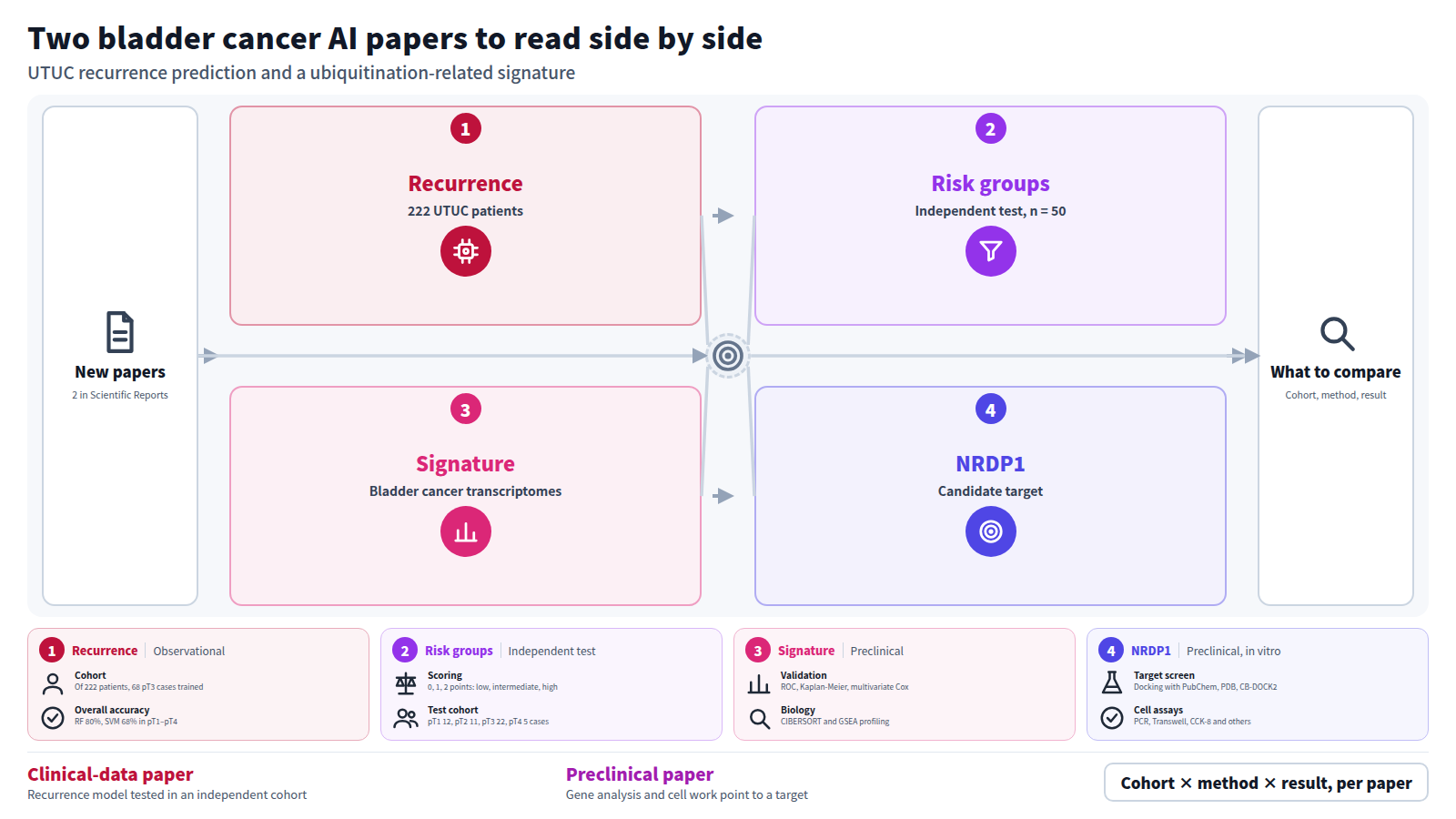
Upper-tract urothelial carcinoma (UTUC) is rare, constitutes < 5% of urothelial cancers, and, given its insidious clinical presentation, is typically diagnosed at advanced stages; post-radical nephroureterectomy recurrence remains challenging. Postoperative management is primarily guided by pathological factors, including T-stage and lymph-node status, which cannot accurately identify patients who would benefit from treatment intensification, particularly considering concerns regarding cisplatin-associated nephrotoxicity. Using an artificial intelligence (AI)-informed pathology model, we predicted postoperative recurrence using UTUC’s quantitative nuclear features. Among 222 patients with UTUC, support vector machine (SVM) and random forest (RF) models were trained using pT3 cases ( n = 68) comprising sufficient recurrence events. Patient-level model performance was evaluated and validated using an independent test cohort ( n = 50; pT1 = 12, pT2 = 11, pT3 = 22, and pT4 = 5). RF and SVM models achieved patient-level accuracies of 77.3% and 63.6%, respectively, in pT3 cases and overall accuracies of 80% and 68%, respectively, in the independent pT1–pT4 cohort. Model-derived risk stratification (1 point per model with predicted recurrence probability ≥ 0.5 and classifying patients into low, intermediate, and high-risk groups [0, 1, and 2 points, respectively]) significantly discriminated recurrence-free survival in the independent test cohort (pT1–pT4), distinguishing risk groups (low-risk: n = 7, intermediate-risk: n = 8, high-risk: n = 35; log-rank p = 0.01); the low-risk group had no recurrence.
Journal IF-equivalent: 5.2 (OpenAlex 2-year mean citedness, value as of 2026-10-04, retrieved 2026-10-05; not the official Clarivate IF)Reference: Muraoka R, Saito A, Tokuyama N, Matsubara S, Shen B, Tsujino T, et al. A novel machine-learning model using nuclear features to predict upper tract urothelial carcinoma recurrence. Sci Rep. 2026 Oct 5 [Epub ahead of print]. doi:10.1038/s41598-026-72946-5.Checked: Abstract only - Abstract
Ubiquitination-regulated molecular events exert crucial regulatory effects on the initiation and progression of bladder cancer (BCa), yet clinically actionable ubiquitination-related prognostic models are still in short supply. This study is designed to construct a ubiquitination-associated prognostic signature for BCa via machine learning strategies. Ten machine learning algorithms with 101 parameter combinations analyzed BCa transcriptomes. The prognostic model was validated using time-dependent receiver operating characteristic curves, Kaplan-Meier survival analysis, nomogram construction, and multivariate Cox regression. To elucidate underlying biological functions, we conducted immune microenvironment profiling (via CIBERSORT algorithm) and gene set enrichment analysis (GSEA). Molecular docking experiments were performed using PubChem compound libraries, Protein Data Bank structures, and the CB-DOCK2 platform to screen potential drug targets. Subsequent experimental validation included Polymerase Chain Reaction (PCR), cell migration assays (Transwell and wound healing assays), and cell proliferation evaluations (colony formation and CCK-8 assays). Transcriptomic analysis identified 106 ubiquitination-related differentially expressed genes (DEGs) specific to BCa, among which 9 prognosis-related genes were filtered out via univariate Cox regression analysis. Our machine learning-based ubiquitination-related prognosis-associated signature showed superior performance over conventional clinical predictors, enabling accurate stratification of BCa patients into high- and low-risk subgroups. Computational docking results revealed strong binding affinities between the E3 ubiquitin ligase NRDP1 and classic agents. Notably, targeted knockdown of NRDP1 substantially impaired the migration capabilities of BCa cells. This study introduces a BCa machine learning derived prognostic model, identifies NRDP1 as a key BCa prognostic and therapeutic target, and highlights the value of integrating machine learning and ubiquitination biology.
Journal IF-equivalent: 5.2 (OpenAlex 2-year mean citedness, value as of 2026-10-04, retrieved 2026-10-05; not the official Clarivate IF)Reference: Zhong Z, Zheng F, Li S, He J, Yuan Y, Deng X, et al. Machine learning-driven identification of a ubiquitination-related prognostic signature and potential target NRDP1 in bladder cancer. Sci Rep. 2026 Oct 5;16(1):30948. doi:10.1038/s41598-026-67956-2.Checked: Abstract only