AI & International Politics News — 2026-10-08 (Thu) Evening News
Source links point to the original outlet. The AI Integrated Analysis is auto-generated from the headlines below only and is not intended to add facts beyond them. Not investment advice.
Overview
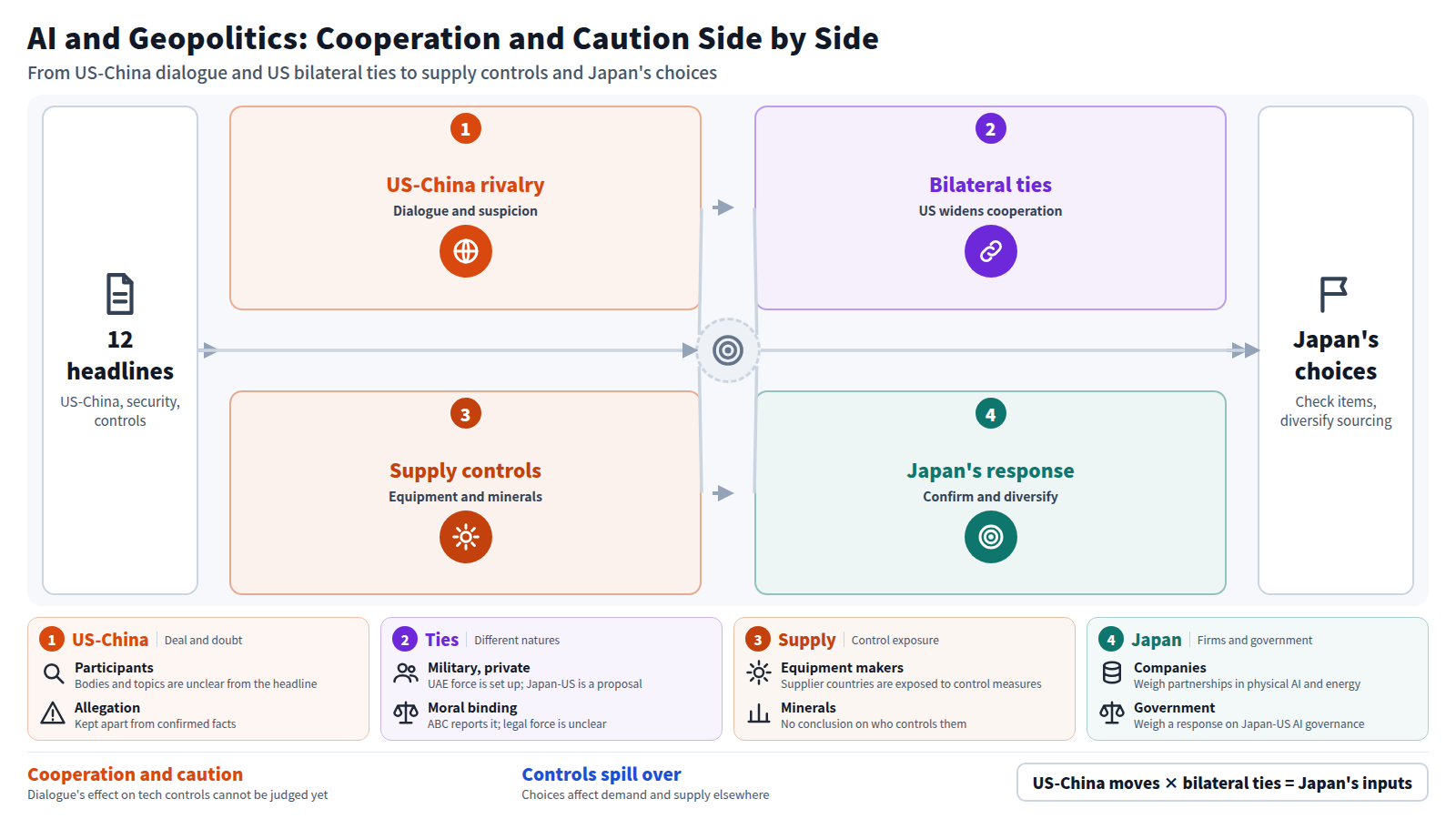
- It was reported that the US and China have agreed on AI dialogue and tariff reductions (on items worth $30bn). On the other hand, there are also reports claiming China's involvement in US AI research institutes. - The United States and UAE establish the first bilateral military AI task force in the Middle East. Japanese and American business leaders called on the two governments to cooperate on AI governance. - Export controls and control over critical minerals are on the agenda for semiconductor equipment and AI supply chains.
Competition between the US and China
- The US and China reportedly agreed to hold an AI dialogue and reduce tariffs on $30bn worth of items (The Daily Star). The participating organizations and topics for the dialogue are not clear from the headline. - Foreign Policy discusses the possibility that China will advance the adoption of AI at a faster pace than the United States. Sinocism covers the situation after the US-China summit and the EU-China trade talks. These are analytical articles and are not established facts. - A former Anthropic researcher claims there are "already Chinese spies" at a U.S. AI lab, SCMP reported. This is an unconfirmed suspicion and remains at the stage of an allegation. Distinguish from confirmed facts. - From this headline, it is not clear how the Chinese side responded to this claim.
International organizations/international agreements
- There are no headings about international organizations such as the United Nations. - US and UAE establish first bilateral military AI task force in the Middle East (Yemen Online). It has already been agreed and established as a bilateral framework. - Japanese and American business leaders called on the two governments to cooperate on AI governance (nippon.com, Kyodo News). This is a proposal from the private sector and is not an agreement between governments.
Diplomacy/Summits/Alliance
- ABC reports that a White House summit resulted in a "morally binding" AI agreement. From the headline, it is not clear which countries are participating, whether there are signatures, or whether the text is legally binding. Because it is described as ``moral,'' it is treated differently from treaties that involve legal obligations. - The establishment of a task force between the United States and the UAE is a deepening of their alliance and partnership (see Section 3).
Security/Military
- A Dutch company is using AI to help drone systems communicate with each other ("talk") on battlefields in Ukraine, Reuters reported. The report is from the operational stage, and the scale and troops of the deployment are unclear from the headline. - US and UAE military AI task forces have been established. The details of the activity are unclear from the headline. - C-SPAN aired a discussion about the impact of AI on national security and modern warfare. This is the planning and discussion stage.
Election/information warfare
- politicstoday.org covers AI-powered propaganda in Mali. The headline says non-existent combatants are finding real viewers. It is unclear from the headline who created and spread the message, and it is impossible to determine who created it and spread it. - There are no election headlines.
Export regulations and negotiations between countries
- AlphaStreet says that ASML's demand for semiconductor equipment will depend on AI demand and control measures regarding China. It is unclear from the headline which measures are being taken by which countries. - Visual Capitalist (via EnergyNow.com) is about who controls the critical minerals that support AI. The conclusion is not stated in the heading.
Japanese diplomacy and AI
- The Japan-U.S. Business Council has advocated cooperation in the fields of "physical AI" and energy (Asahi Shimbun). - Japanese and American business leaders urged their governments to cooperate on AI governance (nippon.com, Kyodo News). - This is a private recommendation and not an agreement between governments.
Remarks from VIPs
- There are no headlines or relevant information regarding the targets of UN Secretary-General Guterres, Indian Prime Minister Modi, and French President Macron.
Integrated analysis: How are international relations moving?
- Regarding US-China dialogue and tariff reductions. While the US and China have agreed to dialogue, there are also reports of suspicions regarding involvement in human resources and research institutes. Coordination and vigilance are in parallel, and it is not possible to judge from this information how the dialogue framework will affect the technology management discussion. - About the US alliance network. The establishment of a military AI task force between the United States and the UAE and requests for cooperation between Japanese and American business leaders indicate that the United States is expanding its bilateral cooperation. However, the former is a military proposal and the latter is a civilian proposal, so they have different characteristics. - Regarding the position of middle-sized countries. Foreign Policy discusses the influence mid-power countries have in the AI race. This is an editorial, not an official announcement. As the ASML article shows, countries supplying equipment are susceptible to control measures, and choices spill over into demand and supply in other countries. - The implications for Japanese companies and government are as follows. - U.S.-China dialogue and tariff movements may affect the supply chain and the assumptions for trade with China, so it is necessary to confirm the items and timing of application. - Semiconductor equipment and critical minerals are subject to control measures and changes in sourcing. The diversification of procurement sources and continuous confirmation of regulatory trends will be the deciding factors. - In response to recommendations from Japanese and American business leaders, the government is now considering how to respond to AI governance cooperation between Japan and the United States. Companies can consider investments and partnerships in line with cooperation in the physical AI and energy fields. - The case study of information warfare (Mali) will serve as material for examining the impact of AI-generated false information on the business environment in overseas bases and business partner regions.
Future points of interest
When will the U.S.-China AI dialogue be held, among which institutions, and what will be the topic? 2. Participating countries and specific content of the “morally binding” AI agreement. 3. The activities of the US and UAE task forces and the responses of both governments to the recommendations of Japanese and US business leaders.
- China Might Lap the United States on AI Adoption — Foreign Policy10/07 21:39 UTC
- 'China already has spies' at US AI labs, claims ex-Anthropic researcher — South China Morning Post10/07 23:39 UTC
- US and China agree AI dialogue and tariff cuts on $30bn of goods — The Daily Star10/07 20:40 UTC
- EU-China trade talks; Reality after the Xi-Trump meeting; US-China AI/SI — Sinocism | Bill Bishop10/07 20:17 UTC
- Dutch firm uses AI to help drone systems 'talk' on Ukraine's battlefield — Reuters10/08 09:06 UTC
- Discussions on Impact of AI on National Security & Modern Warfare — C-SPAN10/08 04:00 UTC
- Mali's AI Propaganda War: The Fake Fighter With a Real Audience — politicstoday.org10/08 06:49 UTC
- Japan-US Business Conference Pledges Cooperation on Physical AI and Energy — 朝日新聞10/07 22:00 UTC
- Japanese, U.S. Biz Leaders Call for AI Governance Cooperation — nippon.com10/08 04:30 UTC
- United States , UAE Establish First Bilateral Military Artificial Intelligence Task Force in the Middle East — Yemen Online10/08 06:42 UTC
- ASML (ASML): Semiconductor Equipment Demand Still Hinges on AI and China Controls — AlphaStreet10/08 00:50 UTC
- The Leverage Middle Powers Have in the AI Race — Foreign Policy10/08 04:01 UTC