AI and Cancer Research ── Gastric ── 2026-10-07
Gastric cancer: treatment, trials and AI
- Abstract
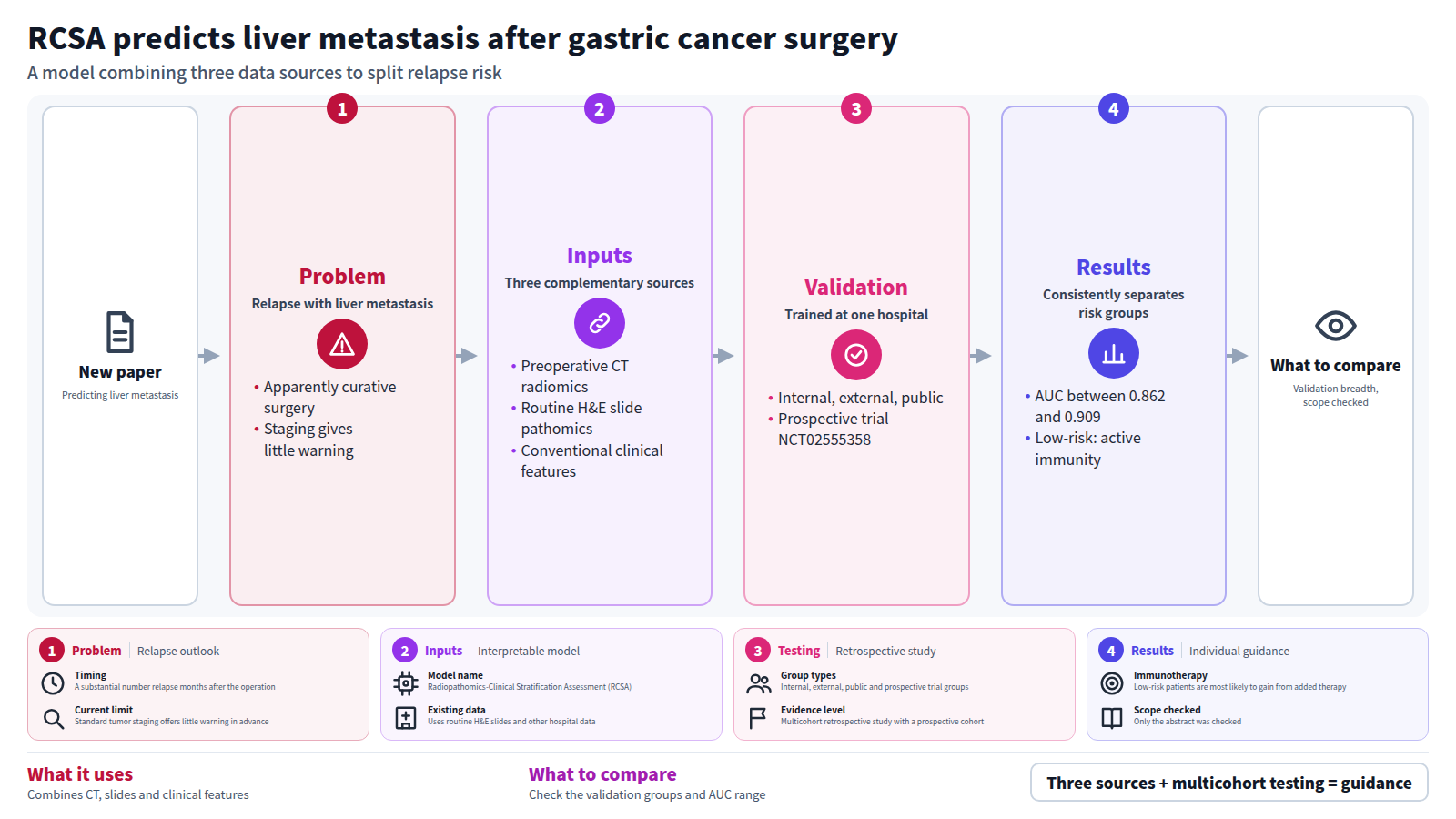
In locally advanced gastric cancer, a substantial number of patients relapse with liver metastasis months after an apparently curative operation, and standard tumor staging offers little warning of who is at risk. Here, we develop the Radiopathomics-Clinical Stratification Assessment (RCSA), an interpretable model that integrates three complementary sources of information: radiomic features from preoperative computed tomography, pathomic features from routine hematoxylin and eosin tumor slides, and conventional clinical features. Trained on patients from one hospital and then tested on separate internal, external, public, and prospective trial groups (NCT02555358), RCSA consistently separates high- and low-risk patients, with area under the curves between 0.862 and 0.909. Tumors it labels low-risk carry a notably more active immune environment, indicating that these patients are the ones most likely to gain from added immunotherapy. RCSA therefore turns existing hospital data into individualized guidance for postoperative follow-up and treatment.
Journal IF-equivalent: 18.1 (OpenAlex 2-year mean citedness, value as of 2026-10-06, retrieved 2026-10-07; not the official Clarivate IF)Reference: Ding P, Yang J, Guo H, Chen S, Liu Y, Han X, et al. Multimodal radiopathomics model predicts postoperative metachronous liver metastasis in gastric cancer. Nat Commun. 2026 Sep 4;17(1):10518. doi:10.1038/s41467-026-76382-x.Checked: Abstract only