AI and Neurological Rare & Neuroimmune Diseases ── Basic research ── 2026-10-07
Neurodegeneration and neuroimmunology research and AI
- Abstract
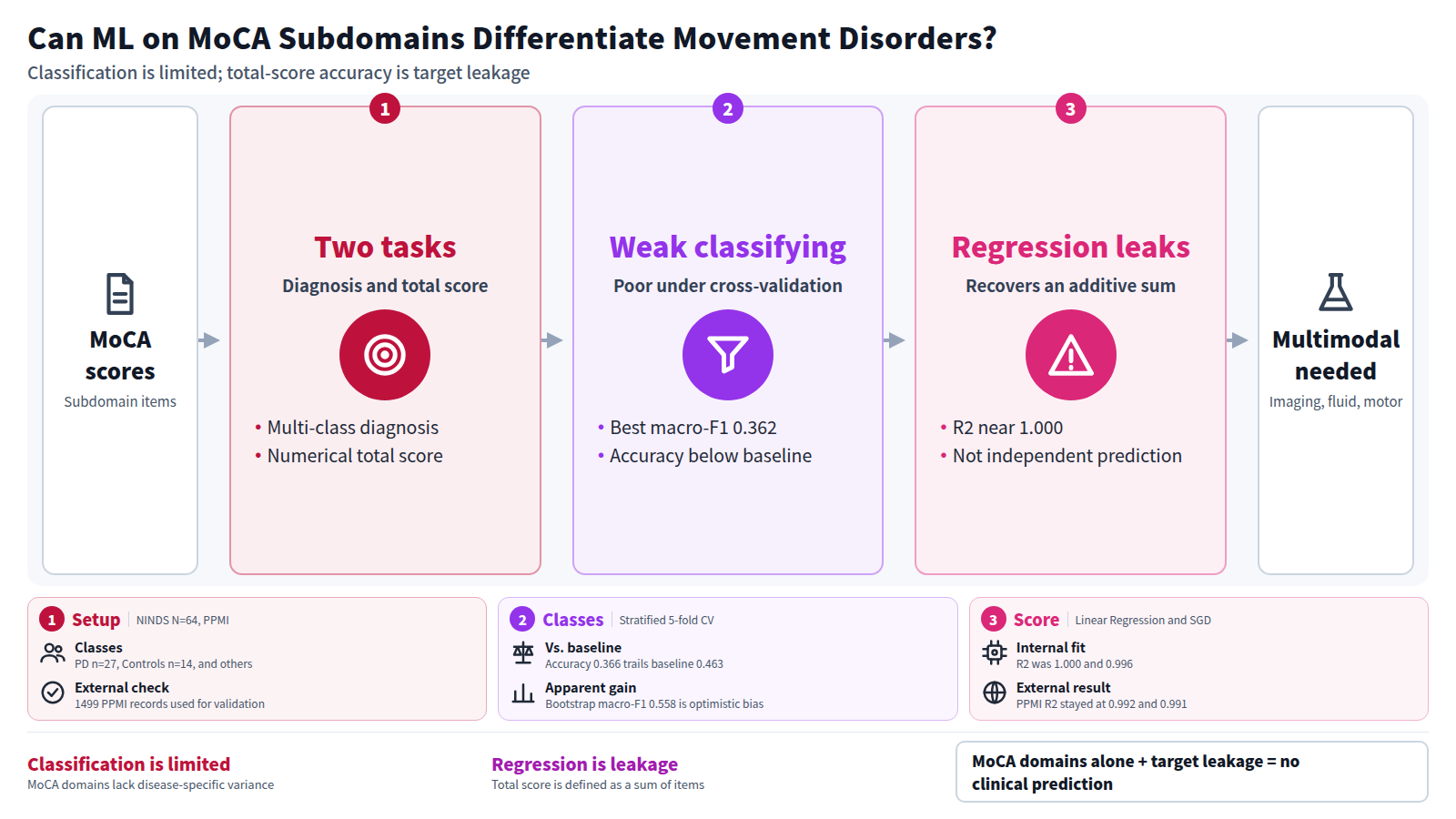
Early differentiation of neurodegenerative movement disorders remains challenging because of overlapping cognitive-behavioral profiles. The Montreal Cognitive Assessment (MoCA) is a widely used 30-point screening instrument; however, the extent to which MoCA subdomain scores alone can support automated multi-class differential diagnosis or score prediction requires rigorous methodological evaluation. In this study, we investigated supervised machine learning algorithms across two distinct tasks using clinical data from the National Institute of Neurological Disorders and Stroke (NINDS) Parkinson’s Disease Biomarkers Program (N=64): (1) multi-class classification across movement disorder diagnoses, including Parkinson’s disease (PD, n=27), No Neurological Diagnosis (Controls, n=14), Progressive Supranuclear Palsy (PSP, n=9), Essential Tremor (ET, n=8), Corticobasal Degeneration (CBD, n=1), Multiple System Atrophy (MSA, n=1), and Other (n=4); and (2) numerical prediction/reconstruction of the MoCA total score from its constitutive domain items, with external validation on 1499 records from the Parkinson’s Progression Markers Initiative (PPMI). Under stratified 5-fold cross-validation, multi-class diagnostic classification was severely limited: the highest macro-averaged F1-score achieved by any trained model was 0.362 (95% CI: 0.284–0.440; Logistic Regression), trailing a naive Constant majority-class baseline in classification accuracy (0.463 vs. 0.366). Bootstrap resampling yielded apparent increases in performance (Neural Network macro-F1: 0.558, 95% CI: 0.512–0.604; AdaBoost: 0.555); however, this reflects optimistic bias from pseudo-replicate sampling rather than genuine clinical generalizability. For continuous score modeling, Linear Regression and Stochastic Gradient Descent achieved near-perfect internal fit (R2=1.000 and 0.996, respectively), and retained near-perfect performance in the external PPMI cohort (R2=0.992 and 0.991; MSE ≤0.077). We demonstrate that this regression success reflects the mathematical recovery of an additive scoring definition, i.e., target leakage, rather than independent clinical prediction. MoCA domain scores alone possess insufficient disease-specific variance to differentiate complex parkinsonian syndromes, underscoring that automated clinical classification requires the integration of multimodal neuroimaging, fluid, and digital motor biomarkers.
Journal IF-equivalent: 5.3 (OpenAlex 2-year mean citedness, value as of 2026-10-06, retrieved 2026-10-07; not the official Clarivate IF)Reference: Olanrewaju KB, Mbue ND. Machine Learning Applied to Montreal Cognitive Assessment Subdomains for Differential Diagnosis of Neurodegenerative Movement Disorders: Classification Limits and Deterministic Score Reconstruction. Bioengineering. 2026 Oct 4;13(10):1161. doi:10.3390/bioengineering13101161.Checked: Abstract only