AI & Education News — 2026-10-09 (Fri) Evening News

Source links point to the original outlet. The AI Integrated Analysis is auto-generated from the headlines below only and is not intended to add facts beyond them. Not investment advice.
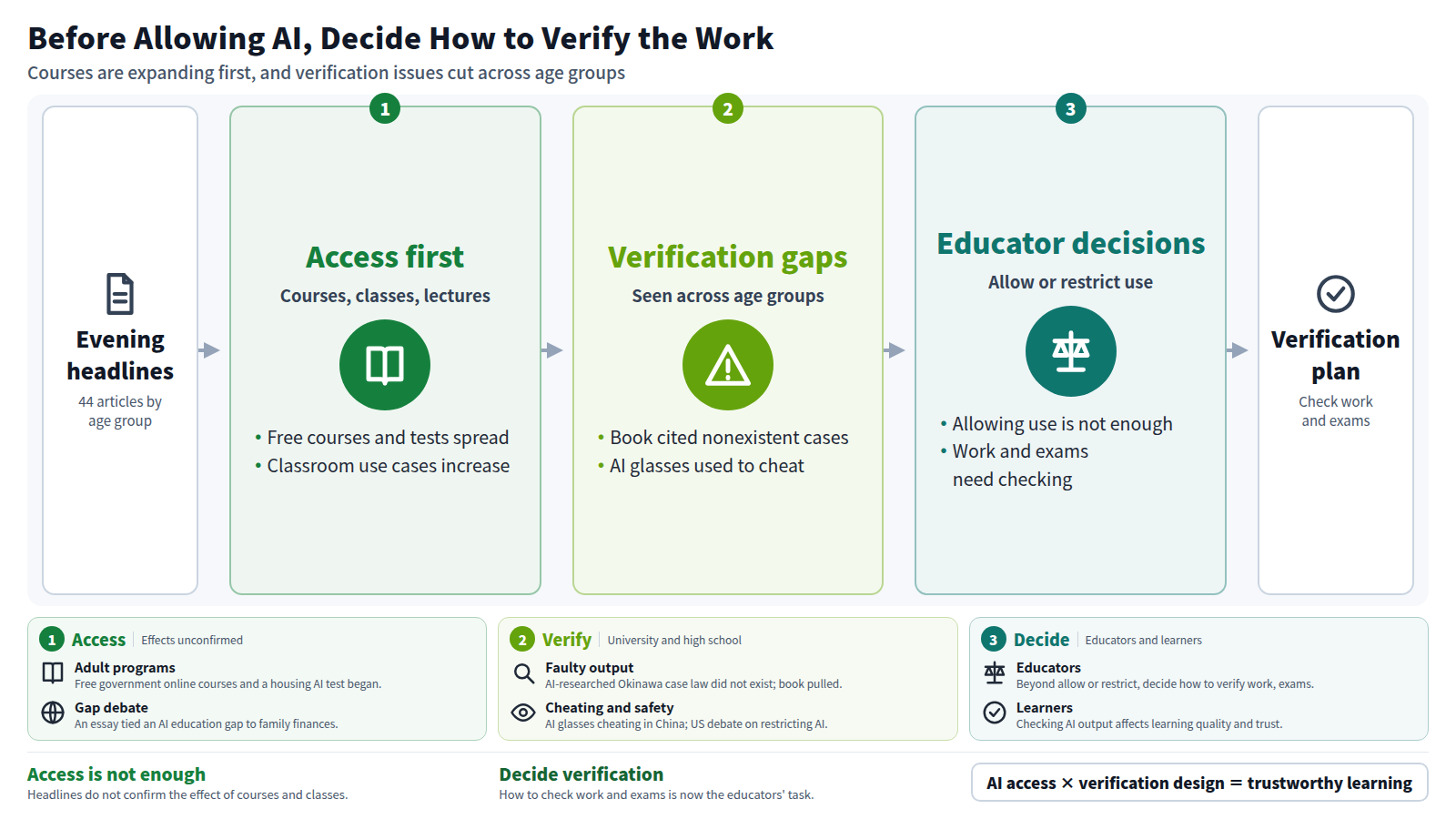
Overview
- The areas where the movement was most noticeable were high school students (discussions on regulation of generated AI and safety), university students (use in classes and fraud/misinformation), and AI literacy (collaboration between schools and disparity theory). - For elementary school students, we mainly provide examples of use in classes and experiential learning, and for adults, we mainly provide free courses and certifications. - There are few headlines dealing with education itself, such as early childhood education and old age.
AI Literacy
- In the US, the first AI course was held for students in St. Charles County (Spectrum News). Union Catholic aims to prepare students for the future with an AI literacy program (TAPinto). As far as the headlines are concerned, these are reports of the course opening and planning stages, and the effects cannot be confirmed. - There is an article discussing the skills needed to transition from academia to the bio field (BioSpace) and a presentation on building AI literacy for remote companies (BigGo Finance). - In Japan, Risho Gakuen and Osaka Kyoiku University have signed a comprehensive partnership agreement to cooperate in teacher training and generative AI education (Weekly Osaka Nichinichi Shimbun). An FD/SD webinar will be held on October 30th for university faculty and staff (Iza!). There was also an article (Modern Business) discussing the ``AI education gap'' that depends on parents' economic circumstances. The actual state of disparity cannot be confirmed from the headline and is treated as an essay.
Early childhood education
- We cannot confirm any headlines about how AI will affect young children's learning. - In Japan, in conjunction with the implementation of the Japanese version of DBS for childcare facilities on December 25th, a free webinar was announced to cover the scope of things that can be left to AI (Nico Nico News). The target is the management of the child care facility, not the learning of the young children themselves.
Elementary school students
- In Vietnam, 5th graders used AI to create scented candles in science class (Vietnam.vn, 2 similar headlines). This is a report on implementation, and learning effects are not shown. - In the UK, a nurse's license was revoked for creating child pornography using AI (SmartNews). This is an example of how to deal with AI abuse involving children. - In Japan, an AI art exhibition was held in Takamatsu, featuring 85 works by people ranging from elementary school students to people in their 80s (COOL KAGAWA). Kyoto Notre Dame University will hold a public lecture on November 14th to learn how generative AI works (Keiku Kaikai Shimbun). An interview with Nikoru Kondo, a middle school student entrepreneur and representative of EdFusion, was also published (ThinkIT).
Junior high school students
- In Vinh Hung, Vietnam, an AI applied science institute was opened at a science and technology festival for students (Vietnam.vn). The target age group cannot be identified as junior high school students from the headline, so it can be read as a movement aimed at students in general. - In Japan, there are no educational headings directly related to junior high school students. The headlines for webinars for human resources and education personnel are workplace topics and are not subject to this section.
high school student
- In the US, experts and students' opinions on whether LAUSD should limit generated AI were published on EdSource. MCHS students expressed concerns about the use of generative AI (KSJD). There is also an article (Education Week) asking whether AI shortcuts or deepens historical thinking in social studies. - A watchdog group report called ChatGPT for Teens an "unacceptable risk" (The Indian Express, Fast Company). These are reported claims and are not treated as confirmed risks. - In Japan, we cannot confirm the heading of education for high school students. Headings such as Management, Case Law, Tokyo Stock Exchange, and Diet, which are arranged in the same section, are not treated as they are not directly related to education.
university student
- In the US, a forum at Johns Hopkins University will discuss "Will generative AI enhance or hinder university learning?" (Baltimore Fishbowl). - Vietnam's Hoa Sen University is working on using AI in classes and improving students' critical thinking skills (Vietnam.vn, 2 articles). - In China, people are cheating on university exams using AI glasses, which take pictures of questions and display the answers on the lenses. Rentals are becoming more common, and eyeglass examinations are also being conducted as a preventative measure (Yahoo! News). - In Japan, Osaka Electro-Communication University uses AI instructors in "Physics 1 Exercises" to support learning by solving problems that are unique to each student (PR TIMES). The effect cannot be confirmed from the headline. The ``Inquiry Learning White Paper'' includes information on generative AI and evaluations in university entrance exams (Monthly Shijukukai). A professor at the University of the Ryukyus used AI to research the case law on the Battle of Okinawa, which was found to be non-existent, and the book was recalled and went out of print (Okinawa Times, Shimotsuke Shimbun). This is an example of the result of using AI output without verifying it.
adult
- In Japan, the government will provide 100,000 free online courses on AI and other topics (mtown.my). The ``Housing AI Test'' for housing company employees began on October 9th, and the 5th grade test is an online format with no exam fee (PR TIMES). There is also an all-you-can-read guidebook on game development and generation AI (Mado no Mori), and the introduction of an AI assistant function to public relations courses (Niconico News). The Housing AI Certification is a test that measures the skills of employees, and although it tends to be more oriented toward workplace development, it is included in this section as a qualification. - Headlines for overseas adult learning cannot be confirmed.
Old age
- Headings that directly deal with learning for the elderly cannot be confirmed. - In Japan, a method was introduced that if you receive a suspicious email or SMS, you can ask ChatGPT if it is a scam (INTERNET Watch). The target age group is not specified. There is also an article that discusses the redefinition of human abilities through AI (Bunshun Online).
Remarks from VIPs
The headline regarding Sal Khan (founder of Khan Academy), who is being tracked, cannot be confirmed at this time. No applicable information.
Integrated analysis: How is lifelong learning changing?
common movements - In many generations, the provision of opportunities to use AI (courses, classes, public lectures) has moved forward, and confirmation of its effectiveness has not appeared in the headlines. - Verification problems persist across generations. Universities are dealing with errors in judicial precedents and AI glasses, high schools are dealing with regulations and the safety of interactive AI, and elementary school students are dealing with AI abuse. - The issue of disparity is reflected in the section on AI literacy (modern business) and the provision of free courses and free exams for adults.
Different movements depending on the age - For elementary school students, the focus is on introduction through experience and production, for high school students, the pros and cons of restrictions and safety, for university students, the focus is on use in classes and the fairness of evaluation, and for adults, the focus is on the development of courses and qualifications. - There are few education headings for early childhood and old age, and no direct movement can be confirmed.
Points where judgment changes - Teachers now need to decide whether to allow or restrict use, as well as how to verify results and tests. - For learners, whether or not they check and use the output of AI has a bearing on the quality and trust of learning. - The above is just a reading from the headline, and its effect on learning has not been confirmed.
Future points of interest
Responding to high school regulations on generative AI (LAUSD, etc.) and reports on the safety of interactive AI. 2. The spread of anti-fraud measures (AI glasses) at universities and education that requires verification of output. 3. Usage status of the Japanese government's free online courses and implementation details of teacher training and collaboration agreements.
- Transitioning from Academia to Biotech in the Age of AI: Skills, Strategy, and Positioning — BioSpace10/08 22:50 UTC
- AI course a first for St. Charles County students — Spectrum News10/08 16:43 UTC
- Union Catholic AI Literacy Program Will Prepare Students for The Future — TAPinto10/08 18:41 UTC
- Rissho Gakuen and Osaka Kyoiku University Sign Comprehensive Partnership on Teacher Training and Generative AI Education — Japanese media10/09 05:17 UTC
- How Remote Companies Build AI Literacy: Automattic's Em Shreve | AI Engineer — Japanese media10/09 02:50 UTC
- Webinar for University Staff on Latest Trends in AI Education to Be Held October 30 — Japanese media10/09 08:33 UTC
- 'In the End, Only the Wealthy Can Master AI': The Harsh Reality of an AI Education Gap Tied to Family Finances — Japanese media10/08 20:03 UTC
- Effective December 25: With Two Months Left, How Much of Japan's DBS Compliance at Childcare Facilities Can AI Handle? Free Webinar — Japanese media10/09 08:48 UTC
- AI Under Legal Regulation — Vietnam.vn10/09 08:11 UTC
- Niigata Business Sentiment Hits 35-Year High on Rising AI-Related Demand: BOJ September Tankan — Japanese media10/09 06:37 UTC
- Korean ICT Companies Launch Campaigns to Promote the Korean Language — 매일경제10/09 01:32 UTC
- Diet Reform Panel Discusses Use of AI — Japanese media10/08 09:35 UTC
- Fifth-grade students use AI to make scented candles during their science lesson. — Vietnam.vn10/09 07:34 UTC
- AI art shows its potential at Takamatsu exhibition of 85 works by elementary schoolers to people in their 80s — COOL KAGAWA10/09 04:46 UTC
- Fifth-Grade Students Use AI to Make Scented Candles in Science Lesson — Vietnam.vn10/09 07:36 UTC
- Creating Education for the AI Era: 'I Want to Keep Creating Success Experiences for Children Worldwide' — Interview with EdFusion CEO Nicole Kondo — ThinkIT10/09 07:04 UTC
- Kyoto Notre Dame University to Hold Public Lecture on How Generative AI Works on November 14 — Japanese media10/08 22:01 UTC
- Nurse Struck Off Over AI-Generated Child Abuse Images in UK — SmartNews10/08 22:00 UTC
- Vinh Hung Ward opens applied AI science institute at student science and technology festival — Vietnam.vn10/08 12:00 UTC
- Free webinar: Why AI Isn't Used After Rollout, and Building Organizations Where AI Takes Hold — Japanese media10/08 13:30 UTC
- Should LAUSD restrict generative AI? Here’s what experts and students say — EdSource10/09 07:46 UTC
- MCHS students voice concerns over use of generative AI — KSJD10/08 21:05 UTC
- In Social Studies, Does AI Shortcut Historical Thinking? Or Deepen It? — Education Week10/08 19:34 UTC
- Primavera of Ota, Gunma, holds seminar on using AI to improve management efficiency — Japanese media10/09 06:30 UTC
- Advanced AI may have been used in indiscriminate attacks targeting system weaknesses — Japanese media10/09 06:55 UTC
- House of Representatives to discuss use of AI — Japanese media10/08 18:40 UTC
- Book withdrawn and taken out of print after AI-researched court cases proved nonexistent — Japanese media10/09 09:16 UTC
- Tokyo stocks fall for second day, closing down 11 yen, as AI and chip shares sold — Japanese media10/09 06:51 UTC
- Live Debate & Podcast Recording - The Hopkins Forum: Will Generative AI Enhance or Stunt College Learning? — Baltimore Fishbowl10/08 18:00 UTC
- AI in the classrooms of Hoa Sen University: Mastering technology and enhancing students' critical thinking skills. — Vietnam.vn10/09 05:39 UTC
- Students cheat on university exams with AI glasses in China; answers appear on lenses — Japanese media10/09 09:17 UTC
- "Inquiry-Based Learning White Paper 2026-2027" published, includes generative AI and university entrance exam evaluation — Japanese media10/09 09:04 UTC
- AI in the classrooms of Hoa Sen University: Mastering technology and enhancing students' critical thinking skills. — Vietnam.vn10/09 07:45 UTC
- Osaka Electro-Communication University uses AI instructor in Physics 1 and exercises course — PR TIMES10/09 00:00 UTC
- Okinawa battle court cases found with AI do not exist; book recalled and taken out of print — Japanese media10/08 18:59 UTC
- Many books on game development with Python, Unity, JavaScript, C++ and generative AI available to read freely on TechLib — Japanese media10/09 08:09 UTC
- SHO-SAN launches Shinken Housing-supervised "Housing AI Certification" on October 9 — PR TIMES10/09 05:00 UTC
- Government provides 100,000 free online courses on AI and other subjects — mtown.my10/09 04:30 UTC
- GMO ReTech connects AI with rental management data — Japanese media10/08 21:00 UTC
- Japan PR Education Center's new PR training course adds AI assistant function in October — Japanese media10/09 01:45 UTC
- If a suspicious email or SMS arrives, try asking ChatGPT whether it is a scam — Japanese media10/09 02:52 UTC
- How AI Redefines Human Capability | Nobuyasu Wakamatsu | Bungei Shunju PLUS — Japanese media10/09 02:00 UTC
- Booking.com Innovation Summit Japan 2026 to Discuss AI, Fintech and Security in Travel — Japanese media10/09 00:00 UTC
- Bizznet sets up AI-ready data center in Bali and expands undersea network — Japanese media10/08 15:18 UTC