AI & Education News — 2026-10-09 (Fri) Morning News

Source links point to the original outlet. The AI Integrated Analysis is auto-generated from the headlines below only and is not intended to add facts beyond them. Not investment advice.
Overview
- Introduction to schools (devices/platforms), AI as a counselor, and experiences of exploration and starting a business started at the elementary school, middle school, and high school stages. - High school students discussed OpenAI's functions for teenagers, and university students presented a university model based on AI. For adults, an article questioned the value of practical courses and degrees. - There are no headlines about dignitaries (Sal Khan), and no headlines about infants and old age.
AI Literacy
- USA: Newsweek reported that Aymeric Lim is building AI literacy in healthcare for the next generation. The target audience is the new generation involved in medical care. - USA: Simplilearn and Columbia University Engineering Executive Education have launched a collaboration to improve agent-based AI skills for professionals (the headline does not reveal the program's implementation and effectiveness). - South Korea: Forestsoft and HanbitN have entered into a business partnership in the AI education business (target age group and content are unclear from the headline). - In Japan: No applicable information.
Early childhood education
No applicable information
Elementary school students
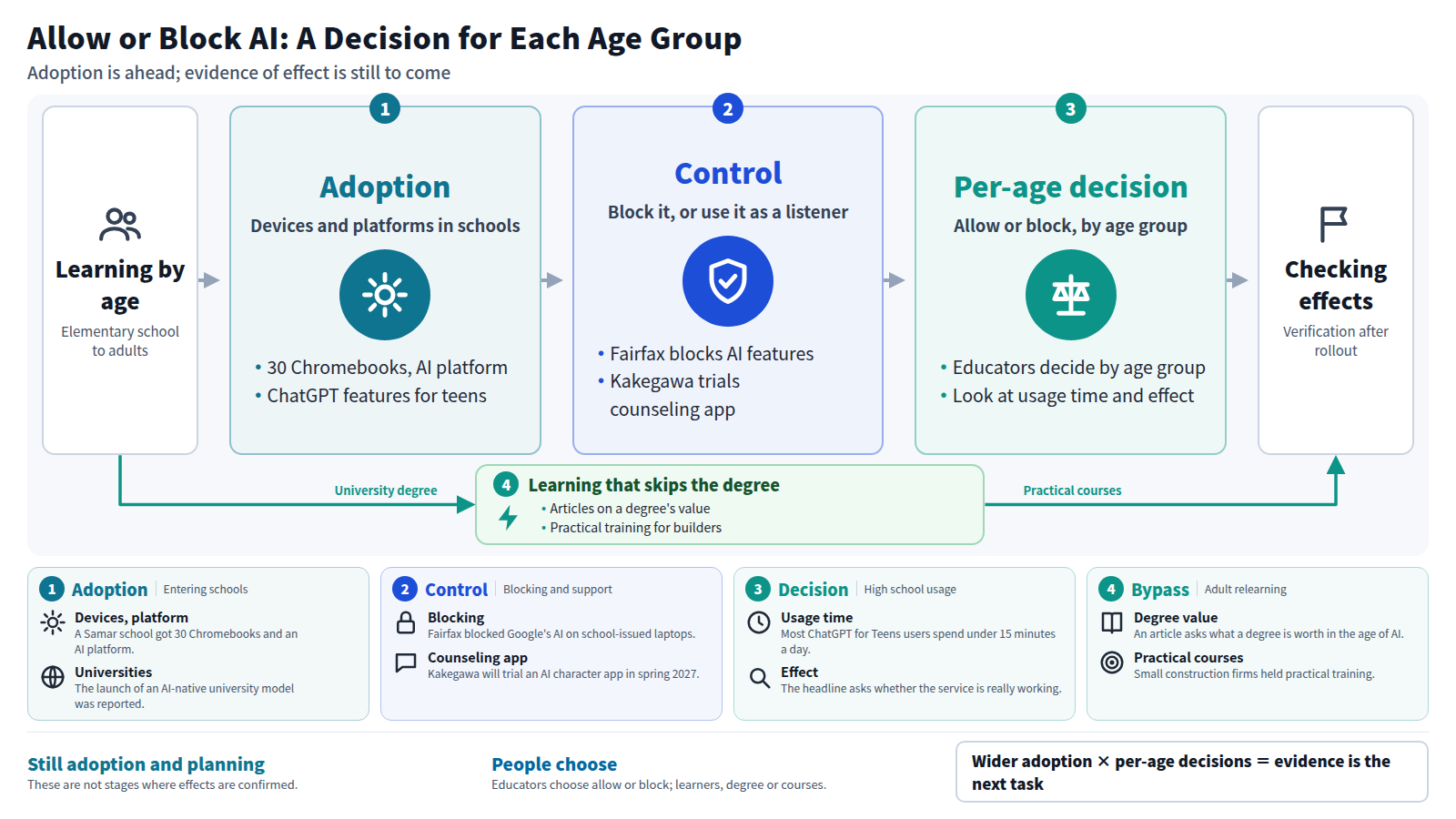
- United States: Fairfax County (InsideNoVa) introduced a setting that blocks Google's AI functionality on school-issued laptops. This is a measure aimed at restricting usage. - Philippines: A school in Samar received 30 Chromebooks and an AI-powered education platform (at the implementation stage, no confirmation of learning effects is in the headlines). - Vietnam: The Naval Academy is increasing its use of AI to build smart schools (the target age group cannot be identified from the headline). - In Japan: The Kakegawa City Board of Education plans to trial an app with an AI character that will serve as a "listener to the worries" of elementary and junior high school students starting in the spring of 2027 (at the planning stage, effectiveness has not yet been confirmed). Additionally, a winter break entrepreneurship education camp was held in Tsukuba, Ibaraki, taught by slightly older student entrepreneurs, with the idea that even elementary and junior high school students can start their own businesses using AI, and participation has become a hot topic.
Junior high school students
- Vietnam: Students in Vinh Hung District and Hanoi are experiencing science, technology, and AI (Experience implementation. Confirmation of results is not in the headline). - In Japan: A 10-course online learning program for junior high and high school students will be held in the fall/winter of 2026, with RIKEN researchers and AI experts on stage (the event's effectiveness has not been confirmed).
high school student
- US: Firstpost explained that OpenAI said that the majority of teenage users of ChatGPT for Teens spend less than 15 minutes a day. The headline asks if this service actually works. - In Japan: The Okinawa Times reported that OpenAI has expanded its ChatGPT functionality for teenagers to help them get into college in the United States.
university student
- Vietnam: In order to improve the quality of education, an article was published about actively sharing the experience of using AI in education, and an article about the launch of the "AI Native University" model (the content and effects of the launch are unclear from the headline). - In Japan: No applicable information.
adult
- Vietnam: An article has been published asking what value a university degree has in the age of AI. - In Japan: ``Generative AI Utilization (Practical Edition)'' was held for small and medium-sized construction companies to learn through practical exercises, but this is treated as a course for working adults and does not discuss human resource development and employment in the workplace.
Old age
No applicable information
Remarks from VIPs
- Sal Khan (Founder of Khan Academy): No applicable information
Integrated analysis: How is lifelong learning changing?
- Common movement: There is a movement to not only teach AI to students from elementary school to adults, but also to incorporate it into the learning environment and course premise. These include Chromebooks and AI platforms for elementary school students, online courses for middle and high school students, AI nativeization at universities, and practical courses for adults. - Different trends depending on the age group: At the elementary school level, usage management and emotional support are at issue, as seen in Fairfax County's shutdown measures and Kakegawa City's trial of a counseling app. Among high school students, the discussion points are the functions available to teenagers and the verification of their usage time and effectiveness. For adults, there are articles that question the value of degrees and practical courses, and opportunities for learning are expanding beyond universities. - Changes in judgment: Teachers need to decide whether to use or block AI depending on the age group. Learners need to choose between relying on a degree or learning through practical courses. In either case, we are not talking about the stage where effectiveness has been confirmed, but rather at the stage of introduction and planning.
Future points of interest
- Under what conditions will Kakegawa City's consultation app (trial in spring 2027) be implemented? - How does the actual usage of ChatGPT for Teens (less than 15 minutes a day) lead to actual learning? - How the "AI native university" model and the debate over the value of degrees will affect adult relearning.
- Aymeric Lim Is Building AI-Literacy for a New Generation of Health Care — Newsweek10/08 16:00 UTC
- Simplilearn and Columbia Engineering Executive Education Launch Collaboration to Advance Agentic AI Skills Among Professionals — PR Newswire10/08 11:00 UTC
- Forestsoft and HanbitN form business partnership in AI education — 디지털투데이10/08 13:42 UTC
- Samar school gets 30 Chromebooks, AI-powered teaching platform — Newsbytes.PH10/08 08:53 UTC
- Kakegawa Board of Education to Trial AI Character App for Pupils' Worries From Spring 2027 — Japanese media10/08 11:27 UTC
- Naval academy strengthens use of AI to build a smart school — Vietnam.vn10/08 14:01 UTC
- Vinh Hung ward students experience science, technology and AI — Vietnam.vn10/08 14:30 UTC
- RIKEN researchers and AI experts to speak in 10 courses broadening middle and high schoolers' interest in learning — Infoseek10/08 04:10 UTC
- Is ChatGPT for Teens really working? OpenAI says most teen users spend under 15 minutes a day — Firstpost10/08 04:54 UTC
- Aiming to improve the quality of education, actively share experiences regarding the use of AI in education. — Vietnam.vn10/08 14:00 UTC
- Launch of an AI-native university model — Vietnam.vn10/08 12:18 UTC
- Practical generative AI training for small construction firms held, with exercises based on site work — Infoseek10/08 08:19 UTC
- What Is a University Degree Worth in the Age of AI? — Vietnam.vn10/08 09:43 UTC