AI & Education News — 2026-10-08 (Thu) Evening News

Source links point to the original outlet. The AI Integrated Analysis is auto-generated from the headlines below only and is not intended to add facts beyond them. Not investment advice.
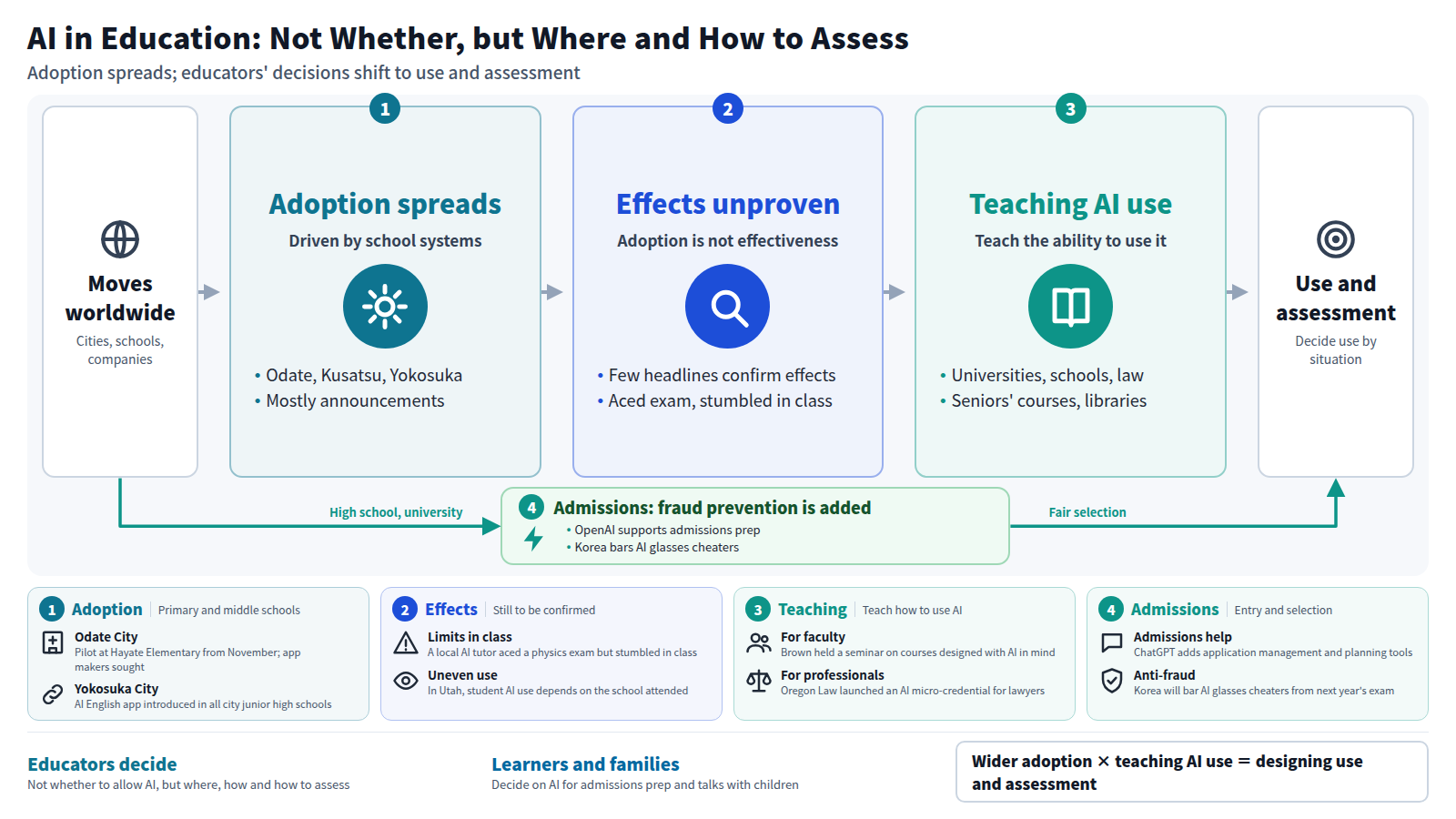
Overview
- For high school and university students, OpenAI's academic advancement support function (ChatGPT) and countermeasures against AI glass fraud in Korean university entrance exams have been released, and there is a noticeable movement in the university entrance exam scene. - In Japan, introduction and adoption is progressing in elementary and junior high schools (multi-grade classes, English learning apps, AI-based teaching materials), and for seniors and adults, the focus is on providing courses and experiences. - There is no heading regarding VIP list (Sal Khan).
AI Literacy
- A US university (Brown Daily Herald headline) held a seminar for faculty to help them create and redesign classes based on AI. - The University of Oregon School of Law in the US has launched an AI skills microcredential for legal professionals. - Balancing clinical skills and AI literacy is an issue in radiology resident education (Diagnostic Imaging). - In the US, UT held an AI summit focused on the future of business and education. - Singer Shakira is backing a new initiative to help Latin American women learn about AI. - In Japan, Gaiax will work with Ehime Prefecture and SPC to dispatch AI education instructors to high schools in Ehime Prefecture. This is an announcement of collaboration, and the implementation results and effects cannot be seen from the headline.
Early childhood education
- In Uzbekistan, new proposals regarding the introduction of AI in education and English classes were presented to the president (Zamon.uz). It is at the proposal stage and implementation cannot be confirmed. - In Japan, the Asahi Shimbun newspaper took up the question ``Is AI a tool or a conversation partner for children?'' and argued that the nature of conversations between parents and children is being questioned.
Elementary school students
- In Japan, there is a plan to introduce AI to multi-class elementary schools in Odate City, and a demonstration project will be conducted starting in November using Hayate Elementary School as a model. We are publicly recruiting businesses to create apps. Effects have not been confirmed at the planning and public recruitment stage. - In Japan, Kusatsu City, Shiga Prefecture, has officially adopted the learning e-portal and AI-based educational material ``Cubina''. The learning effect cannot be determined from the headline, just the fact that it was adopted. - Toride City's "Education and AI" article is about a junior high school sports festival, and it's hard to tell from the headline that it's aimed at elementary school students. - The Asahi Shimbun reports that a female junior high and high school student spent about five months developing the app and learned about the advantages and difficulties of generative AI (targeted at junior high and high school students, not limited to elementary school students).
Junior high school students
- In Japan, an AI-based entrepreneurship education camp for elementary and junior high school students was held in Tsukuba, Ibaraki, during winter vacation, and the camp was fully booked within 6 days of opening registration. The repeat participation rate is reported to be 60%. - In Japan, Yokosuka City has introduced an AI learning English app to all municipal junior high schools. It is said to be the first in the prefecture. This is a report on the introduction of the program, and the learning outcomes have not been confirmed. - In Vietnam, ``Innovate with AI 2026'' is being shown as a technical training ground for ideas that contribute to local communities. - Vietnam.vn also has an article that questions the limits of using AI in education and learning literature, indicating interest in the limits of its use.
high school student
- In the United States, OpenAI has added functions to ChatGPT to support preparation for university admission (unified application management, university admission planning tools). Targeted at teenagers and high school students in the United States. - In the US state of Utah, it is reported that the way students use AI varies depending on the school they attend (KSL News). - In Japan, Psycom held a special class at Houou High School that used video generation AI to convey gratitude to loved ones. Initiatives already implemented. - In Japan, AI (artist name) released the behind-the-scenes footage of the music video shooting for the high school section of the NHK National School Music Competition. "AI" here seems to be the name of an artist rather than artificial intelligence, and is not an educational move. - In Vietnam, a "Let's innovate with AI" contest will be launched for high school students. - In Japan, the Ibaraki Prefectural Board of Education uses AI interviews in the first round of open recruitment for principals. This is a selection process for teachers and administrators, and is not directly related to high school students' learning.
university student
- In the US, CU Denver is said to be expected to set up a base to teach students how to use AI (Chalkbeat). - There are reports that local AI tutors performed well on physics exams but floundered in the classroom (Bioengineer.org). - South Korea has announced that those who cheat using AI glasses will be excluded from next year's university entrance exams. Policy stage. - In Japan, 47NEWS/Saitama Shimbun reported on OpenAI's support for college admissions in the United States and the expansion of ChatGPT functionality for teenagers. Seikei University will hold a lecture on the theme of AI on the 24th.
adult
- In Japan, Seifukan High School will hold the "Shirahama AI Boot Camp" in December in Shirahama Town, Wakayama Prefecture, aiming to solve problems. It is not clear from the headline alone whether the target audience is adults. - For working adults, the micro-credentials for legal professionals from the University of Oregon School of Law may be relevant in terms of AI literacy. However, the topic of human resource development in the workplace is not covered in this section.
Old age
- In China, high-tech courses for the elderly, such as AI and video editing, are reported to be popular. - In Japan, the provision of an "AI creation package" for libraries has begun. It is said that anyone can easily hold a creative experience using AI. The target audience is not limited to the elderly.
Remarks from VIPs
No relevant information (there is no headline regarding the tracked Sal Khan [Khan Academy founder]).
Integrated analysis: How is lifelong learning changing?
common movements - While its adoption is expanding, emphasis is shifting to education on how to use it. Universities (Brown, CU Denver), legal and medical professional education, high schools (Ehime Prefecture, Cycom), and courses and libraries for the elderly are all working to teach the ability to use AI. - There are many implementation announcements and introduction decisions, and there are few headlines that confirm the effectiveness. The example of an AI tutor doing well on an exam but failing in the classroom shows that implementation and effectiveness are two different issues.
Different movements depending on the age - For elementary and junior high school students, local governments and schools often introduce teaching materials and apps (Odate City, Kusatsu City, Yokosuka City). The main body of learning is the school system. - For high school and university students, the focus is on advancement and selection. OpenAI's academic support has changed the way students prepare, and South Korea's AI glasses measures are a response to those who want to protect the fairness of exams. - For young children, the way families interact with each other, such as conversations between parents and children, has become a point of contention. - In the old age period, the focus is on providing lectures and experience opportunities.
Points where judgment changes - Teachers need to decide how to use AI and how to evaluate it, rather than whether or not to use it. Preventing fraud will also be added to entrance exams. - Learners and families will have to decide whether to use AI to prepare for higher education and how to talk about AI with their children. - Because students use AI differently at each school (report from Utah), differences may occur depending on the environment.
Future points of interest
Will confirmation of learning aspects be made public after the demonstration project in Odate City's multi-grade classrooms (scheduled to start in November) and Yokosuka City and Kusatsu City's implementation? 2. How will OpenAI's academic support function be used for high school students' career selection, and will measures against entrance exam fraud take shape in South Korea? 3. Will courses and experiences for the elderly and adults (Chinese courses for the elderly, packages for libraries, Shirahama boot camp) become more widespread?
- New AI literacy seminar helps faculty create, redesign courses with AI in mind — Brown Daily Herald10/08 04:29 UTC
- Oregon Law Launches AI Skills Micro-Credential for Legal Professionals — University of Oregon Law School10/07 18:16 UTC
- Balancing 'Ironclad' Clinical Skills with AI Literacy in Radiology Residency Training — Diagnostic Imaging10/07 20:31 UTC
- UT hosts AI summit on the future of business and education — WATE 6 On Your Side10/07 21:46 UTC
- Shakira Promotes New Initiative for Latin American Women to Learn About AI — ColombiaOne.com10/08 00:30 UTC
- Gaiax partners with Ehime Prefecture and SPC to send AI education instructors to Ehime high schools — PR TIMES10/08 01:00 UTC
- Artificial intelligence in education and English-language lessons: New proposals presented to the President — Zamon.uz10/07 15:43 UTC
- Is AI a tool or a conversation partner for children? Parent-child talk put to the test — 朝日新聞10/07 21:50 UTC
- Odate City elementary school to introduce AI to multi-grade classrooms Demonstration project for fast-talking small model from November Open call for businesses to create apps — 株式会社 北鹿新聞社10/07 21:04 UTC
- Education and AI: Toride Daini Junior High School sports festival (Deputy Mayor Tetsu Ito) — 取手市10/08 05:00 UTC
- “If we have AI, we can create apps too” A junior high school and high school student learned about the wonders and difficulties of generative AI after about 5 months of development. — 朝日新聞10/07 22:32 UTC
- [Ibaraki/Tsukuba] In an age where even elementary and junior high school students can start a business using AI, students who are slightly older are teaching the students. Entrepreneurship education camp during winter vacation was fully booked within 6 days of registration opening, with repeat participation rate of 60% — PR TIMES10/08 04:59 UTC
- Yokosuka introduces AI English learning app in all city junior high schools, a first in Kanagawa — 毎日新聞10/07 20:02 UTC
- "Innovate with AI 2026": a training ground for technology ideas that serve the community — Vietnam.vn10/08 07:04 UTC
- What are the limits of using AI in educational and learning literature? — Vietnam.vn10/08 04:22 UTC
- ChatGPT Adds College Admissions Support Feature, Centralizing Application Management for U.S. High School Students — BigGo Finance10/08 03:55 UTC
- How Utah students use AI in school depends on where they go — KSL News10/08 01:08 UTC
- Ibaraki Board of Education uses AI interviews in first-round screening for principal applicants — 日本教育新聞電子版 NIKKYOWEB10/08 05:15 UTC
- CU Denver officials believe a new hub could offer lessons to students on AI's use — Chalkbeat10/07 23:23 UTC
- Local AI Tutor Aces Physics Exam but Stumbles in the Classroom — Bioengineer.org10/08 04:00 UTC
- Korea to Bar AI Glasses Cheaters From Next Year's College Exam — Seoul Economic Daily10/08 01:12 UTC
- OpenAI Adds College Planning Feature to ChatGPT for US Teens — 47NEWS10/08 00:16 UTC
- AI Creative Package for Libraries Launched to Make AI-Based Workshops Easy to Hold — 時事ドットコム10/08 04:16 UTC