AI & Education News — 2026-10-08 (Thu) Morning News

Source links point to the original outlet. The AI Integrated Analysis is auto-generated from the headlines below only and is not intended to add facts beyond them. Not investment advice.
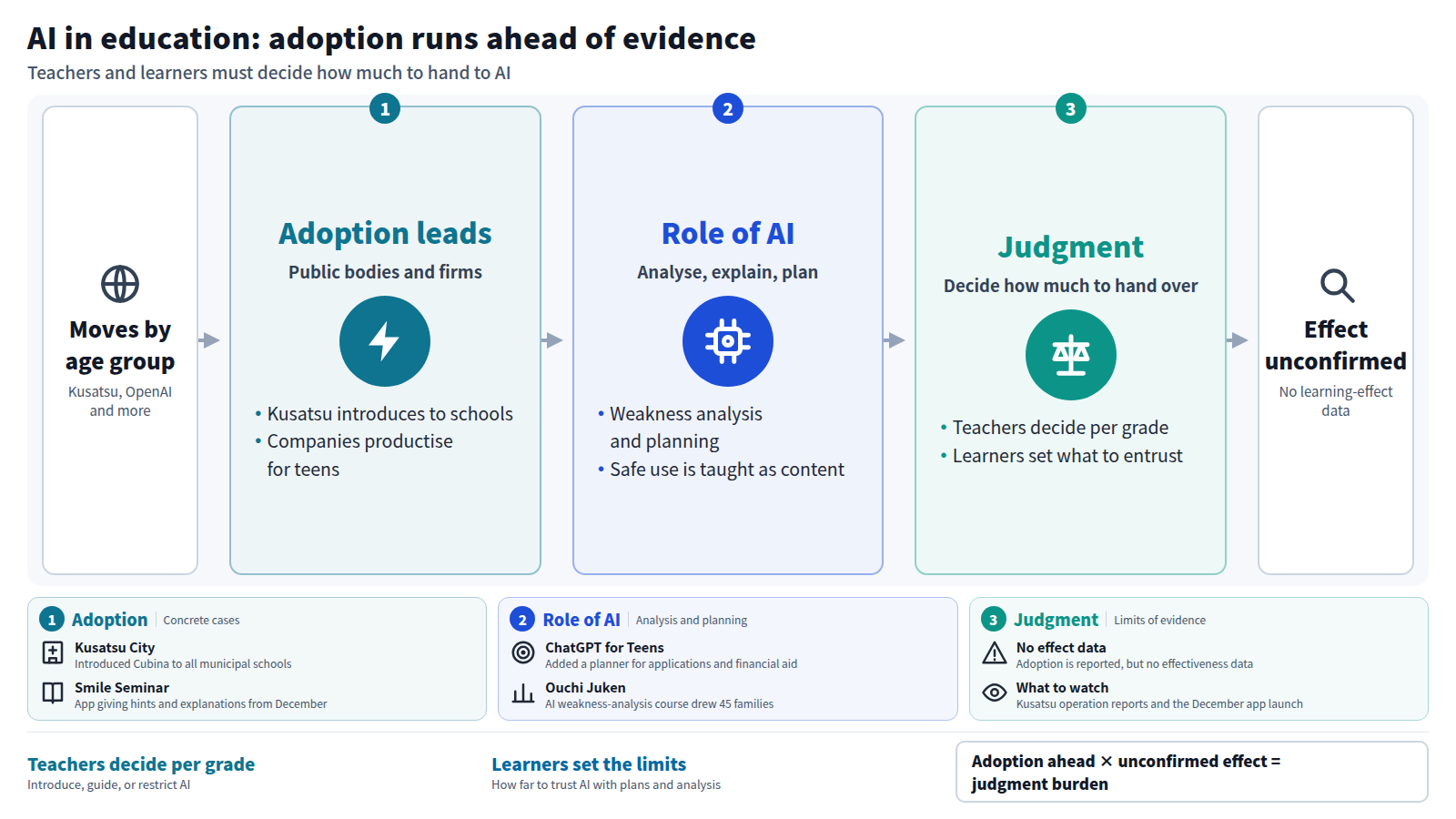
Overview
- In Japan, plans have been announced to introduce AI teaching materials to elementary and junior high schools (Kusatsu City) and to provide an AI-equipped learning app for high school students (Just System). There is also an example (Okayama University) where university students give courses at high schools. - Overseas, OpenAI has released a university preparation function for teenagers, and in Vietnam, elementary schools have been given guidance on the safe use of AI. It was reported that universities in the United States are moving towards the active use of AI. - Support for qualification examinations for adults and courses for elderly people in China made headlines. Infants and junior high school students do not move independently.
AI Literacy
- International (information for NGOs): fundsforNGOs has posted a sample grant application on the theme of "AI literacy and responsible technology education for young people." This suggests that more organizations are seeking funding in this area, but the headlines do not reveal the content or scale of their efforts. - UAE (Abu Dhabi): According to The National, Abu Dhabi has launched a major training program to teach AI skills. The target age cannot be determined from the headline. - In Japan: No applicable information.
Early childhood education
No applicable information
Elementary school students
- Vietnam (Xuan Truong District, Da Lat City): Police officers teach children at Phan Boi Chau Elementary School how to safely use digital technology and artificial intelligence. It is a move that can be confirmed to be implemented, but the effect on children is not clear from the headline. - In Japan: Kusatsu City, Shiga Prefecture, introduced the AI-based educational material ``Cubina'' to all municipal elementary and junior high schools. At the time the introduction of the system was reported, there was no information showing the effectiveness of the system in terms of learning.
Junior high school students
- There are no standalone headings. - In Japan: The introduction of Cubina in Kusatsu City also includes municipal junior high schools (see the section on elementary school students).
high school student
- United States (OpenAI): ChatGPT for Teens has added a university admissions planner function to manage application status and scholarships/financial aid (Fox Business). OpenAI's own article, "Helping teens learn, plan, and shape the future of AI," is also available. For purposes of collection, the article is categorized under the section on college students, but the subject of the headline is teenagers. - In Japan: - Students from Okayama University held a data science course at Kurashiki Minami High School in Okayama Prefecture. The content is designed to help students overcome the barrier of English data using generative AI and experience the usefulness of Mathematics I through the analysis of music data. "Experience" is an expression of the presenter and is not the result of verification of effectiveness. - Just System (Tokushima City) will provide an app from December that uses AI to provide hints and explanations for the correspondence course ``Smile Seminar.'' It is still in the planning stage, and its use and effectiveness cannot yet be confirmed.
university student
- United States: The Japanese version of Newsweek reported that American university education is moving towards the active use of AI. The names of individual universities and their policies cannot be identified from the headlines. - In Japan: Okayama University, mentioned above, is an example of university students teaching high school courses (see the section on high school students).
adult
- In Japan: - CM Partners, a member of the Class Method Group, has announced measures regarding exam fees for data infrastructure x AI qualifications such as Snowflake and Databricks. The headline is cut off, making it impossible to confirm the scope of support. - Before the regular test in October, Ouchi Examination held a course to analyze study weaknesses using AI, and 45 families participated. The target audience is families preparing for school tests, which is different from relearning for adults. I have placed them here according to their collection classification. - Overseas: No applicable information.
Old age
- China: High-tech courses on AI and video editing for the elderly are reported to be popular (Livedoor News). The level of popularity and learning outcomes cannot be determined from the headline. - In Japan: No applicable information.
Remarks from VIPs
- Sal Khan (Founder of Khan Academy): No applicable information
Integrated analysis: How is lifelong learning changing?
common movements - Products and services that use AI to analyze, explain, and plan learning are lined up for elementary school students (Kusatsu City), high school students (Smile Seminar, ChatGPT for Teens), and adults (home entrance exam courses). Movements based on the premise of individualized learning can be seen across generations. - For elementary school students (Vietnam) and AI literacy (fundsforNGOs, Abu Dhabi), teaching the skills to use AI and how to use it safely is part of the educational content itself. - There is a movement toward the use of AI for university students (in the United States), high school students (in courses at Okayama University), and senior citizens (in China).
Different movements depending on the age - For elementary and junior high school students, introduction and guidance by public entities such as local governments and police is noticeable. For high school students, companies are offering products to help them prepare for higher education and support self-study. - In the section on high school students, there are examples of university students teaching at high schools, and connections across school levels can also be seen. - In adulthood and old age, voluntary participation in the form of qualifications and courses is the focus.
Points where judgment changes - Teachers need to decide for each grade whether to introduce AI teaching materials and AI functions, provide guidance on how to use them, or impose restrictions. The introduction is moving forward, and there is no information in the headlines indicating its effectiveness. - Learners will decide how much to entrust AI with planning for higher education and analyzing weaknesses. - The headlines this time mainly focus on reports on introduction, provision, and holding, and do not include confirmation of learning effects. The impact on children cannot be determined from this point.
Future points of interest
The launch of Smile Seminar's AI commentary app in December and the status of "Cubina" operation in Kusatsu City (whether there are any reports after implementation). 2. Usage status of OpenAI's school education planner for teenagers and whether it has been expanded to other regions including Japan. 3. What kind of specific measures will be presented in the U.S. university's AI utilization policy?
- A Sample Grant Proposals On“ AI Literacy and Responsible Technology Education for Youth ” — fundsforNGOs10/07 13:15 UTC
- Abu Dhabi launches major training programme to teach AI skills to the public — The National10/07 13:21 UTC
- OpenAI launches college planner in ChatGPT for Teens to track application, financial aid — Fox Business10/07 16:03 UTC
- AI gives hints while explaining: JustSystems of Tokushima to offer app from December for Smile Zemi correspondence course — 徳島新聞デジタル10/06 20:00 UTC
- Helping teens learn, plan, and shape the future of AI — OpenAI10/07 16:02 UTC
- American university education steers towards active use of AI | Newsweek Japan Edition Official Site — ニューズウィーク日本版10/07 09:20 UTC
- Oucchi Juken to hold October course for 45 families on analyzing study weaknesses with AI before regular tests — https://pr-free.jp/10/07 02:09 UTC