AI & Education News — 2026-10-07 (Wed) Evening News
Source links point to the original outlet. The AI Integrated Analysis is auto-generated from the headlines below only and is not intended to add facts beyond them. Not investment advice.
Overview
At the high school and university student stage, there were notable movements regarding restrictions and policies on usage (introduction in school districts and cities in the United States, and in Estonia), as well as surveys of actual usage (university transfer entrance exams). Japanese local governments are introducing AI teaching materials for elementary and junior high school students. For adults and senior citizens, the focus was on developing qualifications and courses, and there were no headlines about important people (Sal Khan).
AI Literacy
- The headline says that Baruch College in the United States has won a federal grant to advance AI literacy and applied learning (it is unclear from the headline whether this is for university students or the general public). - US KRON4 reports that the ``AI Literacy Project'' will make digital communities smarter. - Vietnam has a shortage of AI skills despite significant investment in universities, a report found (Asia News Network). - In South Korea, the Gyeonggi Province Education Superintendent celebrated his 100th day in office and announced that he would proceed with preparations and implementation in 2027 based on three topics, including AI education. It is still at the policy stage and there is no confirmation of implementation. - South Korea's Hancom InnoStream has launched the robot/AI practical education brand "Hancom AX Lab." There have also been reports of the launch of a physical AI/AX education brand and the release of the use of NVIDIA's "Isaac Sim" in education. - In Japan, six teams of students from Doshisha University used generative AI to solve an internal problem at Toyota United Nara, and released a prototype within two weeks of their on-site visit.
Early childhood education
- In South Korea, Choi Kyo-jin pledged to provide full tuition support for new students at local national universities and to expand AI and care (Chosunbiz). The heading does not directly deal with early childhood education and is therefore unlikely to fall under this category. - In Japan, Kyoshin has applied for a patent for interpersonal service support technology that utilizes AI in the fields of education and nursing care. It is not clear from the headline whether it is aimed at young children.
The movement aimed at young children cannot be confirmed from the headline.
Elementary school students
- Fairfax County in the US state of Virginia has installed Google's AI blocker on school-issued laptops (WTOP). This is a measure to restrict use by children and students. - In Japan, - Kusatsu City, Shiga Prefecture, introduced the AI-based educational material ``Cubina'' to 20 municipal elementary and junior high schools. Approximately 12,000 students from 1st grade to 3rd grade junior high school will use the facility. This is a report on the introduction, and there is no confirmation of learning effects in the headline. - 24-hour bear monitoring using AI is being tested at two elementary schools in Shiwa Town, Iwate Prefecture. This is a safety initiative, not a learning one.
Junior high school students
In Japan, - Gakureo, an AI learning service for junior high and high school students, has started offering iOS and Android apps. - MagMag argues that the shift to "AI-based education" that has begun in American universities will raise the standards required of humans. The target audience was universities, but the article was categorized as aimed at junior high school students.
high school student
- In the United States, - New York and Los Angeles restrict student use of AI (The Herald Insight). - Belmont High School's AI policy sparks backlash from students and parents (The Belmont Voice). - The New York Times published an editorial stating that it had strong concerns through conversations with "ChatGPT for Teens." - In Estonia, the Yomiuri Shimbun reported that the Minister of Education and Science said that he wants children to use AI correctly and acquire deep thinking skills from an early age, and will introduce conversational AI in all high schools. This is an announcement of implementation, not confirmation of results. - In Japan, - The Mainichi Shimbun argues that Japanese society needs to come to a consensus regarding the use of AI by children. - As a vision for the future of high school entrance exams, this article features entrance exams that incorporate self-promotion, presentations, and the use of AI, rather than being bound by academic ability tests or surveys. - A special class was held in which high school students tackled video generation using local AI. This is seen as an opportunity for the generation that is forced to use AI to think about how they interact with each other.
university student
- In the US, Penn State announced new AI grants for teachers. Students at Northwest Missouri State University offer their opinions on the use of AI. - In Vietnam, universities are opening AI-related programs on a large scale, reportedly creating a "gap" between the classroom and the job market. - In Japan, - The usage rate of generated AI in university transfer examinations increased from 36% to 97% in two years (survey of 224 successful applicants, PR TIMES). The target of the survey was those who passed the test, and it is unclear from the headlines what they are using. - A two-day gathering of AI experts is scheduled for November 20th and 21st at the Yasuda Auditorium of the University of Tokyo.
adult
In Japan, - GUGA will significantly revise the syllabus for the Generated AI Passport exam starting in 2027 and create a new qualification renewal test. - The 2027 edition text of the Generated AI Passport (all 410 keywords explained with stories and maps) has been published. - Propagate Co., Ltd. is running a campaign to support full exam fees for data infrastructure and AI qualifications.
Movements aimed at adults overseas cannot be confirmed from the headlines.
Old age
- In China, high-tech courses such as AI and video editing for the elderly are reportedly popular. It is also reported that the enthusiasm for AI learning is spreading from middle school and high school students to the elderly. - In Japan, AI courses that can be applied to work will be held at the ``Senior Work EXPO'' sponsored by the Tokyo Metropolitan Government. This is an event to support re-employment, and the positioning of the course is part of that.
Remarks from VIPs
Headlines about Sal Khan (founder of Khan Academy) are not included in this collection. No applicable information.
Integrated analysis: How is lifelong learning changing?
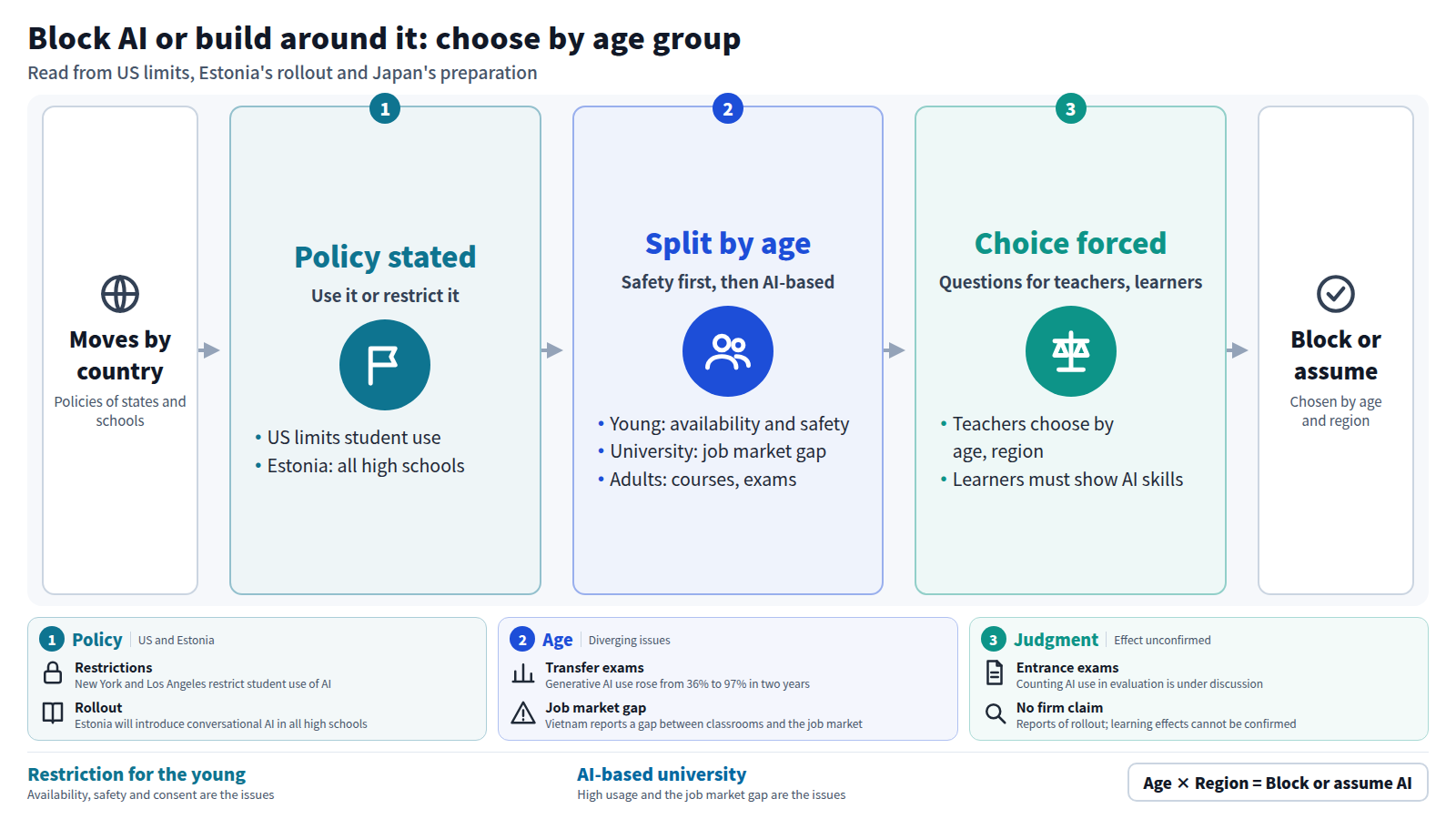
common movements - The country, local governments, and schools are now at the stage where they are making decisions on whether to use it for learning or restricting it as a policy. Restrictions and opposition have centered on elementary school students (Fairfax County's shutdown) to high school students (New York, Los Angeles, Belmont), and Estonian high schools are moving forward with implementing it for all schools. Even within the same age group, judgments differ depending on the country. - In Japan, introduction and maintenance are appearing in the headlines at each stage: elementary and junior high schools (Introduction of AI teaching materials in Kusatsu City), high school entrance exams (Evaluation of AI utilization), university transfer (increase in usage rate of generated AI), adulthood (Revision of qualifications), and old age (AI courses). These are introduction and research reports, and learning effects cannot be confirmed from the headlines.
Different movements depending on the age - At younger ages, decisions regarding availability and safety (restrictions, parental concerns, need for social consent) are central. - For university students, the issue of discussion is the gap between education based on widespread use ("AI-based education") and the job market after graduation (Vietnam). - For adults and senior citizens, learning is provided in the form of qualifications and courses, and is also linked to re-employment support (for example in Tokyo).
Points where judgment changes - Teachers need to choose whether to prohibit or assume AI based on age and region. There are discussions to include the use of AI in the evaluation of entrance exams. - Learners are being asked both their ability to use AI and their ability to respond to the rising standards required of humans, given the high usage rate (survey of transfer entrance exams). - Regarding student use, safety concerns have been raised as seen in an editorial in the NYT, so it is not possible to say for certain whether it is effective or not.
Future points of interest
Will U.S. school districts and cities' restrictions on AI use by students spread to other regions, or will they be reconsidered in the face of backlash? 2. How will the introduction of interactive AI to all high schools in Estonia and discussions on consensus building in Japan materialize at the implementation stage? 3. How will the 2027 exam revision of the Generative AI Passport and the establishment of a new qualification renewal test be received by adults relearning?
- Baruch College Awarded Major Federal Grant to Advance AI Literacy and Applied Learning — Baruch News Center.10/06 20:34 UTC
- The AI Literacy Project builds smarter digital communities — KRON410/06 21:51 UTC
- Vietnam faces AI skills gap despite strong university investment: report — Asia News Network10/07 04:46 UTC
- ``In 2027, we will make solid preparations and boldly implement the three topics of AI education and halving private education fees, as well as establishing our main signature policies.'' Gyeonggi Provincial Superintendent of Education Ahn Min-seok, who has celebrated his 100th day in office, has announced plans for next year's Gyeonggi education. — 매일경제10/07 07:48 UTC
- Hancom InnoStream Launches Robot and AI Practical Training Brand 'Hancom AX Lab' — BigGo ファイナンス10/07 01:36 UTC
- Six Doshisha University Student Teams Tackle Toyota United Nara's Internal Issues with Generative AI — ニコニコニュース10/07 05:15 UTC
- Physical AI/AX education brand launched Physical AI education released at SLW2026 NVIDIA “Isaac Sim” used for education — 매일경제10/07 06:16 UTC
- Choi Kyo-jin vows full tuition for regional national freshmen, expands AI and care — Chosunbiz10/07 01:58 UTC
- Fairfax Co. rolls out Google AI blocker on school-issued laptops — WTOP News10/06 20:45 UTC
- About 12,000 Students From Grade 1 to Grade 9 Use AI Learning Material as Kusatsu Adopts 'Qubena' in All 20 Schools — DXマガジン10/07 02:53 UTC
- Why My Conversations With ‘ChatGPT for Teens’ Made Me Very Worried — The New York Times10/07 09:07 UTC
- Belmont High School AI Policy Faces Backlash From Students, Parents — The Belmont Voice10/06 22:31 UTC
- New York and Los Angeles restrict student AI as the technology becomes harder to avoid — The Herald Insight10/06 19:34 UTC
- As I See It: Japanese society needs to reach consensus on how children should use AI — 毎日新聞10/06 22:01 UTC
- [Special feature] Future of high school entrance exams ② Entrance exams that are not bound by academic ability tests and surveys Self-promotion, presentations, and the use of AI — みんなの学校新聞10/07 04:23 UTC
- Estonian Minister of Education and Science: ``I want to use AI correctly and develop deep thinking skills from an early age''...Introducing interactive AI in all high schools — 読売新聞10/06 20:00 UTC
- Penn State Announces New Artificial Intelligence Grants For Faculty — Onward State10/07 08:11 UTC
- Northwest students express opinions on AI, use of advancing technology in the University | News | nwmissourinews.com — Northwest Missourian10/07 05:24 UTC
- Generative AI Use in University Transfer Exams Rises From 36% to 97% in Two Years, Survey of 224 Successful Applicants Finds — PR TIMES10/07 06:38 UTC
- Universities are opening AI-related programs at scale: The "gap" between the classroom and the job market. — Vietnam.vn10/07 08:15 UTC
- University of Tokyo: Two Days of AI Experts Gathering at Yasuda Auditorium on November 20 and 21 — Digital PR Platform10/06 23:21 UTC
- Wazaaka Publishes 2027 Generative AI Passport Textbook Explaining All 410 Keywords With Stories and Maps — PR TIMES10/07 04:22 UTC
- Propagate Runs Campaign Covering Full Fees for Data Platform and AI Certification Exams Through CM Partners — ニュースメディアVOIX10/07 07:44 UTC
- Tokyo Hosts Senior Job Expo Supporting Re-employment, Including AI Course for Workplace Use — Yahoo!ニュース10/07 01:50 UTC
- High-Tech Courses on AI and Video Editing Popular With Older Adults in China — dメニューニュース10/07 01:38 UTC
- China: Enthusiasm for Learning AI Grows, Spreading From Students to Seniors — 亜州ビジネス中国10/07 05:29 UTC