AI & Education News — 2026-10-10 (Sat) Morning News

Source links point to the original outlet. The AI Integrated Analysis is auto-generated from the headlines below only and is not intended to add facts beyond them. Not investment advice.
Overview
- Movements are most noticeable in elementary, junior high and high schools (required subjects in Russia, criticism of ChatGPT for Teens, rules for use in classes and at home) and universities (partner courses with Google etc., AI-native courses). - The necessity of AI literacy across K-12 was discussed, and a Japanese webinar for university faculty and staff was also announced. - For adults and seniors, there are only one online self-protection guidance and one guide for beginners. Early childhood education is only one of the ward's policies.
AI Literacy
- Unite.AI published an article in English and Japanese stating that AI literacy is necessary in all K-12 classrooms (this is a statement/commentary, not a confirmation of implementation or effectiveness). - Arden and Google Cloud partner to incorporate practical AI skills into degree programs (this is just a partnership announcement, so the results are not obvious from the headlines). - In Japan, an FD&SD webinar for university faculty and staff is scheduled to be held on Friday, October 30th (posted on October 9, 2026). The theme is the latest trends in AI, including the basics and utilization skills that should be taught to students. This is an announcement of a scheduled event.
Early childhood education
- Ridgefield School District, USA, begins a technology and AI oversight plan to overhaul K-12 writing instruction. The target is K-12 as a whole, and the content is not specific to young children, and the headline does not reveal any movement specific to early childhood education. - In Japan: No applicable information.
Elementary school students
- In Russia, it was reported that AI will become a compulsory subject for students in grades 5 to 11 (at the policy stage, implementation and effects cannot be confirmed). - In Vietnam, there were reports of cases of using the ChatGPT app in elementary school science classes. The headline indicates the positioning, ``AI is an assistant, and the focus is on the learner.'' Another article describes an effort by students and teachers to compete with AI (it's unclear from the headline if it's aimed at elementary school students). - In Japan, NHK reported that educational institutions are exploring ways to utilize generative AI in classes. Kyoiku Kaisha Shimbun raised the question of whether ``banning'' children's use of AI is counterproductive, and reported that SHIFT AI has released an archived video for free that explains how to design and use rules at home. ``Reverse effect'' is a question in the headline, and it does not mean that the effect has been confirmed.
Junior high school students
- Teachers in Quang Tri Province, Vietnam are practicing the use of AI in their educational settings (it is a practice on the teacher's side, and the effect on students is not clear from the headline). - Coverage of compulsory subjects in Russia (grades 5 to 11) also applies to junior high school students. - In Japan: No applicable information.
high school student
- In the United States, a watchdog group issued a report calling ChatGPT for Teens an "unacceptable risk" (reported by Spectrum News and WSOC TV, with similar headlines in Albanian media). This is an organization's evaluation, and the basis for the evaluation cannot be confirmed from the headline. - Students from Peninsula School District in Washington state helped draft a national K-12 AI bill. The bill is at the "proposal" stage. - Reports on compulsory subjects in Russia apply to students up to their second year of high school. - In Japan, a high school student newspaper reported that a student who was accepted into a national university through a school-recommended selection process also used generative AI to practice for 50 interviews in two months. This is an individual case.
university student
- In India, Bengaluru University will partner with Google to offer a course on agent-based AI. - In Vietnam, CMC University opened its fifth course and announced an AI native model. - In the US, it was reported that OpenAI plans to add "College Planner" to ChatGPT for Teens to help manage college applications. This is the connection from high school to university entrance. The addition is still in the planning stage. - In Japan, the University of Tokyo will hold "Tokyo Forum 2026," an international symposium for the general public on the theme of AI, in November. The event is scheduled to be open to the general public, not just students.
adult
- In Ho Chi Minh City, Vietnam, residents are receiving guidance on how to use AI to protect themselves online. This is safety education for citizens rather than relearning for working adults, and there are no other headlines about courses or qualifications. - In Japan: No applicable information.
Old age
- In Japan, in an article published in SmartNews, author Yuki Masuda introduces ``Getting Started with AI'' with an easy-to-understand illustrated guide even for the elderly (she is introduced as a best-selling author). This is introductory content for elderly people.
Remarks from VIPs
- Sal Khan (founder of Khan Academy): No statement or movement in this headline. No applicable information.
Integrated analysis: How is lifelong learning changing?
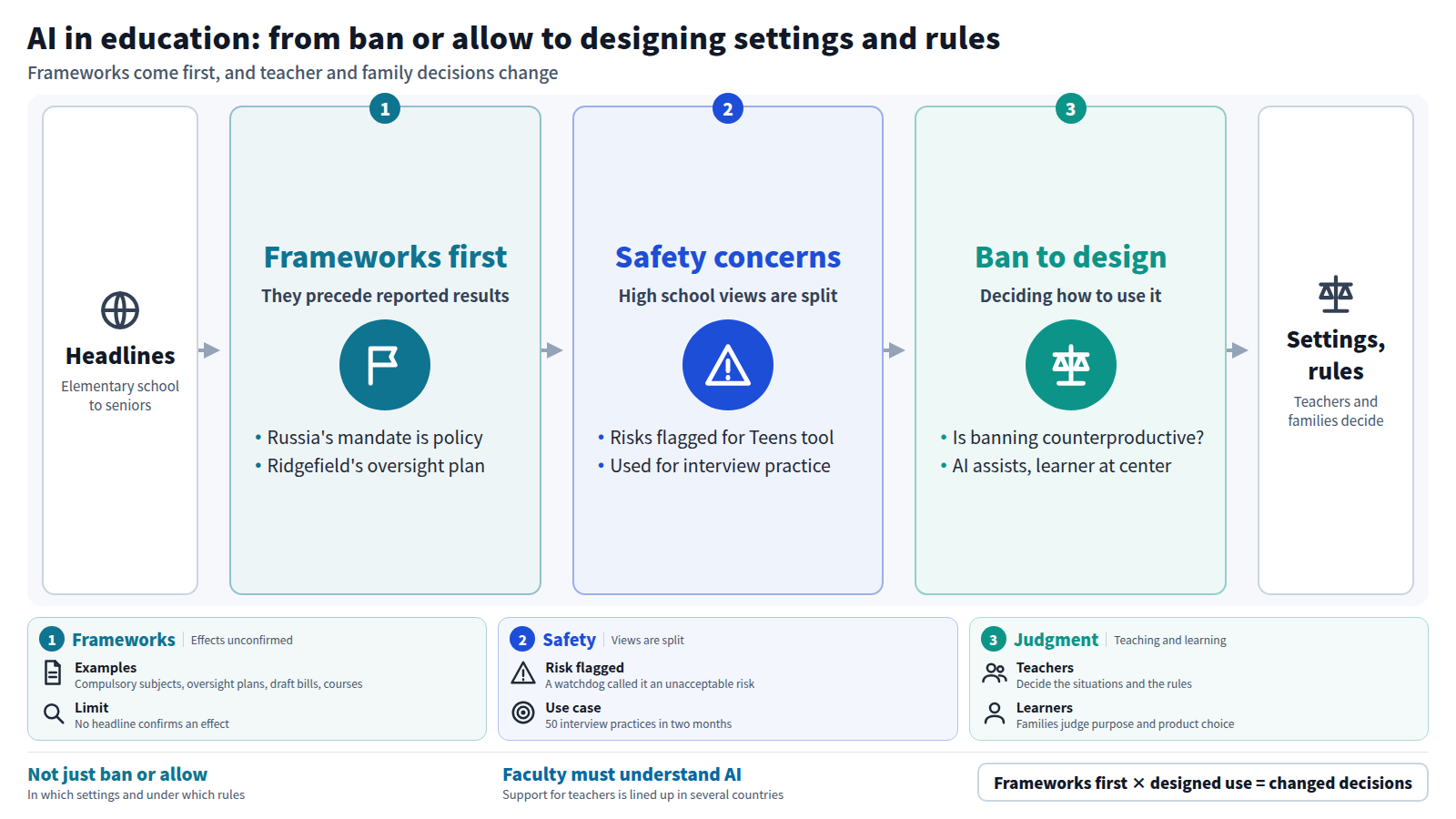
common movements - From elementary school students to university students, the framework for introduction (compulsory subjects, supervision plans, draft bills, affiliated courses) is being developed before the results are reported. These include compulsory education in Russia, Ridgefield's oversight plan, draft legislation in Peninsula, and courses in Arden, Bengaluru, and CMC. There are no headlines that confirm the effect. - Headlines such as ``AI is an assistant, the focus is on the learner'' (Vietnamese elementary school science) and ``Design rules at home rather than prohibition'' (Japan) indicate a shift from the decision not to use AI to the decision to design how to use it. - Support for teachers (webinars for Japanese teachers, practices of teachers in Quang Tri province) is being lined up in multiple countries.
Different movements depending on the age - For elementary, junior high and high schools, the focus is on systems and safety, such as compulsory subjects and usage rules. Especially among high school students, evaluations of ChatGPT for Teens are mixed, with some pointing out the risks and using it for interview practice and college planning (College Planner). - Universities mainly offer practical AI courses through partnerships with companies such as Google. - For adults and senior citizens, the amount of learning provided is small, with basic standards such as safety and introductory guides.
Points where judgment changes - Teachers: Rather than deciding whether to prohibit or allow use, it is now necessary to decide in what situations and under what rules. Faculty members themselves are also required to understand AI. - Learning side: There are examples of students using AI to practice for interviews and prepare for higher education, and there will be more situations where students and their families will have to decide the purpose of use and whether to use products that have been identified as having risks.
Future points of interest
How will compulsory education in Russia be implemented in practice (transition from policy to implementation)? 2. OpenAI and schools responded to the indication of "unacceptable risks" to ChatGPT for Teens, and began providing College Planner. 3. What direction for education will be shown at Japan's October 30th webinar and November's Tokyo Forum 2026?
- AI Literacy Belongs in Every K-12 Classroom — Unite.AI10/09 11:08 UTC
- Arden and Google Cloud partnership puts practical AI skills into degree courses — Onrec10/09 10:18 UTC
- AI Literacy Is Needed in Every K-12 Classroom — Unite.AI10/09 11:08 UTC
- Ridgefield Schools Review K-12 Writing Instruction, Launch Technology And AI Oversight Plan — Patch10/09 14:19 UTC
- AI will be a compulsory subject for Russian students from grades 5 to 11. — Vietnam.vn10/09 14:08 UTC
- ChatGPT app for teaching elementary science: AI is just an assistant, students are at the center. — Vietnam.vn10/08 19:42 UTC
- How to utilize generative AI in classes: Exploring educational settings — Japanese media10/09 11:31 UTC
- Students and teachers compete against AI. — Vietnam.vn10/09 10:29 UTC
- Quang Tri Province Teachers Practice Using AI in Education — Vietnam.vn10/09 12:17 UTC
- ChatGPT po paraqet rrezik të madh për fëmijët — Reporteri.net10/09 06:51 UTC
- Peninsula School District students help draft proposed AI bill for nation's K-12 schools — Gig Harbor Now10/08 20:51 UTC
- Artificial Intelligence to Become a Compulsory Subject for Russian Students From Grade 5 to Grade 11 — Vietnam.vn10/09 13:30 UTC
- "50 interview practices in two months": student passes national university via school recommendation, also using generative AI — Japanese media10/09 06:00 UTC
- Agentic AI course: Bengaluru University partners with Google — YourStory.com10/09 10:22 UTC
- CMC University launched its fifth course and announced AI Native Model. — Vietnam.vn10/09 15:28 UTC
- Ho Chi Minh City Residents Are Taught How to Use AI to Protect Themselves Online — Vietnam.vn10/09 11:45 UTC
- [Easy even for the elderly, comes with illustrated guide] Best-selling author Yuki Masuda teaches "First AI" — SmartNews10/09 11:00 UTC