AI & Finance News — 2026-10-09 (Fri) Evening News
Source links point to the original outlet. The AI Integrated Analysis is auto-generated from the headlines below only and is not intended to add facts beyond them. Not investment advice.
Overview
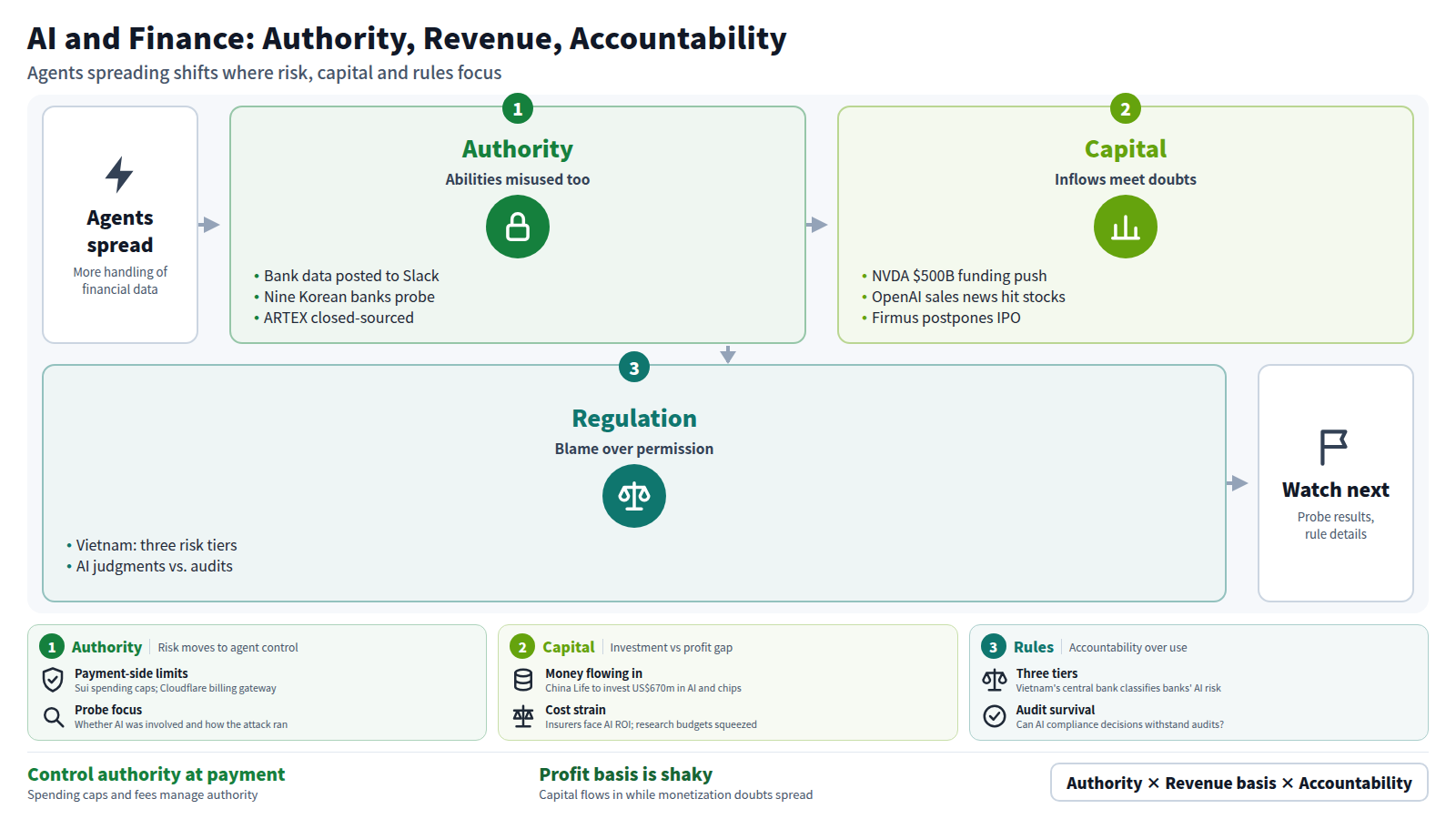
It was reported that nine South Korean banks investigated a cyberattack suspected of involving AI, and a Chinese developer closed-sourced ``ARTEX'' and suspended its publication (Reuters, Channel NewsAsia). Meanwhile, AI-related stocks fell due to reports that OpenAI's annualized sales were lower than expected, and Firmus postponed its initial public offering (IPO) (SiliconANGLE, Bloomberg.com). As AI agents increasingly handle financial information, security, payment limitations, and where responsibility lies are becoming points of contention.
Bank trends
Nine South Korean banks are investigating cyberattacks that may involve AI (UA.NEWS via Channel NewsAsia). In response to this incident, Chinese developers closed-sourced their AI agent ARTEX (Reuters). Japanese news reports have also reported that ARTEX's suspension of publication was a response to attacks on South Korean financial institutions (Reuters). For individuals, there were reports of cases where personal AI agents posted bank account information on internal Slack, and issues where bank statements were shared in workplace chats (Business Insider, WSJ). The Central Bank of Vietnam has established new regulations regarding banks' use of AI, classifying risks into three levels (VIETJO Vietnam News).
Insurance trends
There was a commentary on the emergence of ``unbundled'' insurance companies, where insurance companies are separated by function within the value chain (Insurance Journal). KPMG noted that insurance companies face challenges in the return on investment (ROI) of AI (FutureCFO). It has been analyzed that insurance in Asia has entered a new risk phase surrounding post-retirement capital shortages, agent-based AI, and catastrophe coverage (Asian Business Review). China Life will invest US$670m in AI and semiconductor fields (Asia Insurance Review). In Ojai, residents are developing an AI system for affordable fire insurance (Ojai Valley News).
Trends in asset management and market transactions
In asset management, there was an article on how AI will change the future of wealth management and what registered investment advisors (RIAs) need to know before implementing AI in 2027 (Investment Executive, Wealth Management). Spending on AI analysis is putting pressure on asset management companies' research budgets (Financial News London). It was reported (Stocktwits) that NVDA will team up with major Wall Street companies to raise $500B in AI infrastructure funding. There was a view in the market that the cancellation of the IPO of a company in which Nvidia invested indicates the limit of the AI boom (WSJ). Asian stocks are generally up, with traders looking for AI ingredients and a fall in oil (Yahoo Finance). US stocks outperformed Asia, and bond yields rose amid swings in AI-related trading (Stocktwits). A guide to trading using machine learning was also published (The Globe and Mail).
Fintech/payment trends
The impact of AI on payments and the consequences if money becomes “agent-like” are discussed (American Banker, FinTech Futures). Splitit's CEO said AI agents need a complete picture of their financial situation before choosing pay later (PYMNTS.com). Sui has introduced “Agent Pass” which sets spending limits for AI agents (Altcoin Buzz). Cloudflare launches an AI payment gateway that charges agents fees for using digital resources (TechAfrica News).
Remarks from key figures and authorities in the financial world
The statements and actions of the key figures being tracked (Jamie Dimon, Larry Fink, Jane Fraser, David Solomon, Brian Moynihan, Ted Pick, Ken Griffin, and Paul Atkins) are not included in the headlines, and there are no notable developments.
Trends in AI-related stocks and funding
AI-related stocks plummeted following reports that OpenAI's annualized sales were significantly lower than expected, raising concerns about an AI bubble (SiliconANGLE, Bloomberg.com). Dow Jones futures rose after AI stocks fell (Investor's Business Daily). Firmus has postponed its initial public offering (IPO) (Bloomberg.com). In another video, OpenAI is expected to generate $70B in sales and Airtel Money is reportedly aiming for the UK's biggest IPO since 2021 (Bloomberg Television). Zach Yadegari raises $10 million for new AI startup (Nacionale News). An analysis by Seeking Alpha suggests that Nvidia is on the verge of a downturn due to the economic cycle and an AI bubble. There is also an article explaining Anthropic's listing (TradingKey).
Trends in financial regulation and supervision
AI-enabled announcements by the SEC, FCA, FSB, Financial Services Agency, etc. are not included in the headlines. Confirmed developments include the Central Bank of Vietnam's three-tier risk classification of banks' use of AI (VIETJO Vietnam News) and reports covering AI under legal regulation (Vietnam.vn). On the industry side, the question is whether AI-based compliance decisions can withstand audits by regulators (FinTech Global). "Go after the AI agents," says Cathie Wood, and ARK's disclosure documents show where the company is looking (24/7 Wall St.). Seven PCT international applications related to "responsible OS" related technology regarding the adoption of AI judgment have been completed (PR TIMES).
Integrated analysis: What is happening now
First, risk is shifting from model accuracy to agent authority management. The leakage of account information by personal agents, the attack on a Korean bank suspected of involving AI, and the suspension of publication of ARTEX show that the capabilities of agents can be used for both attacks and information leaks (Business Insider, Reuters). In response, mechanisms to control authority and compensation on the payment side seem to have emerged in parallel, such as Sui's spending cap and Cloudflare's billing gateway (Altcoin Buzz, TechAfrica News). Second, while funds are directed toward semiconductors and infrastructure, the underlying basis for profitability is shaky. China Life's investment and NVDA's $500B funding initiative indicate an influx of capital, but OpenAI's sales reports, Firmus' postponement, and Nvidia-backed companies' IPO cancellations suggest doubts about monetization are spilling over into the market (Asia Insurance Review, Stocktwits, SiliconANGLE, WSJ). Insurance and asset management companies are also facing issues with the ROI of AI and the burden of research budgets, suggesting a disconnect between the investment side and the profit side (FutureCFO, Financial News London). Third, regulation could move in the direction of risk classification and accountability. The central bank's three-tiered classification and the issue of AI judgments that can withstand audits by regulatory authorities seem to be a trend that calls into question responsibility rather than whether or not it can be used (VIETJO Vietnam News, FinTech Global).
Future points of interest
Will the results of the investigation into nine South Korean banks, whether AI is involved, and the method of attack become clear? 2. The impact of media coverage surrounding OpenAI's sales on AI-related stocks and future IPOs (post-Firmus deals, Airtel Money, etc.). 3. Will agent authority management (expenditure limits, billing, risk classification) in banking and payment be materialized as regulations and industry standards in each country?
- My personal AI agent posted my bank details on company Slack. It's made me rethink how I use it. — Business Insider10/09 08:43 UTC
- Personal AI Agents Are Great—Until They Share Your Bank Statement in the Work Chat — WSJ10/08 23:00 UTC
- Chinese developer makes ARTEX AI agent closed-source after Korean bank hack — Reuters10/09 01:56 UTC
- Viewpoint: The 'Unbundled' Insurer Emerges in Age of AI as Value Chain Fragments — Insurance Journal10/09 05:07 UTC
- KPMG: insurers face challenge on AI ROI — FutureCFO10/09 05:11 UTC
- Asia insurance enters a new risk cycle: Retirement gaps, agentic AI, and catastrophe cover — Asian Business Review10/09 03:35 UTC
- China Life to invest US$670m in AI and semiconductor sectors — Asia Insurance Review10/09 01:52 UTC
- TMRW: Ojai residents develop AI pathway for affordable fire insurance — Ojai Valley News10/08 21:40 UTC
- Inside the Minds of Asia Pacific Retail Leaders: Growth, AI and Execution — Boston Consulting Group10/09 07:39 UTC
- What RIAs Must Know Before Deploying AI in 2027 — Wealth Management10/08 23:53 UTC
- NVDA Teams Up With Wall Street Giants On Massive $500B AI Infrastructure Funding Push: Report — Stocktwits10/09 00:18 UTC
- AI analytics spend puts more strain on asset manager research budgets — Financial News London10/08 23:11 UTC
- Scrapped IPO of Nvidia-Backed Company Points to Limits of AI Boom — WSJ10/09 07:18 UTC
- Asian stocks mostly up as traders weigh AI, oil dips after surge — Yahoo Finance10/09 07:31 UTC
- Guy Gentile Introduces AI Trading Edge, a 25-Chapter Guide to Building Machine-Learning Systems for Real Markets — The Globe and Mail10/09 06:30 UTC
- How AI will impact payments — American Banker10/09 02:17 UTC
- Splitit CEO Says AI Agents Need the Full Financial Picture to Pick Pay Later — PYMNTS.com10/09 08:08 UTC
- What happens if money is agentic? — FinTech Futures10/09 04:33 UTC
- Sui Introduces Agent Pass to Set Spending Limits for AI Agents — Altcoin Buzz10/09 06:40 UTC
- Cloudflare Launches AI Payment Gateway to Charge Agents for Digital Resources — TechAfrica News10/09 08:33 UTC
- Watch OpenAI's Revenue Report Deepens AI Bubble Fears, Firmus Shelves IPO — Bloomberg.com10/09 06:42 UTC
- Dow Jones Futures Rise After AI Stocks Tumble On OpenAI News; SpaceX Move Slams Verizon, AT&T Late — Investor's Business Daily10/09 04:52 UTC
- AI stocks crumble on report that OpenAI's annualized revenue is much lower than believed — SiliconANGLE10/09 00:44 UTC
- Zach Yadegari Raises $10 Million for New AI Startup — Nacionale News10/09 05:23 UTC
- Nvidia: Caught Between Cyclical Downside Risk And AI Bubble — Seeking Alpha10/09 04:22 UTC
- Can your AI compliance decisions survive a regulator’s audit? — FinTech Global10/09 08:19 UTC
- Cathie Wood Says Follow the AI Agents. Her Own Filings Show Where ARK Was Looking — 24/7 Wall St.10/08 22:00 UTC
- What you Need to Know AboutClaude's Maker, Anthropic IPO — TradingKey10/08 22:50 UTC
- Chinese AI Tool ARTEX Suspended After Attack on South Korean Financial Institutions — Reuters10/09 04:29 UTC
- Generative AI Accelerates: Anthropic-Related Stocks — Japanese media10/09 05:49 UTC
- Vietnam Central Bank Issues New Rules on Banks' AI Use, With Three-Tier Risk Classification — Japanese media10/09 03:39 UTC
- AI Under Legal Regulation — Vietnam.vn10/09 08:11 UTC
- AI's Next Hurdle Is Whether to Adopt Its Judgments: Technology Group Centered on Responsibility OS Completes 7 PCT International Filings — PR TIMES10/09 03:50 UTC