AI Around the World News — 2026-10-09 (Fri) Daily News
Source links point to the original outlet. The AI Integrated Analysis is auto-generated from the headlines below only and is not intended to add facts beyond them. Not investment advice.
Overview
- In the United States, United Kingdom, and India, there have been notable movements regarding AI regulation and operational frameworks (the UK regulator's approach to companies, India's announcement of draft regulations, and US public opinion polls). - In South Korea, there were reports that AI was lowering the barrier to entry for cyberattacks, and a Chinese AI tool was withdrawn. - In Australia, there were reports of an Nvidia-backed company withdrawing its IPO and concerns about copyright. There were moves to establish bases and invest in the UAE and Colombia.
Domestic in the United States
- U.S. charity: Plan to use AI to monitor "hateful" speech in classrooms in Gaza (in the planning stages). - U.S./Investigative Reporting (Fortune): 64% said "AI is developing too fast," and 80% want the government to control it under human control. - Related to New York State, United States: Reports on initiatives surrounding AI regulation, centering on Kristen Gonzalez. - Colorado, USA: New state recognition recognizing intentional use of AI in higher education. - US/Federal Agencies: McKinsey notes that AI spending will soar as subsidized contracts transition to market prices. - U.S. government AI chatbot: Reportedly "adjusted" after objecting to Trump's claims (IOL report, details not confirmed). - US Market Analysis (Saxo): Discusses the implications of midterm election scenarios for AI and bond yields.
Domestic in China
- US company Synopsys: Considering partnering with China's AI research institute to speed up semiconductor design (currently under consideration). - Commentary from Australian research institute ASPI: Argues that there will be high opacity if China's AI loses control. - China's AI stack (MarketForces Africa): Reports that it could help expand into cost-sensitive markets. - Classification note: ``Western open weight push'' (TechTarget) and ``64% of Americans'' (Fortune) were in the China section, but not domestic movements. The former is a movement surrounding control rights of companies in Europe and America, and the latter is described in the section on the United States.
European countries
- United Kingdom/Government: Accepted the recommendations of the National Commission on Medical AI (The Royal College of Physicians welcomed the recommendation. Implementation status has not been confirmed). - UK/ICO (Information Commissioner's Office): Secured changes from major AI development companies. The scope of surveillance has also expanded to include AI agents. - UK Commentary: Argues that £500m for sovereign AI is a small answer to a 20bn scale challenge. - Netherlands and UK (RAND): Comparing AI ecosystems in the agri-food and agritech sectors. - Enterprise (Spotify): Expand audiobooks to 180 markets and introduce AI reading.
India/South Asia
- India/Government: Minister in charge says that blueprint for AI regulation will be published within 30 days (at preliminary stage). - India/Telecommunications/Semiconductors: There is a view that efforts in semiconductors and agent-based AI will change communications and connected devices (ET CIO). - HubSpot: Indian-American CEO accelerates AI transformation and cuts 600 jobs.
Southeast Asia/Oceania
- Australia/Music Industry: Warns of rights exploitation by OpenAI and Anthropic. - Australia/Firmus (backed by Nvidia): Withdrew its $5 billion IPO. The reason for this is divided into two reports: some say it's due to increased scrutiny of AI, and others say it's due to market fluctuations. - Australia/SC Media: Reports that AI strategies face talent shortages and cybersecurity deficiencies. - Vietnam: International cooperation is reportedly key to AI-enabled education (OpenGov Asia).
Korea/Taiwan
- South Korea/Japan: A spate of hacks and AI is reportedly lowering barriers to entry for cybercriminals (Reuters). - South Korea: After being hacked, a Chinese AI tool was withdrawn to "prevent abuse" (the entity responsible for the withdrawal is unclear from the headline). - South Korea/Defense: AI, autonomous systems, and anti-drone technology rose to the top of defense challenges. - South Korea/Market: AI data centers created expectations for ESS (energy storage), and battery ETFs rose. - South Korea/Companies: Discusses the necessity of "handover testing" after implementation. - Taiwan: No applicable information.
middle east
- Abu Dhabi, UAE: Introduced an AI vehicle that detects accidents, fallen trees, and traffic signal failures. - UAE: UK's Nextgen moves its global headquarters to the UAE. - UAE: Abu Dhabi has committed to invest $5 billion following an energy, defense and AI deal with India (bilateral relations are subject to a separate section). - Middle East companies/collaborations: Scale AI and Presight collaborate on sovereign AI for critical systems. - Commentary (Global Voices): Argues that undersea cables and oil pipelines connect AI, empire, and occupation.
Africa/Central and South America
- Mexico: positions AI as key to industrial transformation. - Colombia: ARC announced its strategy to become a hub for expanding the AI market in Latin America. - Brazil: A new method for measuring pest damage on sugarcane using image AI has been reported. - Nigeria: U.S. Consulate supports AI disclosure standards in the media sector (headline: “Fisclosure”).
Integrated analysis: What can be seen when comparing the movements of each country
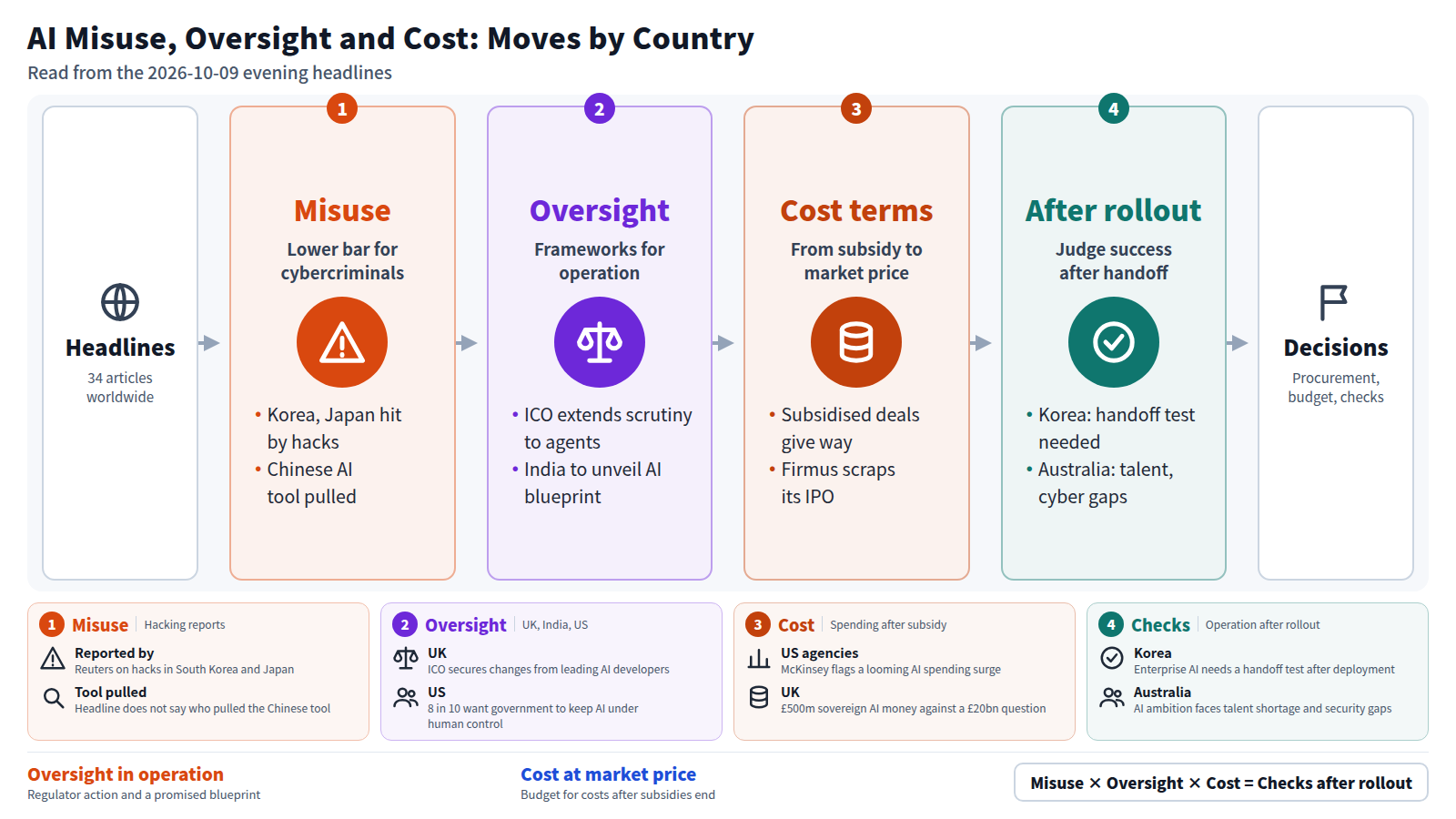
similar movements - The center of gravity is shifting to operational control. In the UK, the ICO asked AI developers to make changes, expanded the scope to agents, and the government accepted recommendations for medical AI. India has announced proposed regulations, and in the US, 80% of public opinion calls for human control. However, the means are different. In the UK, existing regulatory authorities are responding individually, in India, a new framework has been announced, and in the US, discussions and public opinion are at the state level. - The misuse of AI has begun to be talked about as a real cause. There are reports of hacking in South Korea and Japan, withdrawal of Chinese tools, and pointing out security deficiencies in Australia. There is a recognition in several countries that the barriers to entry are lowering not only for AI users but also for attackers. - Funding conditions are changing. In the US, it has been pointed out that subsidized contracts for government agencies will be transferred to market prices, in the UK, the scale of public funding has been raised as an issue, and in Australia, Firmus has withdrawn its IPO. HubSpot's staff cuts can also be read as a sign of the company's commitment to paying for its AI transformation. - Selection of locations is progressing. The UAE has been promised $5 billion to relocate British companies' headquarters, while Colombia and Mexico are also being touted as hubs and industrial transformation sites. - The field of introduction is expanding to the practical field. It is being introduced in agriculture, medicine, transportation, education, news reporting, and defense.
different movement - Chinese stacks are talking about expanding into the low-cost market, and in Europe and the US there is talk of a move to increase control over companies through open weight. The decision axis for procurement is divided into price and management rights. - Unlike other countries' efforts to monitor classroom speech, a US charity organization plans to use AI as a means of control and monitoring. The rights aspect is subject to ethical division. - In Australia, AI rights holders (music industry) have issued a warning, and companies such as Spotify, which is said to have originated in Sweden, are expanding AI reading. Interests regarding content are not aligned even within Japan.
Points that will change the decisions of Japanese companies and governments (judgments based on headlines, not predictions) - Japan, along with South Korea, has been mentioned in hacking reports. When procuring AI tools, in addition to the provider, it is necessary to check the mechanism to prevent misuse and the response to take down. - US government agencies have pointed out the shift from subsidized prices to market prices. Even in Japan's introduction plan, the budget needs to take into account costs after subsidies and initial preferential treatment end. - UK ICO expands surveillance of AI agents. Japanese companies handling UK data will have grounds to check agent authority design and record maintenance. - ``Post-implementation handover testing'' is being discussed in South Korea. The perspective of measuring the success or failure of an introduction after the transition to operation, rather than at the time of introduction, can also be applied to Japanese government.
Future points of interest
Will India's AI regulatory blueprint be published within the 30 days stated by the minister in charge? How does the content differ from the individual response type in the UK? 2. Follow-up reports on AI-related hacking in South Korea and Japan, and responses to Chinese tools that were withdrawn. 3. How will the shift from subsidies to market prices for AI be reflected in U.S. government spending and funding like Firmus?
- A US charity plans to use AI to monitor its Gaza classrooms for 'hateful' speech — Audacy10/09 05:06 UTC
- US midterms: Scenarios, and what they can mean for AI and bond yields — Saxo10/09 05:51 UTC
- Kristen Gonzalez and the fight to regulate AI — City & State New York10/08 20:47 UTC
- Synopsys looks to work with Chinese AI labs to speed up chip design — Nikkei Asia10/08 18:13 UTC
- Western open-weight campaign could give enterprises more control over AI — TechTarget10/08 20:17 UTC
- 64% of Americans say AI is developing too fast—and 8 in 10 want the government to keep it under human control — Fortune10/08 13:38 UTC
- If Chinese AI goes rogue, expect opacity — The Strategist | ASPI's analysis and commentary site10/09 03:46 UTC
- China's AI Stack May Support Expansion Into Cost-Sensitive Markets — MarketForces Africa10/08 18:37 UTC
- AI ecosystems in the Netherlands and the UK: Agrifood & agritech — RAND.org10/08 14:14 UTC
- Britain's sovereign AI money is a £500m answer to a £20bn question — Resultsense10/09 08:31 UTC
- Spotify Audiobooks Go to 180 Markets, With AI Narration — Voice Over Herald10/09 00:00 UTC
- ICO secures changes from leading AI developers as scrutiny extends to AI agents — Wired Gov10/09 08:27 UTC
- HubSpot cuts 600 jobs as Indian American CEO accelerates AI pivot — The American Bazaar10/08 18:00 UTC
- India's semiconductor push, agentic AI set to reshape telecom and connected devices — ET CIO10/09 06:30 UTC
- McKinsey flags looming AI spending surge for US agencies as subsidised deals give way to market pricing — https://www.indiagazette.com/10/09 02:04 UTC
- India to Unveil AI Regulation Blueprint Within 30 Days, Minister Says — BigGo Finance10/08 18:28 UTC
- OpenAI, Anthropic Face Copyright Backlash as Australian Music Industry Warns of AI Exploitation — Law Commentary10/08 23:44 UTC
- Nvidia-backed Firmus scraps $5 billion Australia IPO amid growing AI scrutiny — Reuters10/08 22:12 UTC
- Australia’s AI ambition faces talent shortage and cybersecurity gaps — SC Media10/08 16:30 UTC
- Vietnam: International Cooperation Key to AI-Ready Education — OpenGov Asia10/09 01:53 UTC
- Nvidia-Backed Firmus Pulls IPO Amid Market Volatility — The Tech Buzz10/09 01:35 UTC
- South Korea, Japan buffeted by hacks as AI lowers bar for cybercriminals — Reuters10/09 04:24 UTC
- AI, Autonomous Systems and Counter-Drone Technologies Move Up Korea’s Defense Agenda — Asian Military Review10/09 04:38 UTC
- Battery ETFs surge as AI data centers fuel ESS optimism — Korea JoongAng Daily10/09 04:37 UTC
- Enterprise AI in Korea Needs a Handoff Test After Deployment — KoreaTechDesk10/08 21:26 UTC
- Subsea cables and oil pipelines: The infrastructure linking AI, empire, and occupation — Global Voices10/09 06:17 UTC
- Abu Dhabi's new AI vehicle can spot accidents, fallen trees and faulty traffic lights — Gulf News10/09 06:27 UTC
- India, UAE ink major pacts on energy, defence, AI; Abu Dhabi commits $5 billion investment — DD News10/08 19:41 UTC
- UK AI Firm Nextgen Moves Global Headquarters to the UAE — PCMag Middle East10/08 11:46 UTC
- Mexico Bets on AI as the Key for Industrial Transformation — Mexico Business News10/08 15:31 UTC
- ARC Announces Global Strategy Upgrade: Leveraging Colombia as a Strategic Hub to Accelerate Expansion in Latin America’s Artificial Intelligence Market — FinancialContent10/08 17:48 UTC
- Big Brother is programming ... US Government’s AI chatbot 'tweaked' after disputing Donald Trump’s claims — IOL10/09 06:51 UTC
- Brazil: AI-based imaging offers new way to measure sugarcane borer damage — ChiniMandi10/09 03:00 UTC
- US Consulate Backs Nigerian-led Fisclosure Standards For AI In Journalism — TVC News10/09 00:33 UTC