AI and Cancer Research ── Lung ── 2026-10-10
Lung cancer: treatment, trials and AI
- Abstract
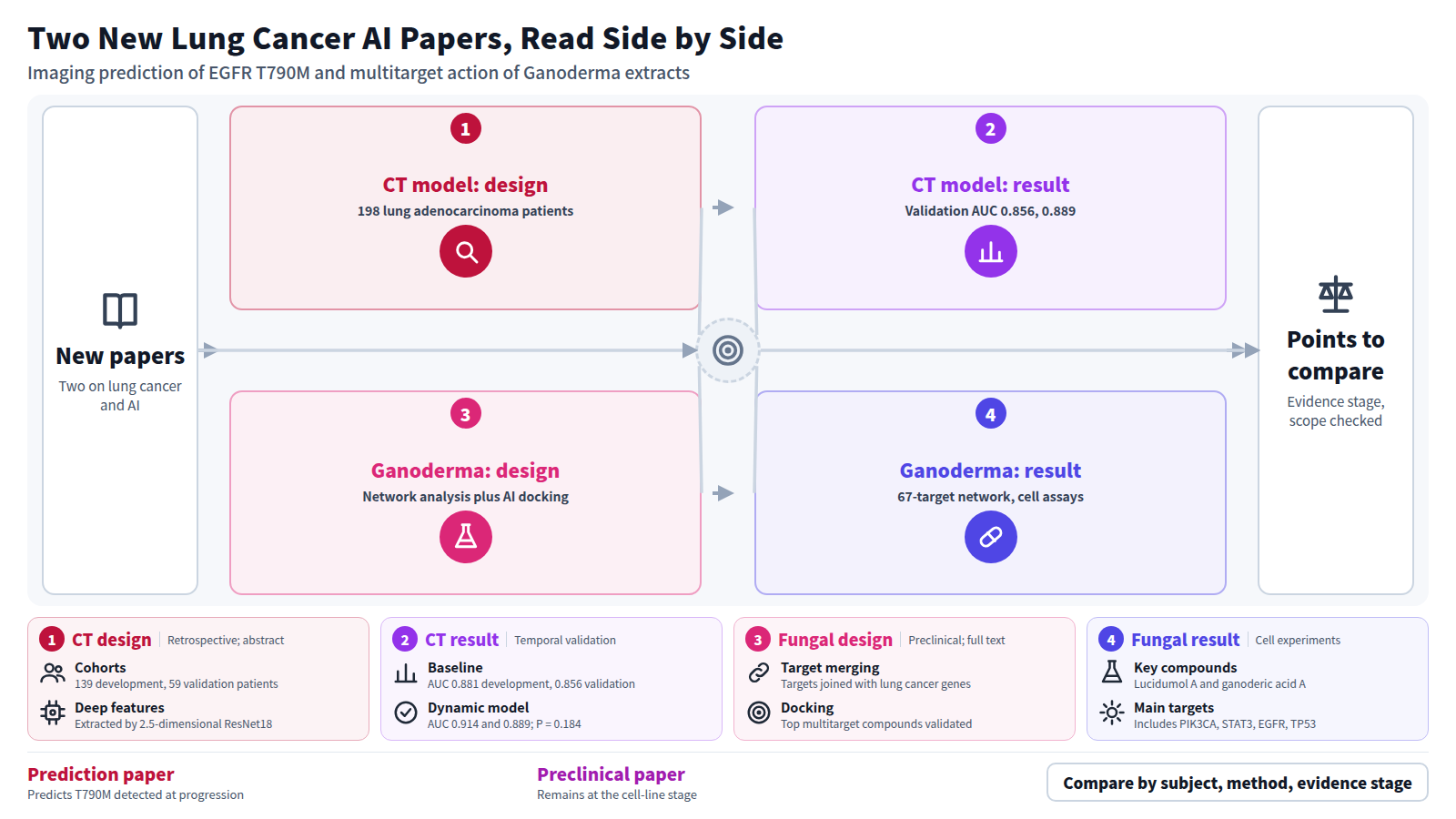
Background. Detecting acquired epidermal growth factor receptor (EGFR) T790M after resistance to first- or second-generation EGFR tyrosine kinase inhibitors (EGFR-TKIs) can guide subsequent treatment. We developed and temporally validated a multimodal computed tomography (CT) model to predict T790M detected at progression. Methods. This retrospective study included 198 patients with lung adenocarcinoma treated with first- or second-generation EGFR-TKIs. Patients were allocated chronologically to a development cohort (n = 139) and a temporal validation cohort (n = 59). Clinical variables, CT semantic features, handcrafted radiomics, and deep features extracted with a 2.5-dimensional ResNet18 network were combined using elastic-net logistic regression. A dynamic model also included early treatment response and delta-radiomic features. Results. The baseline multimodal model achieved areas under the receiver operating characteristic curve (AUCs) of 0.881 and 0.856 in the development and validation cohorts, respectively. The corresponding AUCs for the dynamic model were 0.914 and 0.889. In temporal validation, the dynamic model had a sensitivity of 0.867 and a specificity of 0.862. Its AUC was numerically higher than that of the baseline model, but the difference was not statistically significant (P = 0.184). Higher predicted T790M probability was associated with EGFR exon 19 deletion, greater early tumor shrinkage, and longer progression-free survival. Conclusions. Combining clinical and CT-derived features showed promise for predicting T790M detected at progression after first- or second-generation EGFR-TKI therapy. Early response and delta-radiomics provided a numerical improvement in discrimination. Prospective multicenter validation is needed before this approach can inform molecular retesting in clinical practice.
Journal IF: unknown (could not be matched)Reference: [No authors listed]. Noninvasive prediction of acquired EGFR T790M in lung adenocarcinoma using multimodal CT radiogenomics. Zenodo (CERN European Organization for Nuclear Research). [Epub ahead of print]. doi:10.5281/zenodo.23249913.Checked: Abstract only - Abstract
The medicinal fungus Ganoderma lucidum is rich in bioactive triterpenoids and polysaccharides. The complexity and adaptive resistance of lung cancer necessitate therapeutic strategies that simultaneously disrupt multiple oncogenic pathways. We employed a systems pharmacology approach that integrates network analysis and artificial intelligence to elucidate the multitarget anticancer mechanisms of G. lucidum compounds. Bioactive metabolites were screened, and their targets were integrated with lung cancer-associated genes to construct a compound-target-pathway network. AI-based molecular docking validated key interactions. The top-predicted multitarget compounds were functionally validated in H1299 nonsmall cell lung cancer cells using viability, migration, and Western blot assays. A network of 67 synergistic targets, including PIK3CA, STAT3, EGFR, and TP53, concurrently modulates proliferation, apoptosis, and immune evasion pathways. Triterpenoids, such as lucidumol A and ganoderic acid A, act as key drivers capable of binding multiple signaling hubs. These metabolites and a standardized G. lucidum extract synergistically disrupt oncogenic signaling by inhibiting cell proliferation (extract IC 5 0 = 1669 μg/mL), suppressing migration, and reducing STAT3 phosphorylation and c-Myc expression. These fungal metabolites exhibit potent multitarget tumor-suppressive properties.
Journal IF-equivalent: 5.5 (OpenAlex 2-year mean citedness, value as of 2026-10-09, retrieved 2026-10-10; not the official Clarivate IF)Reference: Wang H, Chen L, Zhang S, Ju M, Feng J, Tang Z, et al. AI-assisted systems pharmacology with experimental validation reveal multi-target anticancer mechanisms of Ganoderma lucidum extracts against lung cancer. Mycology. 2026 Mar 6;17(3):773-93. doi:10.1080/21501203.2026.2634522; PMCID: PMC13647369.Checked: Full text checked