AI & Healthcare News — 2026-10-09 (Fri) Evening News

Source links point to the original outlet. The AI Integrated Analysis is auto-generated from the headlines below only and is not intended to add facts beyond them. Not investment advice.
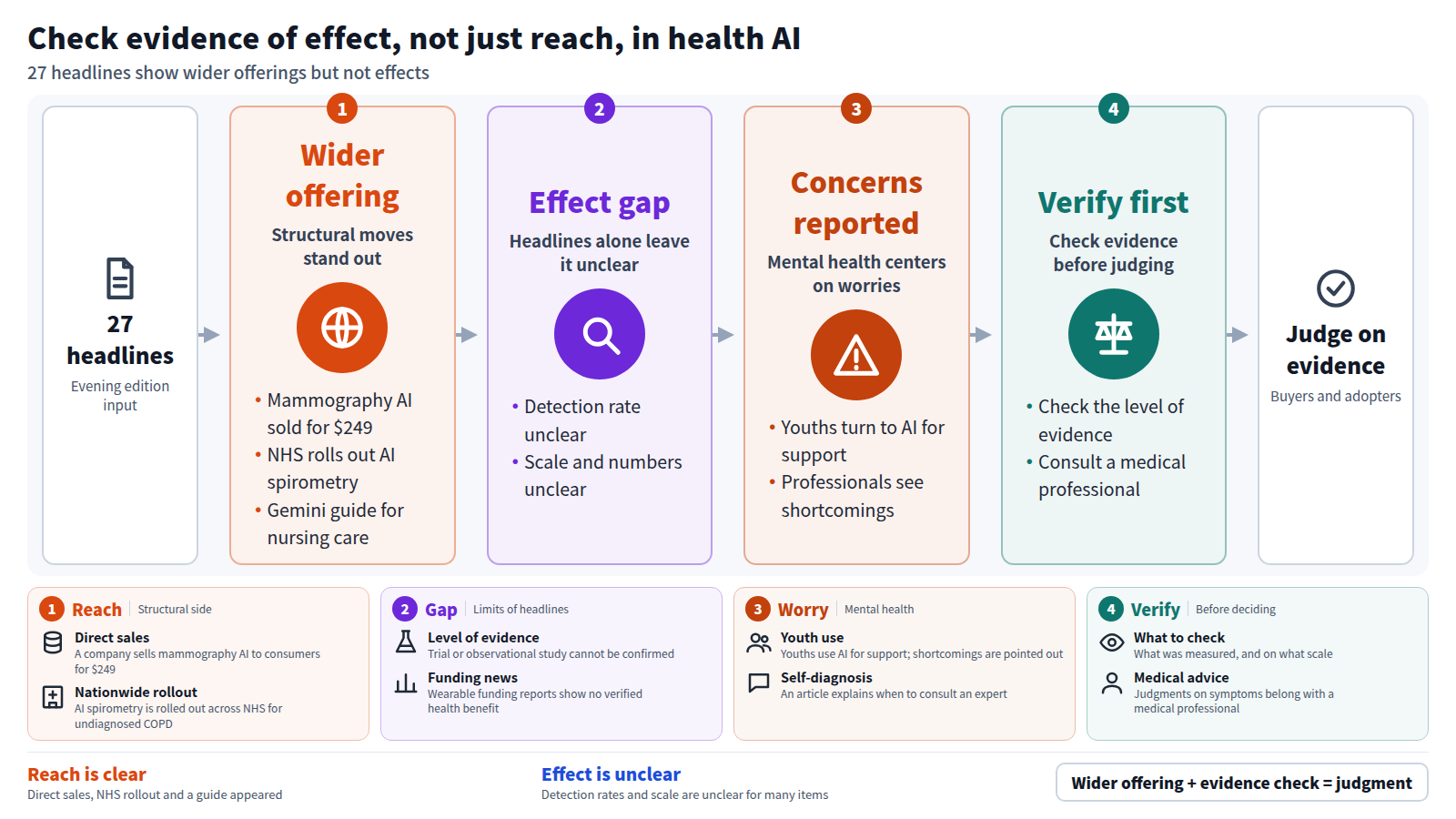
Overview
- The most noticeable movements were in the structural side (direct sales to consumers, introduction in the NHS, guide for use in nursing care), while in the area of mental health, reports centered on concerns surrounding the use of AI by young people. - In physical health, there was funding and research reports for wearables. All of these are just headlines, and the quantitative effects cannot be read from the headlines.
Mental health
- Young people are increasingly using AI to support their mental health, and professionals who work with young people are pointing out the shortcomings (The Daily Reporter). - An article discusses the benefits and risks of using AI in teens (Idaho State Journal). - There is an article explaining when to consult an expert regarding self-diagnosis using AI (The South First). - There is an article asking whether AI can improve employee well-being (Human Resources Director). - The above are all explanatory/commentary headlines, and it is unclear from the headlines what was measured and on what scale. - "Bay Area biotech researchers using AI to advance cell therapy" is research on cell therapy and is not subject to this section.
Exercise/physical activity
- There is a report that a simple wrist-worn AI predicts prolonged sitting for women with chronic pelvic pain (Bioengineer.org). The level of evidence and number of people targeted are unclear from the headline. Funding reports do not indicate any verification of health benefits. - University of Delaware opens an AI lab focused on mobility and rehabilitation care. - MyDefence's drone detection wearable will not be used as it is not related to health.
sleep
- No applicable information
Nutrition/Meals
- There is a headline stating that WHO has mentioned GLP-1 in children (Medical Economics). The link to AI is in a separate item, ``Federal government and major IT companies support AI biology,'' and content indicating the effects of AI on nutrition and diet cannot be confirmed from the headline.
Prevention/Medical checkup
- Health and wellness company begins selling mammography AI directly to consumers for $249 (Radiology Business). Although the provision format has changed, the detection performance is unclear from the headline. - Cancer Research Malaysia has indicated its intention to expand AI-based oral cancer screening to Indonesia and Cambodia (Malaysia-China Insight). Target population and detection rate are unclear from the headline.
Self-management of chronic diseases
- Spirometry (respiratory function test) equipped with AI is being rolled out nationwide in the NHS as a countermeasure for undiagnosed COPD (Distilled Post). The scale and detection rate are unclear from the headline. This is a market forecast and does not indicate clinical efficacy. - Thirona is an AI lung image analysis company introduction (Dealroom).
Elderly people/nursing care
- There is a report on AI home monitoring that tracks the health of elderly people while protecting their privacy (News-Medical). The stage of evidence is unclear from the headline. - There is an article discussing areas where AI can play a role in long-term care (Bioengineer.org). - A team in Barcelona has developed an AI that detects aging in blood stem cells (Yahoo News Australia). Research stage report. - Experts advise countermeasures against AI-based fraud targeting the elderly (WZMQ). - Tsuneishi's article on aging IT systems will not be covered as it has nothing to do with health.
Digital treatment/regulation
- There are no headings regarding regulatory approvals, guidelines, or insurance handling. - Experts say AI can help reduce medical errors (The News Pakistan). - An AI recording app is available for patients with rare diseases (Digital Health). The country name, item name, and scale are unclear from the headline.
Workplace health
- A survey reported that developer burnout is increasing and distrust of the impact of AI on work is increasing (TechRadar). The scale of the investigation is unclear from the headline. - An article (HR Executive) stating that the gap in AI skills is not technical but human. - There are also articles on the mechanism for large-scale introduction of clinical AI (HCI Innovation Group) and ambient AI in rural healthcare (American Hospital Association). All of these are commentary on the system and operation, and the numerical value of the effect is unclear from the headline.
Japanese movements
- The Phage, which develops preventive medicine AI and personalized prevention business, received additional investment in Series A round (PR TIMES). - Started providing training on the use of generative AI for medical and nursing care (Atpress). - Column dealing with "Mental health measures in the AI era" (Japan Human Resources News ONLINE). - Article (ZUU online) that talks about how Excellent Care System utilizes cutting-edge technologies such as AI in care. - Google releases the "Gemini Utilization Guide for Nursing Care" to improve the efficiency of recording work and handing over information (DX Magazine). - Movements of ministries, local governments, and insurers are not in the headlines.
Remarks from VIPs
- No relevant information because the list of important people to be tracked is empty.
AI video/commentary
- No applicable information
Points to note: Only the headings were entered, and the level of evidence (randomized controlled trial, observational study, etc.) and numerical values could not be confirmed for many items. Judgments related to physical condition and symptoms are matters that should be consulted with a medical professional.
- Can AI improve employee wellbeing? — Human Resources Director10/09 02:24 UTC
- ARTIFICIAL INPUT: While youths increasingly turn to AI for mental health support, professionals who work with youth see shortcomings of doing so — The Daily Reporter - Greenfield Indiana10/08 19:30 UTC
- Mental health in the age of self-diagnosis: When to stop AI diagnosis and speak to a professional — The South First10/09 03:23 UTC
- MyDefence Unveils Wearable Drone Detector with AI Spectrum Analysis — Unmanned Systems Technology10/09 05:50 UTC
- Cal AI Co-Founder Zach Yadegari Secures $10M for Persona, an AI Assistant With a Wearable Band — AI Insider10/08 19:34 UTC
- 19-Year-Old Founder Raises $10 Million for Persona AI Wearable — mezha.net10/08 14:57 UTC
- WHO on GLP-1s for kids; long-term opioids and back pain; feds and Big Tech back AI biology — Morning Medical Update — Medical Economics10/08 14:56 UTC
- Cancer Research Malaysia Eyes Expansion of AI-Enabled Oral Cancer Screening Into Indonesia, Cambodia — Malaysia-China Insight10/08 23:02 UTC
- Health and wellness company begins selling mammography AI directly to consumers for $249 — Radiology Business10/09 06:45 UTC
- AI-Driven Spirometry Rolled Out Across NHS to Tackle Undiagnosed COPD — Distilled Post10/09 08:12 UTC
- Blood Glucose Monitoring Systems Market - Size, Share, Trends, Competitive Landscape, and Forecast - 2034 | Wearable CGM and AI Drive 7.72% CAGR to $25.50 Billion — Supply Chain Digital10/09 00:57 UTC
- Thirona: from academic spin-off to global leader in AI lung imaging — Dealroom10/08 16:10 UTC
- Where AI Can Truly Fix Long-Term Care: Looking Beyond the Algorithm — Bioengineer.org10/09 04:13 UTC
- Barcelona team develops AI that detects ageing in blood stem cells — Yahoo News Australia10/09 04:01 UTC
- AI-Driven Scams are Targeting Seniors; Experts Share Tips on Staying Protected — WZMQ 19 News10/08 21:31 UTC
- Two engineers and AI tackle Tsuneishi’s ageing IT systems — Splash 24/710/09 06:02 UTC
- Digital health: AI can help reduce medical errors, say experts — The News Pakistan10/08 19:00 UTC
- AI-scribing app offered to patients with rare diseases — Home | Digital Health10/08 06:33 UTC
- New study shows concerning rise in developer burnout — and growing distrust in how AI may affect their jobs — TechRadar10/08 18:45 UTC
- The Mechanics of Clinical AI Adoption at Scale — HCI Innovation Group10/07 17:00 UTC
- The new AI skills gap isn't technical. It's human — HR Executive10/07 16:41 UTC
- Advancing Rural Health Through Ambient AI — American Hospital Association10/08 14:32 UTC
- Additional Investment in Series A Round of The Phage, Developer of Preventive Healthcare AI — Japanese media10/09 05:53 UTC
- Start of provision of [generated AI utilization training] for medical and nursing care Practical support tailored to issues, from operational efficiency to human resource development — Japanese media10/09 00:30 UTC
- [Human Touch Letter vol.138] Mental health measures in the AI era — Japanese media10/09 02:01 UTC
- Excellent Care System, which operates nursing care facilities nationwide. How can cutting-edge technologies such as AI be used in care? — ZUU online10/09 05:00 UTC
- Use AI to streamline recording work and reporting at nursing care sites! Google releases “Gemini usage guide for nursing care” — Japanese media10/09 08:32 UTC