AI & Healthcare News — 2026-10-10 (Sat) Daily News

Source links point to the original outlet. The AI Integrated Analysis is auto-generated from the headlines below only and is not intended to add facts beyond them. Not investment advice.
Overview
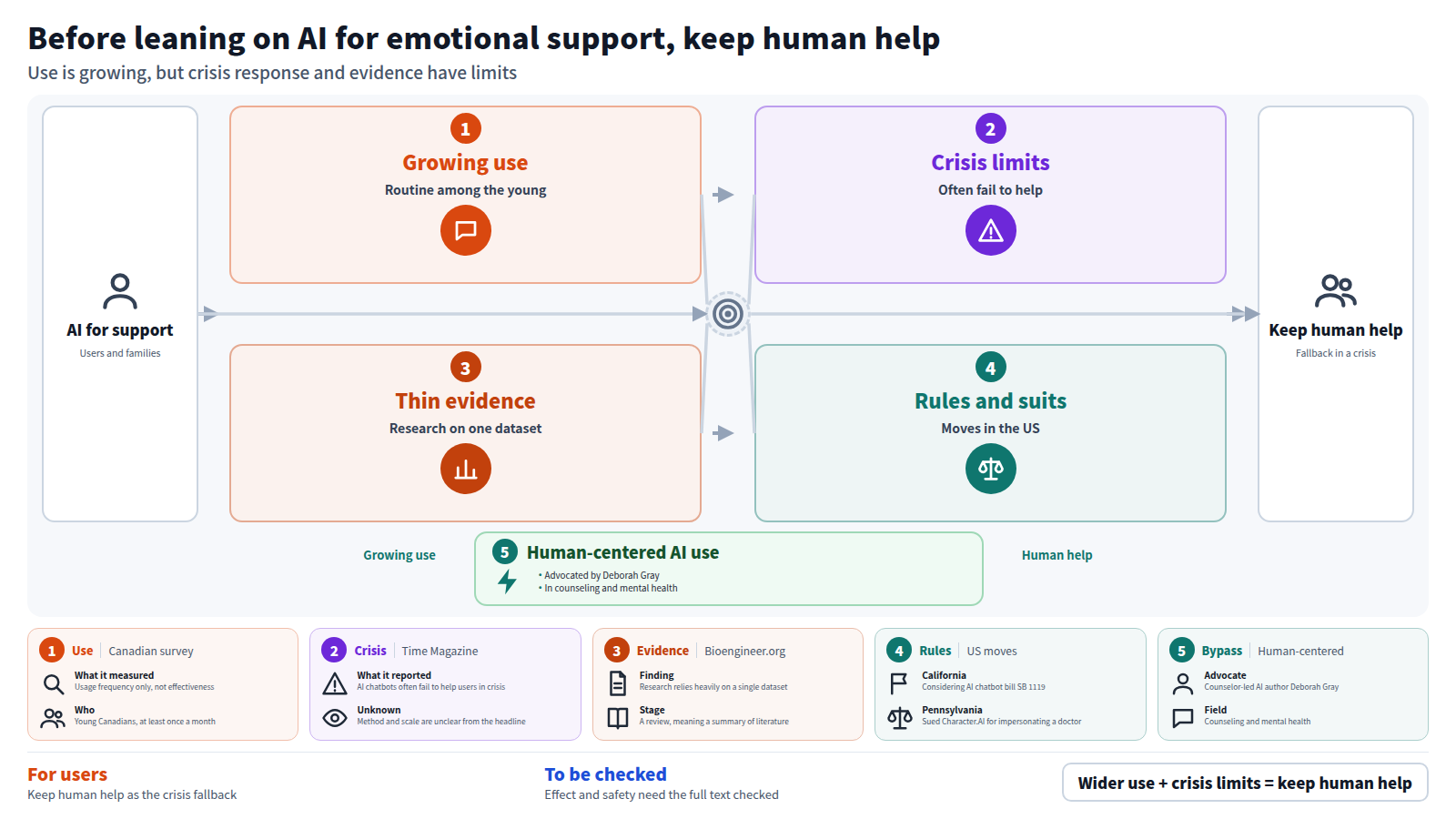
The mental health section saw the most movement, with reports on chatbot shortfalls in crises, youth usage and a review of the evidence base. In physical health, sleep and cardiac-monitoring items appeared, mostly as research or product announcements. On the structural side, regulation and publishing standards moved, including a state lawsuit, a California chatbot bill and a journal policy.
Mental health
- AI chatbots often fail to help users in a mental-health crisis (Time Magazine). The headline does not state the study design or sample. - A report found that 1 in 3 young Canadians use AI once a month for mental health (Global News). The headline gives usage frequency, not outcomes. - A review found that multimodal AI in mental health care leans heavily on a single dataset (Bioengineer.org). This is a literature-level finding about evidence concentration. - Statista posed the question of how users who seek mental support from AI can be protected (Statista). - Deborah Gray advocates human-centered AI in counseling and mental health (EIN News).
Exercise and physical activity
- A Nature paper covers expanding the functional scope of AI-driven rehabilitation exergames through multimodal biofeedback and adaptive safety monitoring (Nature). The headline does not state the evidence stage or participant numbers. - Meta donated 1,000 AI glasses for accessibility in Singapore (WeRSM). - Indian firms showcased AI wearables for India-specific needs at IMC 2026 (Business Standard). - "FG Adopts AI, 3D Printing to Modernise Prosthetics Production" (Pointblank News).
Sleep
- An AI-powered forehead patch tracks brain signals to help boost deep sleep (Medical Xpress). The headline does not state whether this is a trial or what improvement was measured. - An AI model predicts heart risks from sleep study ECGs (Mirage News). The population and validation stage are not stated. - WSJ ran a piece titled "The AI Change That Let Pfizer's Albert Bourla Sleep Better" (WSJ). The headline does not show whether this is a clinical or personal-experience account.
Nutrition and diet
No notable developments.
Prevention and screening
- AI fuses scans and radiation doses to predict a deadly head and neck cancer complication (Bioengineer.org). The target population is patients with head and neck cancer; the headline does not state detection rates or the evidence stage. 【Chronic disease self-management】 - 6 in 10 Americans worry about high blood pressure (Medical Economics, morning roundup). - AI-powered remote cardiac monitoring is reshaping heart care globally (SNS Insider). The headline gives no outcome data.
Older adults and caregiving
- NewDays brought its AI-driven dementia care platform to Nevada and expanded its seed round to $16M (Healthcare IT Today). - Meta published a page on AI glasses for seniors (www.meta.com). This is company promotional content. - Machine learning reveals how muscle power predicts frailty and falls in aging (Bioengineer.org). The cohort and study design are not stated. 【Digital therapeutics and regulation】 - Pennsylvania sues Character.AI for impersonating a doctor (Medical Economics). - JDSupra examined California's new AI chatbot bill SB 1119 (JDSupra). The headline does not describe its contents. - JAMA took action to combat "AI slop" submissions (American Medical Association). - No regulatory approvals or insurance coverage decisions for specific products appeared in the headlines.
Workplace health
No notable developments.
Developments in Japan
- M Co., Ltd. began full-scale service of MVision body, which uses AI to analyze existing CT images and visualize fat mass, muscle mass and muscle quality (PR TIMES). - Kawagoe City in Saitama Prefecture began a trial introduction of AI Sakura-san for its citizens' division and national health insurance division (AI Sakura-san).
Statements by key figures
No notable developments.
AI video and explainers
No notable developments.
- AI Chatbots Often Fail To Help Users In Mental-Health Crisis — Time Magazine10/09 11:00 UTC
- How Can Users Who Seek Mental Support From AI Be Protected? — Statista10/09 15:18 UTC
- Multimodal AI in Mental Health Care Leans Heavily on a Single Dataset, Review Finds — Bioengineer.org10/09 15:43 UTC
- 1 in 3 young Canadians use AI once a month for mental health, report shows — Global News10/09 17:50 UTC
- Counselor-Led AI Author Deborah Gray advocates for Human-Centered AI in Counseling and Mental Health — EIN News10/09 11:05 UTC
- Expanding the functional scope of AI-driven rehabilitation exergames: multimodal biofeedback and adaptive safety monitoring — Nature10/09 09:47 UTC
- Meta Donates 1,000 AI Glasses for Accessibility in Singapore — WeRSM10/09 12:41 UTC
- IMC 2026: Indian firms showcase AI wearables for India-specific needs — Business Standard10/09 11:50 UTC
- FG Adopts AI, 3D Printing to Modernise Prosthetics Production — Pointblank News10/09 09:02 UTC
- Sticking it to insomnia: AI-powered forehead patch tracks brain signals to help boost deep sleep — Medical Xpress10/09 13:40 UTC
- The AI Change That Let Pfizer's Albert Bourla Sleep Better — WSJ10/09 09:59 UTC
- AI Model Predicts Heart Risks From Sleep Study ECGs — Mirage News10/09 14:26 UTC
- Crypto Going Bunker Mode, AI Mathpocalypse, Starbucks Explores Chipotle Takeover | Diet TBPN — YouTube10/09 00:55 UTC
- AI Fuses Scans and Radiation Doses to Predict a Deadly Head and Neck Cancer Complication — Bioengineer.org10/09 11:48 UTC
- 6 in 10 Americans worry about high blood pressure; Pennsylvania sues Character.AI for impersonating a doctor; Ohio physician famous for vaccine magnetism claim ordered to pay $699,000 in back taxes – Morning Medical Update — Medical Economics10/09 07:46 UTC
- How AI-Powered Remote Cardiac Monitoring Is Reshaping Heart Care Globally — SNS Insider10/09 11:30 UTC
- NewDays Brings Its AI-Driven Dementia Care Platform to Nevada, Expands Seed Round to $16M — Healthcare IT Today10/09 16:52 UTC
- Gloo AI Hackathon Winners Announced, Showing What Applied AI Can Do for Human Flourishing — Financial Times10/09 12:00 UTC
- AI glasses for seniors: Support that moves with you — www.meta.com10/09 00:16 UTC
- Exclusive: Anthropic's new plan to protect critical infrastructure — Axios10/09 11:42 UTC
- Machine Learning Reveals How Muscle Power Predicts Frailty and Falls in Aging — Bioengineer.org10/08 20:33 UTC
- JAMA takes action to combat “AI slop” submissions — American Medical Association | AMA10/09 14:27 UTC
- Examining California’s New AI Chatbot Bill SB 1119 — JDSupra10/09 16:19 UTC
- Company M begins full-scale service of MVision body, which uses AI to analyze existing CT images — PR TIMES10/09 07:50 UTC
- Clinical AI firm Healthleap, which finds overlooked diseases, raises $38 million from Sequoia Capital and others — Japanese media10/09 08:05 UTC
- [Kawagoe City, Saitama Prefecture] AI Sakura-san is introduced on a trial basis to solve problems in the Citizens Division and National Health Insurance Division — Japanese media10/09 08:07 UTC