AI & Healthcare News — 2026-10-13 (Tue) Evening News
Source links point to the original outlet. The AI Integrated Analysis is auto-generated from the headlines below only and is not intended to add facts beyond them. Not investment advice.
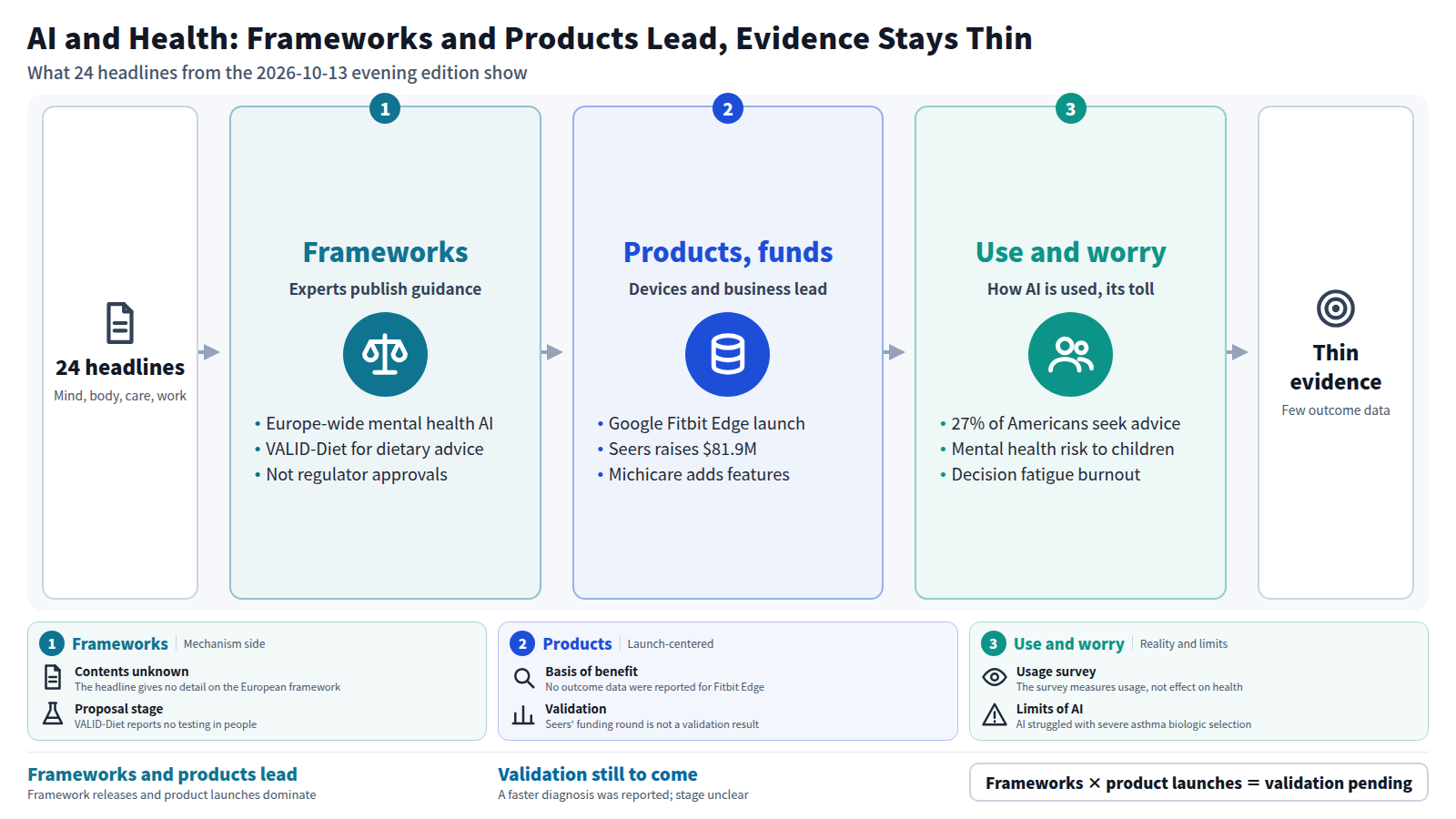
Overview
Developments this period were concentrated on the mechanism side: a Europe-wide framework for AI in mental health (News-Medical) and a risk-proportionate framework for AI-generated dietary advice (Frontiers). On the body side, wearables and consumer devices dominated, with few outcome data in the headlines. Concerns about AI chatbots and children (WLNS 6 News) and about AI-related burnout (Human Resources Director) also appeared.
Mental health
- Experts launched a Europe-wide framework to guide AI use in mental health (News-Medical). The headline gives no detail on its contents or on testing. - Forbes reported that AI personas acting as therapists and as clients shed new light on improving AI-powered mental health guidance (Forbes). The headline suggests simulation-based work, not trials with patients. - A local news segment said AI chatbots pose a mental health risk to children (WLNS 6 News). - In a survey, 27% of Americans use AI for personal advice, 20% for stress relief and 19% for mental health information (Digital Information World). This measures usage, not effect on health.
Exercise and physical activity
- Enlyte's Kim Radcliffe discussed turning unstructured physical therapy notes into predictive risk scores (Risk & Insurance). The headline gives no validation data. - Seers raised $81.9M to push wearable AI diagnostics into the US and Middle East (Dealroom). - Google's Fitbit Edge tracker was described as offering improved GPS, AI health features and a 7-day battery life (TodoMountainBike), and as offering AI-powered workout plans (WION). No outcome data were reported. - Other items were consumer or business products: budget AI smart glasses (The Gadgeteer) and an AI receptionist for fitness, Pilates and yoga studios (StreetInsider).
Sleep
- Bodyfriend debuted an AI heat-therapy and sleep-care lineup (Chosunbiz), and Kiturami launched an AI carbon mat on home shopping channels (Herald Business). - The headlines do not show any measured improvement in sleep, so the evidence stage is unknown.
Nutrition and diet
- A paper in Frontiers proposed a risk-proportionate "VALID-Diet" framework to move AI-generated dietary advice from plausible menus to trustworthy nutrition (Frontiers). It is a proposed framework; the headline reports no testing in people.
Prevention and screening
- A market report covered AI in breast imaging for 2026-2033 (Grand View Research). It is a market-size report and gives no detection rates or target population. 【Chronic disease self-management】 - AI struggled with severe asthma biologic selection (EMJ). The headline does not give the study design or figures. - A Medscape headline asked whether AI adherence in breast cancer harms cardio health (Medscape). It is posed as a question, so no finding can be stated. - AI was reported to cut diagnosis time for an eye disease from 23 days to 30 seconds (AOL.com). The evidence stage and population are not stated in the headline.
Older adults and caregiving
- The IMF chief said AI productivity can offset labor shortages caused by aging populations in Korea, China and Japan (news.sbs.co.kr, Investing.com, NewsBytes). This is a macroeconomic view of the workforce, not a finding on care outcomes. 【Digital therapeutics and regulation】 - No approvals, guidance or insurance decisions from regulators appeared in the headlines. - Non-regulatory frameworks appeared: the Europe-wide framework on AI in mental health (News-Medical) and the VALID-Diet framework for dietary advice (Frontiers).
Workplace health
- AI is creating a new kind of burnout: decision fatigue (Human Resources Director). - Gen Z burnout is worsening as economic pressure and AI adaptation create a double burden (Digital Today). - No policies or workplace practices were described in these headlines.
Developments in Japan
- Sista Inc. began offering "attendance" and "plan" features on its AI platform for care facilities, Michicare (Mainichi Shimbun, VOIX). - An AI system that integrates maternal and child electronic health records to predict health risks from pregnancy through after birth was reported (The Medical AI Times). The headline does not state its validation. - JD Health showed an "AI + medical testing and drugs" closed loop at an elderly-care expo, including nurse visits in as little as one hour (BigGo Finance). It is a Chinese company, and the event location is not stated. - Aitane and Dstyle Holdings jointly developed "cocopi," a beauty and health AI app (Jiji Press).
Statements by key figures
No notable developments.
AI video/commentary
No notable developments.
- A.I. Meets Physical Therapy: Enlyte's Kim Radcliffe on Turning Unstructured Notes into Predictive Risk Scores — Risk & Insurance10/13 07:09 UTC
- Experts launch Europe-wide framework to guide AI use in mental health — News-Medical10/13 02:39 UTC
- AI Personas As Therapists Versus Clients Shed New Light On Improving AI-Powered Mental Health Guidance — Forbes10/13 05:13 UTC
- Mental Health Monday: AI chatbots pose mental health risk to children — WLNS 6 News10/12 21:50 UTC
- 27% of Americans Use AI for Personal Advice, 20% for Stress Relief, and 19% for Mental Health Information — Digital Information World10/13 06:33 UTC
- Seers raises $81.9M to push wearable AI diagnostics into US, Middle East — Dealroom10/13 07:07 UTC
- 3 Budget AI Smart Glasses That Make Wearable Tech Easier to Try — The Gadgeteer10/13 08:00 UTC
- Google Fitbit Edge: New Fitness Tracker Brings Improved GPS, AI Health Features, and 7-Day Battery Life — TodoMountainBike10/12 17:30 UTC
- StudioGrowth Launches AI Receptionist That Books Classes, Sells Memberships and Manages Member Requests for Fitness, Pilates and Yoga Studios — StreetInsider10/13 09:32 UTC
- Bodyfriend debuts AI heat-therapy and sleep-care lineup for seasonal health — Chosunbiz10/13 00:31 UTC
- Kiturami launches AI carbon mat on home shopping channels — 헤럴드경제10/12 01:49 UTC
- AI In Breast Imaging Market Size & Share Report, 2026-2033 — Grand View Research10/13 06:58 UTC
- AI Struggles With Severe Asthma Biologic Selection — EMJ10/13 07:02 UTC
- Does AI Adherence in Breast Cancer Harm Cardio Health? — Medscape10/12 19:55 UTC
- AI comes into being as capital — Monthly Review10/12 20:19 UTC
- AI cuts diagnosis for eye disease from 23 days to just 30 seconds — AOL.com10/12 22:30 UTC
- AI is creating a new kind of burnout: decision fatigue — Human Resources Director10/12 22:27 UTC
- Gen Z burnout worsens as economic pressure and AI adaptation create double burden — 디지털투데이10/13 05:37 UTC
- Press release: AI platform for care facilities "Michi Care" launches attendance and plan features — Japanese media10/13 05:23 UTC
- Integrating mother and child electronic health records to predict health risks from pregnancy through after birth with AI — The Medical AI Times10/13 02:51 UTC
- China's Jingdong Health unveils closed-loop "AI + medical examination medicine" at geriatric expo; nurses can visit for as little as an hour — Japanese media10/13 07:05 UTC
- Aitane and Dstyle Holdings jointly develop beauty and health AI app "cocopi" — Japanese media10/13 01:16 UTC