AI Ethics News — 2026-10-13 (Tue) Evening News

Source links point to the original outlet. The AI Integrated Analysis is auto-generated from the headlines below only and is not intended to add facts beyond them. Not investment advice.
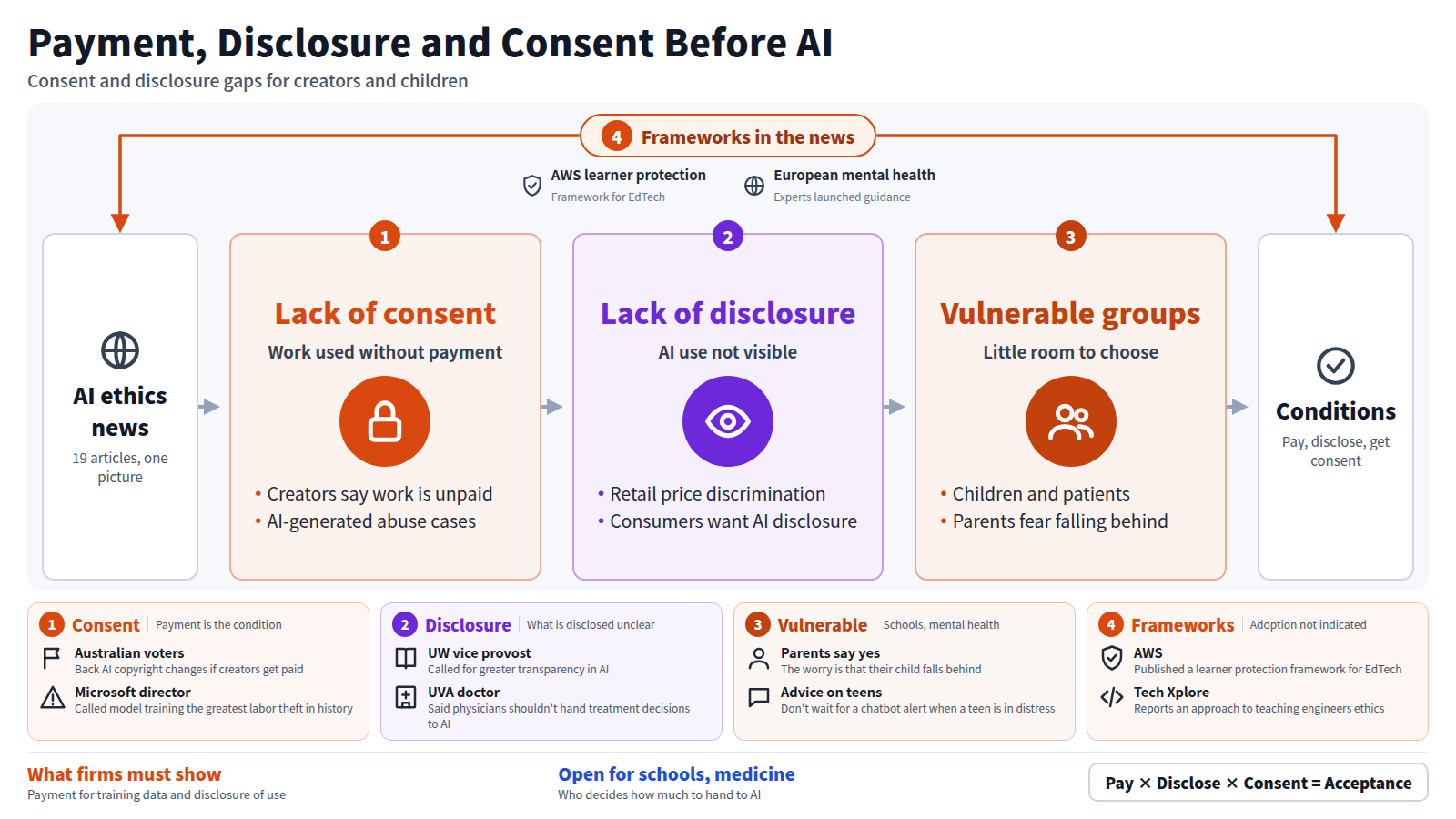
Overview
Disclosure and consent were the main ethical questions in the past 48 hours: AI-driven pricing, AI use in medicine, and the training of AI models on creators' work (Chosun Ilbo, The News Leader, Politico). Protection of children and vulnerable people, including mental health and schools, also featured heavily (News-Medical, Il Sole 24 ORE). Several items concern the spread of AI-generated content in child abuse cases, fake news and fabricated imagery (Star Local Media, LEADERSHIP Newspapers, AAP). 【Bias, discrimination and fairness】 - AI-driven price discrimination has sparked controversy in retail (Chosun Ilbo). The headline does not give who is disadvantaged, how it was measured, or the scale. - A three-year study found that AI ethics skills grow unevenly among students (Bioengineer.org). The headline does not give the sample size or measures. - A piece on digital rights in the age of AI argues that no community should be left behind (The Media Online).
Privacy and surveillance
No notable developments. 【Transparency and accountability】 - The University of Washington's vice provost for AI called for greater transparency in artificial intelligence (The Daily UW). - A University of Virginia doctor said physicians should not hand treatment decisions to AI (The News Leader). - A headline reports that consumers want clear AI disclosure as everyday use expands (Hotel News Resource). - The headlines do not say what is currently disclosed or withheld. 【Creators, copyright and consent】 - Australian voters back AI copyright changes, on the condition that creators get paid (Politico). - A Microsoft Application Science Director called AI model training "the greatest labor theft in human history" (ababnews.com). This is the speaker's own characterization. - The dispute in both items is whether creators are compensated when their work is used to train models.
Disinformation and deepfakes
- Confirmed as reported: a news item states that Muslim worshippers shown on an Australian street were AI creations (AAP). - Claim by a law firm: Potts Law Firm says it stands with families as AI-generated child sexual abuse cases continue to emerge nationwide (Star Local Media). The headline reports the firm's statement, not an independent count. - Countermeasure: INEC has outlined how it will tackle AI-generated fake news in 2027 (LEADERSHIP Newspapers). The headline gives no details of the measures. 【Protection of children and vulnerable people】 - Mental health: experts launched a Europe-wide framework to guide AI use in mental health (News-Medical). A separate piece advises that a teen in distress should not wait for a chatbot alert (Movieguide). - Autism community: a piece argues AI can be used for good (San Antonio Express-News). - Schools: parents are saying yes to AI in schools, with the worry "What if my child falls behind?" (Il Sole 24 ORE). - Child sexual abuse material: AI-generated cases are continuing to emerge, according to a law firm (Star Local Media). 【Ethical principles and guidelines】 - Amazon Web Services published a learner protection framework for responsible AI in EdTech (Amazon Web Services). - Tech Xplore reports an AI framework that offers a new approach to teaching engineers ethical decision-making (Tech Xplore). - Both are frameworks presented by their authors. The headlines do not indicate that any body has formally adopted them.
Japan's AI ethics
- Nikkyoweb, an education news outlet, asks whether handling of education data is sound, discussing literacy in using education data and what generative AI-era EdTech means for school education (Nikkyoweb). - A Japanese-language item on Vietnam.vn covers the debate over the appropriate age for students to start using IT in the context of introducing AI to schools (Vietnam.vn).
Statements by key figures
No notable developments. The tracked figures (Timnit Gebru, Fei-Fei Li, Yoshua Bengio) do not appear in the headlines. 【Integrated analysis: how the ethical questions connect】 - Lack of consent and lack of disclosure recur across sections. Creators say their work is used without payment (Politico, ababnews.com). Consumers want clear disclosure (Hotel News Resource). Calls for transparency come from universities and medicine (The Daily UW, The News Leader). - Education and child protection form a second cluster. Frameworks for learner protection and ethics teaching are appearing alongside parental concern about children falling behind (Amazon Web Services, Tech Xplore, Il Sole 24 ORE). This suggests that schools and EdTech providers may increasingly be asked to show how they protect learners, not only to offer AI tools. This is an inference. - Fabricated content is a related problem. Items on AI-generated child abuse material, election-related fake news and fake street scenes suggest that the burden of verification is falling on affected people and institutions (Star Local Media, LEADERSHIP Newspapers, AAP). This is an inference. - Companies using AI for pricing, medical decisions or training data may face growing demands to disclose the use and, for creators, to pay.
What to watch
Whether creator compensation, which Australian voters support, turns into concrete proposals (Politico). 2. Whether the learner protection and ethics-teaching frameworks are adopted by schools or companies (Amazon Web Services, Tech Xplore). 3. What measures INEC details for tackling AI-generated fake news (LEADERSHIP Newspapers).
- AI-Driven Price Discrimination Sparks Retail Controversy — 조선일보10/13 05:20 UTC
- Three-Year Study Reveals AI Ethics Skills Grow Unevenly in Students — Bioengineer.org10/13 05:24 UTC
- Digital rights in the age of AI: ensuring no community is left behind — The Media Online10/13 05:12 UTC
- UW's vice provost for AI calls for greater transparency in artificial intelligence — www.dailyuw.com10/12 17:30 UTC
- UVA doctor says physicians shouldn't hand treatment decisions to AI — The News Leader | Staunton, VA10/13 08:30 UTC
- Consumers Want Clear AI Disclosure as Everyday Use Expands — Hotel News Resource10/12 17:28 UTC
- Australian voters back AI copyright changes — if creators get paid — Politico10/13 07:20 UTC
- Microsoft Application Science Director Calls AI Model Training the Greatest Labor Theft in Human History — https://www.ababnews.com/10/12 11:56 UTC
- Potts Law Firm Stands With Families as AI-Generated Child Sexual Abuse Cases Continue to Emerge Nationwide — Star Local Media10/12 19:19 UTC
- How We'll Tackle AI-Generated Fake News In 2027 – INEC — LEADERSHIP Newspapers10/13 01:25 UTC
- Muslim worshippers on Aussie street are AI creations — www.aap.com.au10/13 05:02 UTC
- Experts launch Europe-wide framework to guide AI use in mental health — News-Medical10/13 02:39 UTC
- Artificial intelligence can be used for good in autism community — San Antonio Express-News10/13 09:04 UTC
- If Your Teen Is in Distress, Don’t Wait for a Chatbot Alert — Movieguide10/13 05:04 UTC
- ‘What if my child falls behind?’: why parents are saying yes to the use of AI in schools — Il Sole 24 ORE10/13 06:39 UTC
- Building responsible AI in EdTech: A learner protection framework — Amazon Web Services (AWS)10/12 17:57 UTC
- AI framework offers new approach to teaching engineers ethical decision-making — Tech Xplore10/12 21:20 UTC
- Is it okay to handle it that way? Literacy in the use of educational data: The state of school education questioned by EdTech in the era of generative AI — Japanese media10/13 05:05 UTC
- Introducing artificial intelligence (AI) into schools: Debate on the appropriate age for students to start using IT — Vietnam.vn10/13 09:03 UTC