AI and Cancer Research ── Lung ── 2026-10-09
Lung cancer: treatment, trials and AI
- Abstract
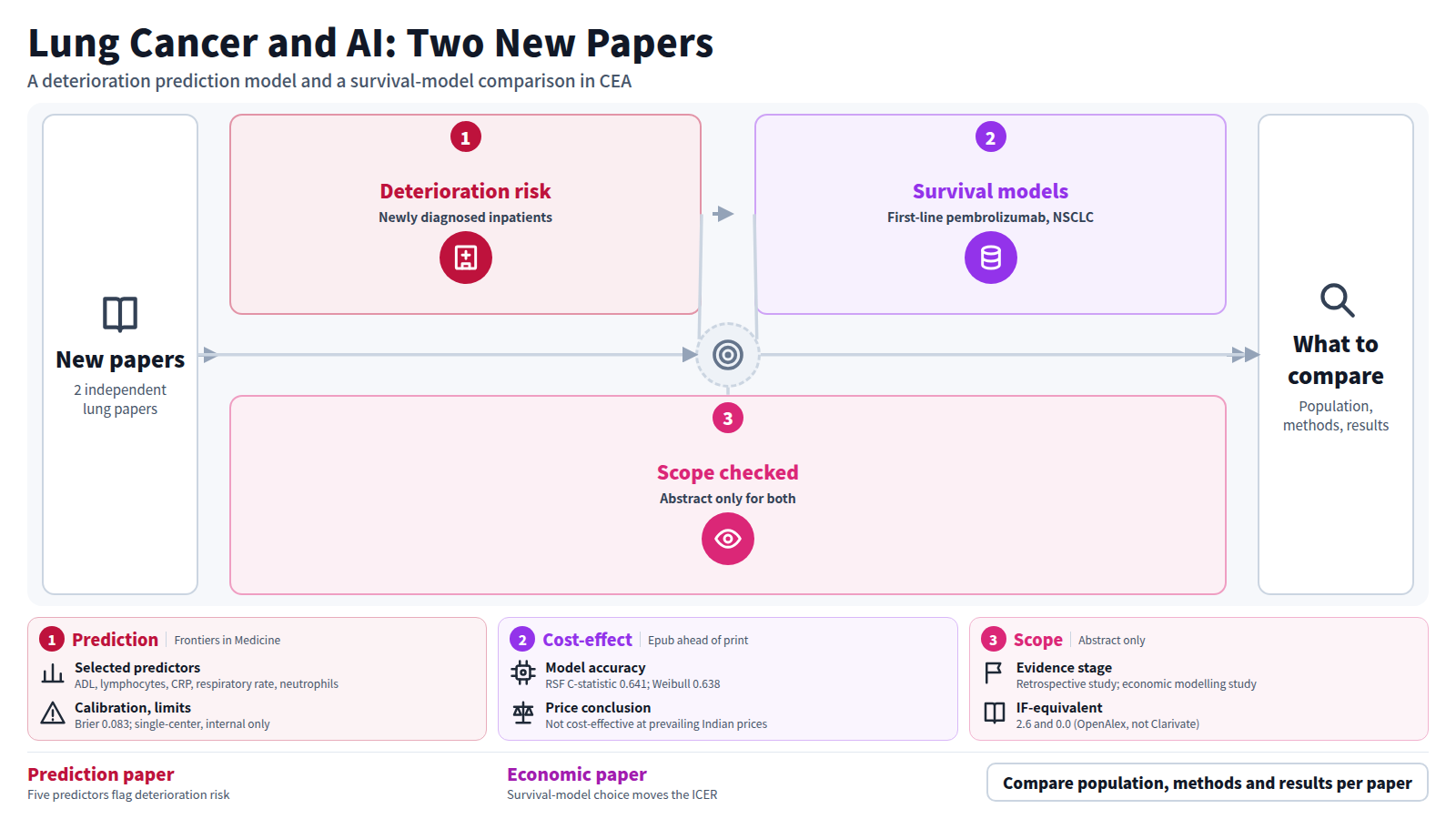
Objective: To develop and validate an interpretable machine learning–based model for the early identification of the risk of clinical deterioration during hospitalization in newly diagnosed lung cancer patients.
Methods: Clinical data of patients with newly diagnosed lung cancer admitted between July 2023 and December 2025 were retrospectively collected in this single-center study. A hybrid feature selection strategy integrating least absolute shrinkage and selection operator (LASSO) regression and the Boruta algorithm was employed to identify key predictors. Logistic regression (LR), random forest (RF), extreme gradient boosting (XGBoost), and support vector machine (SVM) models were constructed. Model performance was evaluated using the area under the receiver operating characteristic curve (AUC-ROC), calibration curves, and decision curve analysis (DCA). SHapley Additive exPlanations (SHAP) values were further applied to interpret the model's decision-making process.
Results: A total of 1,001 newly diagnosed lung cancer patients were included, comprising 121 patients (12.1%) in the deterioration group and 880 patients (87.9%) in the non-deterioration group. Through the hybrid feature selection approach, five core predictive variables were identified, including Activities of Daily Living (ADL) score, lymphocyte count, C-reactive protein (CRP), respiratory rate, and neutrophil count. Among the models, the SVM model achieved the highest observed AUC of 0.822 (95% CI: 0.737–0.899) in the internal validation set, with a sensitivity of 0.750 (95% CI: 0.594–0.893) and a specificity of 0.792 (95% CI: 0.740–0.838). After Platt scaling calibration, the model achieved a Brier score of 0.083 (Hosmer-Lemeshow p = 0.649), with a calibration intercept of 0.141 and a slope of 1.126, indicating satisfactory agreement between predicted and observed risks. DCA suggested a potential net clinical benefit. SHAP analysis, in conjunction with multivariable regression results, consistently demonstrated that ADL score and lymphocyte count were associated with reduced risk of clinical deterioration, whereas CRP and neutrophil count were associated with increased risk.
Conclusion: The SVM model developed in this study may help identify patients at risk of clinical deterioration among hospitalized lung cancer patients and may assist healthcare professionals in achieving early risk identification and potential clinical decision support.
Journal IF-equivalent: 2.6 (OpenAlex 2-year mean citedness, value as of 2026-10-08, retrieved 2026-10-09; not the official Clarivate IF)Reference: Li H, Li Y, Huang X, Zhang Z, Liu Q, Chen Q. Development and internal validation of a predictive model for clinical deterioration in newly diagnosed lung cancer patients based on interpretable machine learning. Front Med. 2026 Oct 7;13:1947529. doi:10.3389/fmed.2026.1947529.Checked: Abstract only - Abstract
Objectives: Survival extrapolation is a consequential choice in oncology cost-effectiveness analysis (CEA), and conventional parametric approaches have known limitations under non-proportional hazards, common with immune checkpoint inhibitors. This study tested whether machine learning (ML) survival models offer a useful alternative to parametric extrapolation using KEYNOTE-189 data, and quantified how survival-model choice affects the incremental cost-effectiveness ratio (ICER) of first-line pembrolizumab plus chemotherapy for advanced non-small cell lung cancer (NSCLC) from an Indian healthcare perspective.
Methods: Individual patient-level data were reconstructed from published Kaplan–Meier curves using the Guyot algorithm. Five parametric distributions and two ML approaches (random survival forest [RSF] and penalised Cox regression with elastic-net regularisation) were fitted and compared on a held-out test set using Harrell’s C-statistic and the integrated Brier score (IBS). A three-state Markov model used survival-derived transition probabilities, Indian drug-acquisition costs, and published EQ-5D utility values to estimate lifetime costs and quality-adjusted life-years (QALYs), with uncertainty assessed via probabilistic sensitivity analysis (PSA), deterministic sensitivity analysis, and expected value of perfect information (EVPI).
Results: The RSF achieved a C-statistic of 0.641 and IBS of 0.1748, comparable to the best-performing parametric models (log-logistic, log-normal) and modestly ahead of the conventionally selected Weibull distribution (C = 0.638). The base-case ICER was ₹1,05,51,767 per QALY with Weibull-derived transitions versus ₹97,96,723 with RSF-derived transitions, a 7.2% reduction. Across 10,000 PSA iterations, the probability of cost-effectiveness at a ₹5,00,000/QALY threshold was near zero under both models; population EVPI was negligible at that threshold but peaked near ₹34,773 crore around ₹1.06 crore/QALY. Drug acquisition cost was the dominant driver of ICER uncertainty, with survival-model choice ranking third among seven parameters examined.
Conclusion: Machine learning survival modelling produced a modest but consistent improvement in predictive accuracy over standard parametric distributions, translating into a non-trivial reduction in the estimated ICER. The reimbursement conclusion that pembrolizumab plus chemotherapy is not cost-effective at prevailing Indian prices was robust to survival-model choice, though the price reduction needed to reach cost-effectiveness varied by approach. Survival-model choice merits explicit consideration as a structural uncertainty in oncology health technology assessment, particularly for therapies with non-proportional hazard patterns.
Journal IF-equivalent: 0.0 (OpenAlex 2-year mean citedness, value as of 2026-10-08, retrieved 2026-10-09; not the official Clarivate IF)Reference: [No authors listed]. Comparative Evaluation of Machine Learning and Parametric Survival Modelling in Cost-Effectiveness Analysis: A Case Study of First-Line Pembrolizumab Plus Chemotherapy for Non-Small Cell Lung Cancer in India. Journal of chemical health risks. [Epub ahead of print]. doi:.Checked: Abstract only