AI and Cancer Research ── Gastric ── 2026-10-08
Gastric cancer: treatment, trials and AI
- Abstract
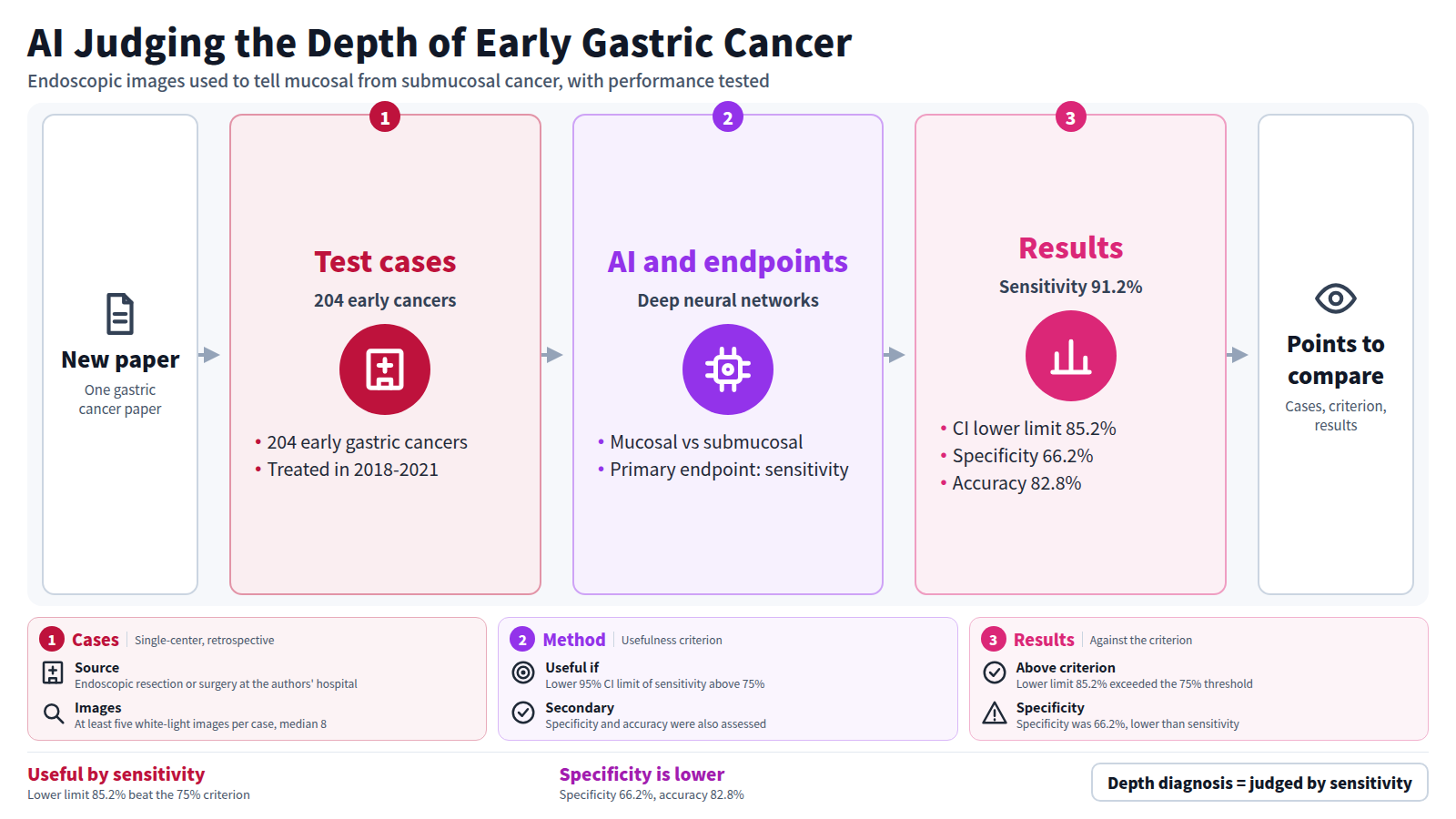
Background and Study Aims The depth of early gastric cancer is an important factor in determining treatment plans, such as endoscopic resection or surgery. We developed an artificial intelligence (AI) program using deep neural networks to diagnose mucosal and submucosal cancers via endoscopic images. Performance evaluation tests were conducted for its clinical applications.
Patients and Methods: A test dataset comprising 204 early gastric cancer cases treated with endoscopic resection or surgery at our hospital between 2018 and 2021 was established. A minimum of five white-light imaging (WLI) images per case were used (median, 8; range, 5-22). The primary endpoint was the sensitivity for diagnosing mucosal cancer. The AI program was defined as useful when the lower limit of the 95% confidence interval (CI) exceeded 75%, based on previous reports on the depth diagnosis of early gastric cancer. Secondary endpoints were specificity and accuracy.
Results: In our study, the sensitivity of this program for the diagnosis of mucosal cancer was 91.2%, and the lower limit of the 95% CI of sensitivity was 85.2%, which was higher than 75%, indicating the usefulness of this program. The specificity and accuracy were 66.2% and 82.8%, respectively.
Conclusions: The AI program developed to diagnose the depth of early gastric cancer is useful and expected to be clinically applicable.
Journal IF-equivalent: 1.6 (OpenAlex 2-year mean citedness, value as of 2026-10-07, retrieved 2026-10-08; not the official Clarivate IF)Reference: Hirata S, Hamada K, Kawahara Y, Aya Y, Nishio A, Yoshikawa T, et al. Performance of an Artificial Intelligence Program for Assessing the Depth of Early Gastric Cancer Using Endoscopic Images. Endosc Int Open. 2026 Sep 17;14(CP). doi:10.1055/a-2957-0692; PMCID: PMC13641218.Checked: Full text checked