AI and Neurological Rare & Neuroimmune Diseases ── Basic research ── 2026-10-09
Neurodegeneration and neuroimmunology research and AI
- Abstract
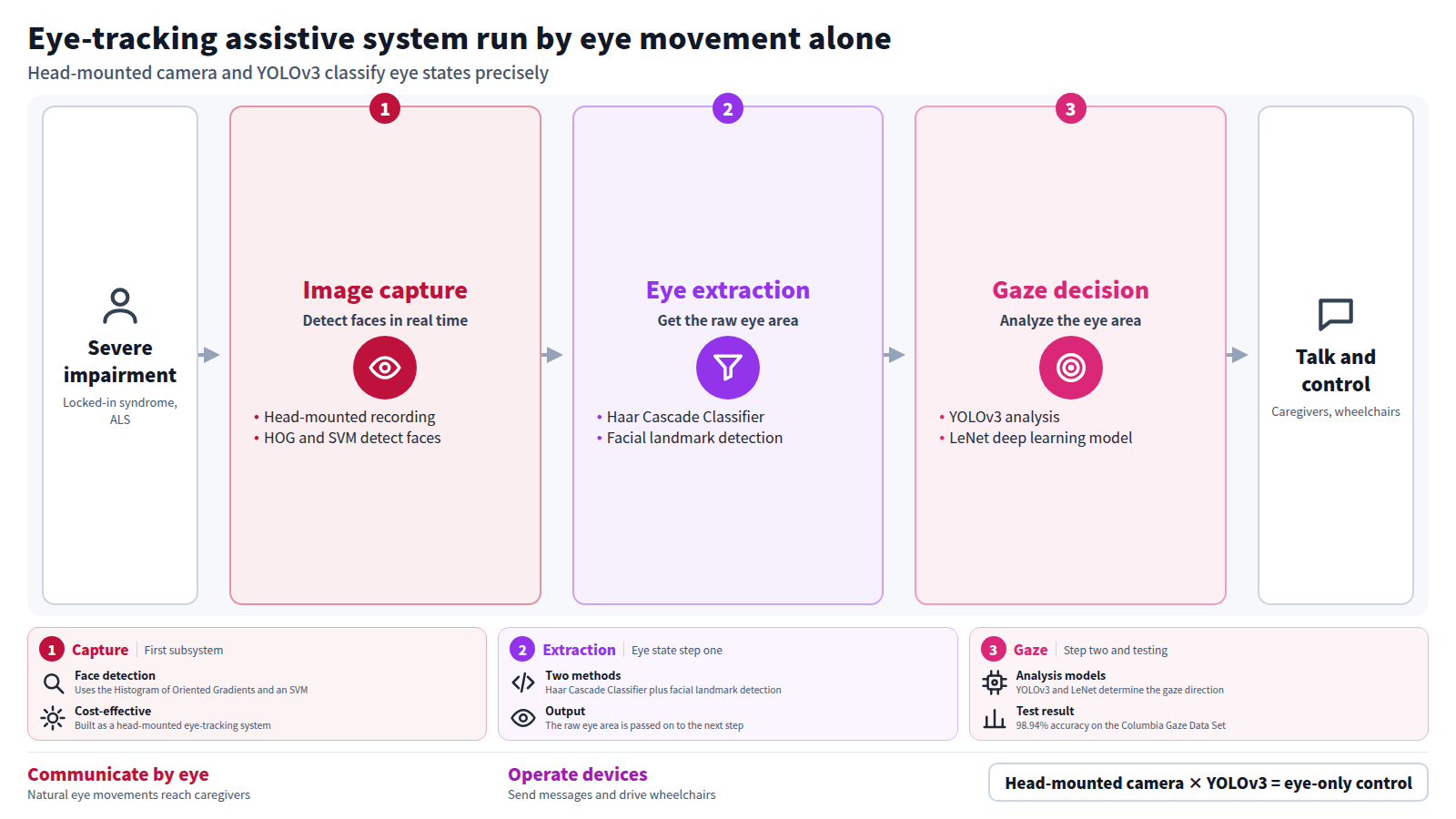
Assistive technologies for individuals with disabilities are crucial in promoting social inclusion and enabling them to participate more fully in daily life. This article focuses on designing and developing a cost-effective head-mounted eye-tracking system aimed at enhancing the quality of life for individuals with severe mobility impairments (locked-in syndrome, amyotrophic lateral sclerosis). This system allows patients to communicate with caregivers, send messages, and operate various devices, including wheelchairs, using only their natural eye movements. The proposed head-mounted smart control system consists of two subsystems: real-time image recording and eye state recognition. The eye state recognition system identifies faces using the Histogram of Oriented Gradients algorithm and Support Vector Machine. In the first step, the raw eye area is extracted using the Haar Cascade Classifier and facial landmark detection algorithms. The extracted eye area is analyzed in the second step to determine gaze direction by employing the YOLOv3 (You Only Look Once, Version 3) algorithm and the LeNet deep learning model. The proposed method was tested using the Columbia Gaze Data Set, part of the Columbia Vision and Graphics Center (CAVE) database maintained by Columbia University’s Computer Vision Laboratory. The results showed an impressive 98.94% accuracy in classifying eye states using the YOLOv3 deep learning model combined with facial landmark detection, demonstrating the system’s high precision. The operational evaluation of the proposed assistive solution yielded promising and encouraging results.
Journal IF-equivalent: 0.9 (OpenAlex 2-year mean citedness, value as of 2026-10-08, retrieved 2026-10-09; not the official Clarivate IF)Reference: Deif MA, Attar H, Elhoseny M, Alomoush W, Alsaqoor S, Chodakowska E, et al. Artificial Intelligence–Powered Eye-Tracking Assistive System with You Only Look Once, Version 3 for Individuals with Disabilities. ELECT. 2026 Oct 7;26. doi:10.5152/electrica.2026.25090.Checked: Abstract only