AI and Cancer Research ── Pancreatic ── 2026-10-09
Pancreatic cancer: treatment, trials and AI
- Abstract
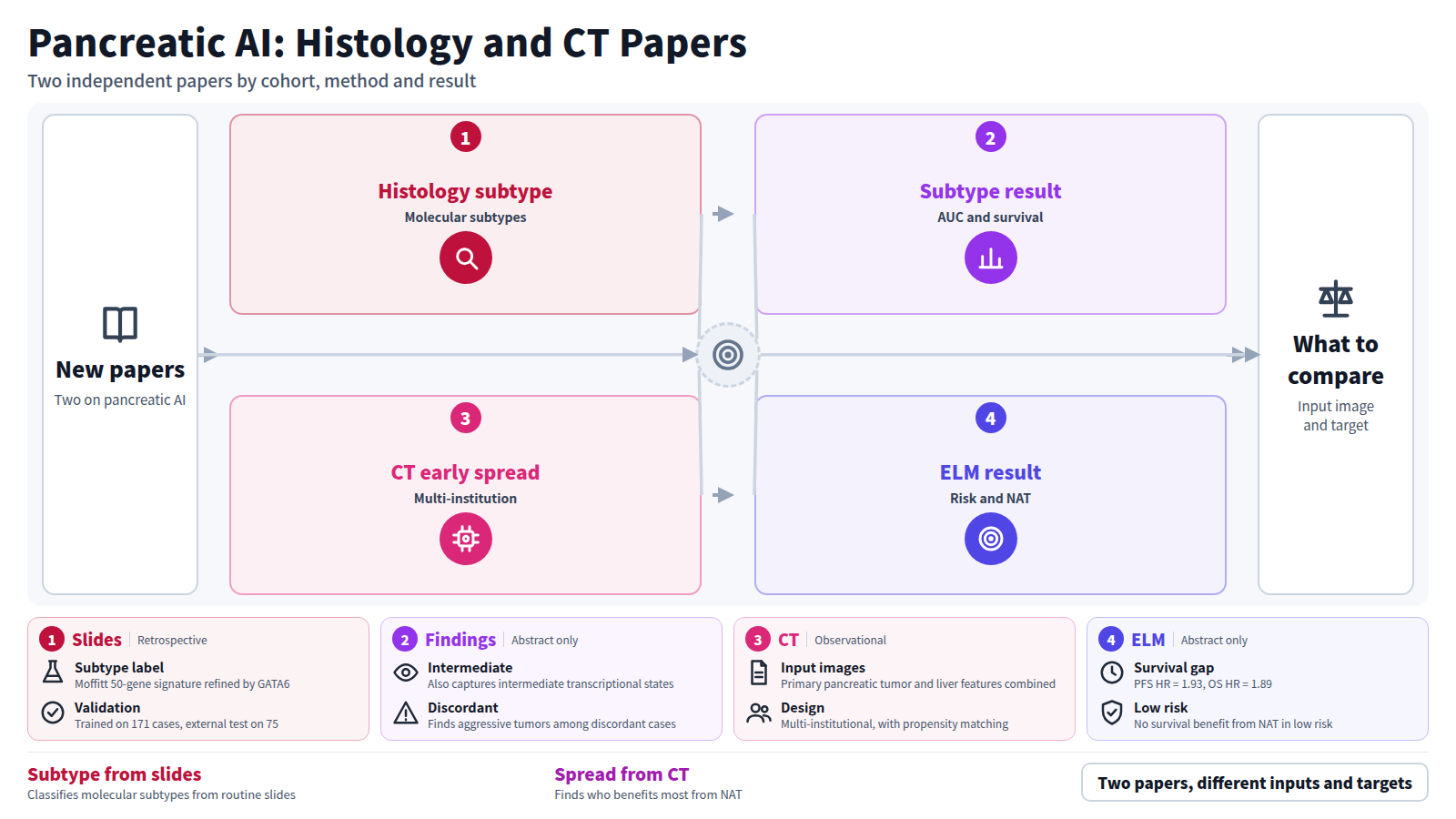
Pancreatic ductal adenocarcinoma comprises classical and basal-like molecular subtypes that differ in prognosis and treatment response. However, transcriptomic subtyping is limited by cost, turnaround time, and tissue requirements. We aimed to determine whether these molecular phenotypes can be inferred directly from routine hematoxylin and eosin–stained whole-slide images using deep learning. We analyzed 689 patients with paired histology and RNA-sequencing data from the Pancreatic Cancer Action Network cohort (n = 506) and The Cancer Genome Atlas (n = 183). Molecular subtypes were defined using the Moffitt 50-gene signature refined by GATA6 expression. PanSubNet integrates cellular morphology with tissue architecture to predict subtype from histology. The model was trained and internally evaluated using five-fold cross-validation on 171 high-confidence cases and independently evaluated on 75 high-confidence external cases. Performance was assessed using classification metrics, and survival associations were evaluated using Kaplan–Meier analysis and log-rank testing. Here we show that PanSubNet distinguishes high-confidence classical and basal-like tumors with a mean area under the receiver operating characteristic curve of 90.3% in internal validation and 84.0% in independent external validation. The model also captures features associated with intermediate transcriptional states. In metastatic disease, PanSubNet-predicted subtypes significantly stratify overall survival and identify aggressive tumors among transcriptionally discordant cases. PanSubNet enables molecular subtyping directly from routine histology and provides a rapid, tissue-sparing complement to transcriptomic profiling. This approach may broaden access to biologically informed stratification, particularly when molecular testing is limited or impractical. Pancreatic cancer can be divided into biological groups that may differ in how aggressive the disease is and how patients respond to treatment. These groups are usually identified using gene-expression testing, which can be expensive, slow, and difficult when only a small amount of tissue is available. We developed PanSubNet, an artificial intelligence method that predicts these biological groups directly from routine microscope slides. We trained and tested the model using patients with both tissue slides and gene-expression data from two independent datasets. PanSubNet accurately identified the major pancreatic cancer subtypes and also captured features related to tumors with intermediate biology. This approach could provide faster and more accessible tumor profiling and may support future treatment planning when molecular testing is limited or unavailable.
Journal IF-equivalent: 6.0 (OpenAlex 2-year mean citedness, value as of 2026-10-08, retrieved 2026-10-09; not the official Clarivate IF)Reference: Akbar AR, Leyva A, Esnakula A, Hasanov E, Noonan A, Meng L, et al. Inferring clinically relevant molecular subtypes of pancreatic cancer from routine histopathology using deep learning. Commun Med. 2026 Oct 6 [Epub ahead of print]. doi:10.1038/s43856-026-01952-5.Checked: Abstract only - Abstract
Accurately predicting the risk of early liver metastases (ELM) and identifying patients who are most likely to benefit from neoadjuvant therapy (NAT) are critical for pancreatic ductal adenocarcinoma (PDAC). Here, we develop a Mamba-based predictive model that integrates imaging features from both the primary pancreatic tumor and the liver to assess the risk of ELM. The model is evaluated in a multi-institutional cohort of 1063 PDAC patients and demonstrates robust performance in predicting ELM (AUCs: 0.806-0.890). Besides, model-defined high-risk patients exhibit significantly shorter progression-free survival (PFS: HR = 1.93, p < 0.001) and overall survival (OS: HR = 1.89, p < 0.001). Notably, NAT confers significant OS benefits in model-defined high-risk patients (17.4 vs. 34.1 months; p < 0.001), even after propensity score matching (p = 0.004), while no survival benefit occurs in low-risk patients. Radiotranscriptomic analyses further reveal relative biological aggressiveness in the high-risk group. Overall, our proposed Mamba-based framework enables accurate prediction of ELM and may serve as a clinically actionable tool for identifying PDAC patients most likely to benefit from NAT.
Journal IF-equivalent: 18.1 (OpenAlex 2-year mean citedness, value as of 2026-10-06, retrieved 2026-10-07; not the official Clarivate IF)Reference: Zhao B, Gong Z, Xiao W, Chen M, Huang S, Zhu L, et al. Deep learning CT signature for predicting early liver metastases in pancreatic ductal adenocarcinoma. Nat Commun. 2026 Sep 8;17(1):10596. doi:10.1038/s41467-026-77665-z.Checked: Abstract only