AI and Neurological Rare & Neuroimmune Diseases ── Parkinson's ── 2026-10-08
Parkinson's disease and parkinsonism: treatment, trials and AI
- Abstract
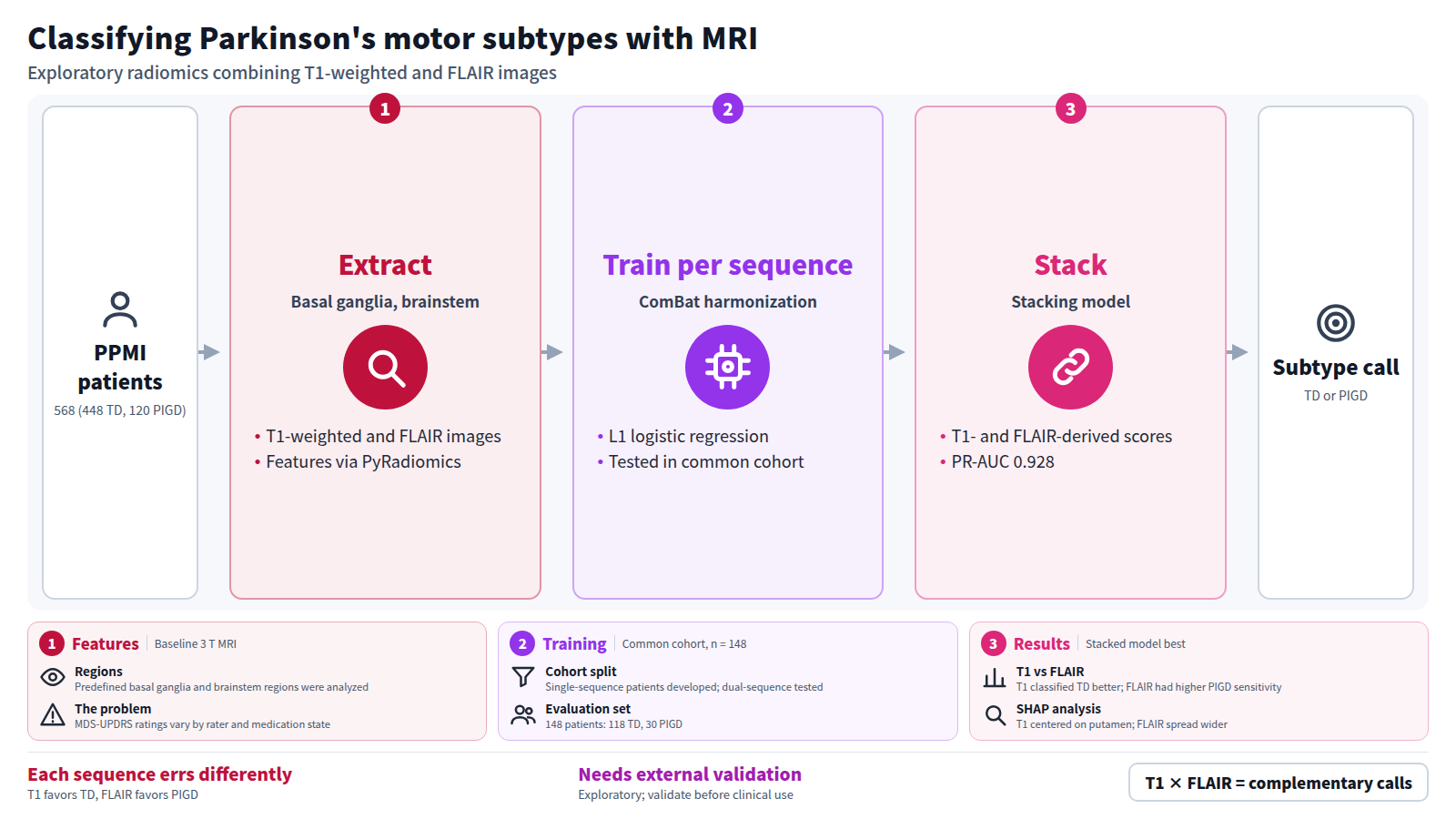
BACKGROUND: Parkinson's disease motor subtypes, tremor-dominant (TD) and postural instability/gait difficulty (PIGD), differ in disease trajectory and prognosis, yet their classification depends on MDS-UPDRS-based clinical ratings that are susceptible to inter-rater variability and medication state. PURPOSE: This exploratory study investigated whether T1-weighted and FLAIR MRI radiomics show differential associations with TD and PIGD motor subtypes in Parkinson's disease, and whether the two sequences contribute complementary subtype-relevant information when combined in a multimodal framework. METHODS: Baseline 3 T MRI data from 568 patients with Parkinson's disease in the PPMI cohort were analyzed (448 TD; 120 PIGD). Radiomics features were extracted from predefined basal ganglia and brainstem regions on T1-weighted and FLAIR images using PyRadiomics. Participants with only T1-weighted or only FLAIR MRI were used as sequence-specific development cohorts; those with both sequences formed a common evaluation cohort. ComBat harmonization was applied within each modality before cohort separation, followed by development-cohort-based feature selection and model fitting. L1-regularized logistic regression models were trained independently for each sequence and evaluated in the common cohort. A stacking model combined T1- and FLAIR-derived probability scores. Model performance was assessed using the area under the precision-recall curve (PR-AUC), balanced accuracy, and F1-score, and Shapley Additive Explanations (SHAP) analysis was used for interpretation. RESULTS: In the common evaluation cohort ( n = 148; 118 TD, 30 PIGD), the T1-weighted model achieved a PR-AUC of 0.814, balanced accuracy of 0.829, and F1-score of 0.750. The FLAIR model achieved a PR-AUC of 0.858, balanced accuracy of 0.832, and F1-score of 0.650. The stacked model showed higher performance, with a PR-AUC of 0.928, balanced accuracy of 0.912, and F1-score of 0.818. The T1-weighted model showed relatively better TD classification, whereas the FLAIR model showed higher PIGD sensitivity. SHAP analysis showed that T1-weighted contributions were mainly concentrated in the putamen, while FLAIR contributions were more broadly distributed across basal ganglia and brainstem regions. CONCLUSION: T1-weighted and FLAIR MRI radiomics showed distinct subtype-associated error profiles and preliminary evidence of cross-sequence complementarity in this PPMI-based exploratory analysis. These findings require external validation before clinical interpretation, but provide a hypothesis-generating framework for multimodal structural radiomics research in Parkinson's disease motor subtype characterization.
Journal IF-equivalent: 3.1 (OpenAlex 2-year mean citedness, value as of 2026-10-07, retrieved 2026-10-08; not the official Clarivate IF)Reference: Lim H, Lee J, Park S, Gi Y, Baek SH, Kim BJ, et al. Exploratory radiomics analysis of T1-weighted and FLAIR MRI in relation to Parkinson’s disease motor subtypes. Front Neurol. 2026 Sep 22;17:1920363. doi:10.3389/fneur.2026.1920363; PMCID: PMC13638411.Checked: Full text checked