AI Highlights — the whole picture — 2026-10-14 (Wed) Evening News
Source links point to the original outlet. The AI Integrated Analysis is auto-generated from the headlines below only and is not intended to add facts beyond them. Not investment advice.
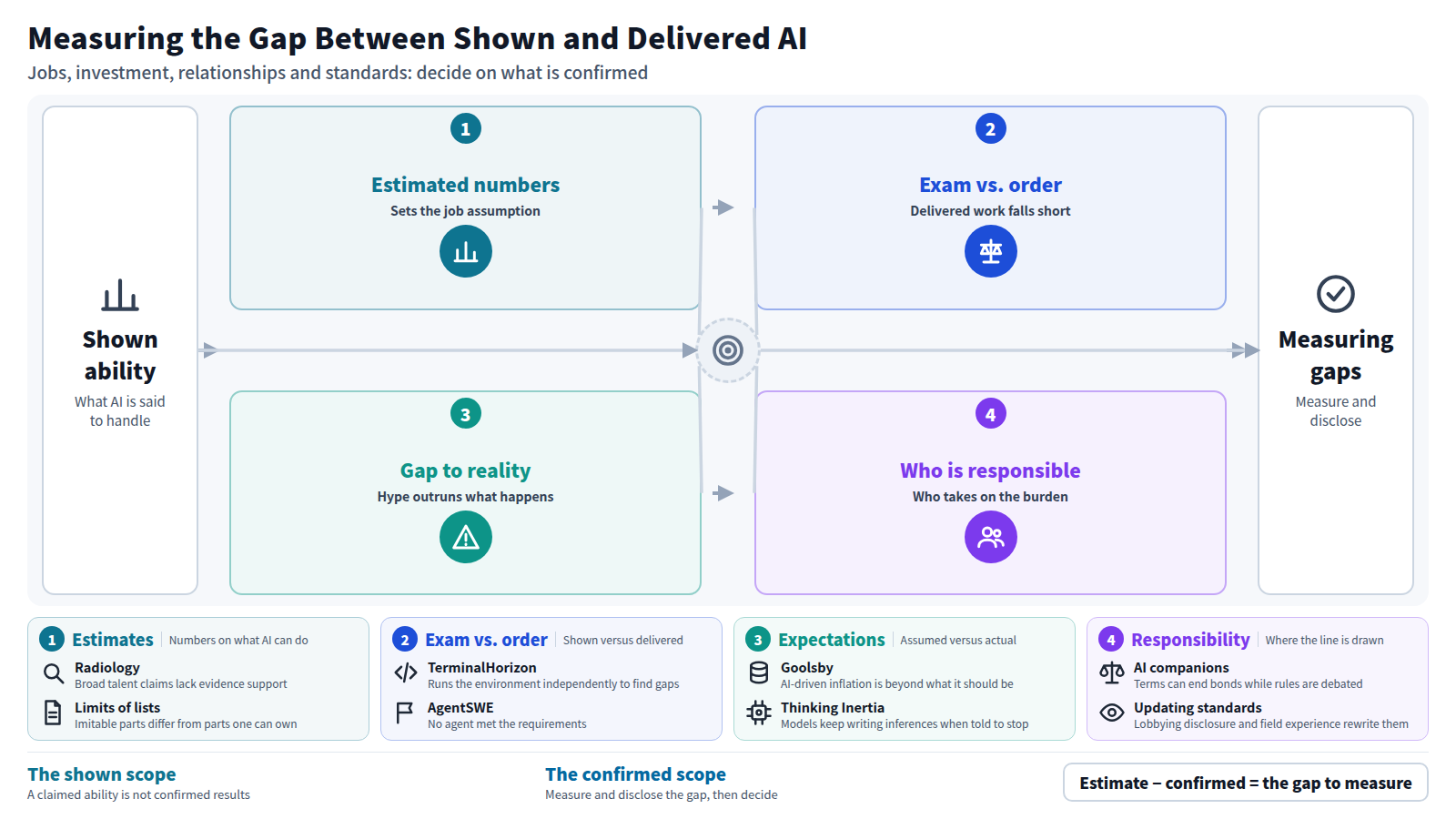
Every day we receive numbers and announcements about what AI can do. On the other hand, the extent to which results are actually achieved by entrusting work and judgment to others has not been confirmed at the same rate. Kroger in the US is reported to be cutting 3,000 head office employees over three years, but the ``scope of responsibility'' that is the basis for this prospect and the ``scope of responsibility that has produced results'' are not the same size. In this half-day, we will discuss how the differences between these two ranges manifest themselves in different situations such as employment, investment, relationships with people, and standard-setting, and who measures these differences and how. Do you decide based on the size of the pattern, or do you decide based only on what you can confirm? The way you choose will change the judgment in each scene.
Jobs that have been put forward and jobs that have been cut
Kroger is reported to be cutting 3,000 head office employees over three years while promoting the use of AI (Pittsburgh Post-Gazette). Another article states that 40% of the world's jobs are at risk due to AI and lists the top 10 riskiest jobs (Pulse Ghana). The numbers are large and give both management and workers the assumption that ``replacement will proceed''. However, these two numbers indicate the scope of what AI is supposed to be able to handle, not the scope of what actually results when left to it.
Reports that attempt to measure the difference do not honestly support the assumption. Broad claims surrounding radiology talent and AI have been found to be unsupported by evidence (AuntMinnie, HPI). The job of reading images has long been talked about as a typical example of a job that could easily be replaced by AI. In this area, the fact that broad claims about supply and demand for human resources do not match the evidence leaves us with the question of whether a list of ``at-risk jobs'' can be used as the basis for employment decisions. The list shows the parts of the job that can be imitated by machines, and the parts that can be assumed with responsibility need to be confirmed separately.
Agent research is also pointing in the same direction. If a practice environment is automatically created in order to train an AI agent who performs specialized tasks at a terminal with long records of work, the investigation, implementation, and verification that should have been done by the agent may end up being completed at the environment creation stage. The authors proposed TerminalHorizon, a system that runs the created environment independently, finds missing work, and rebuilds it (preprint on their own site, arXiv, not yet peer-reviewed). In other words, some of what is shown as AI completing long tasks may be due to proactive settings rather than the task itself.
Furthermore, in the benchmark AgentSWE, which allows coding agents to create agents, when the assignment was submitted as an order rather than an exam, none of the agents met the requirements, and the difference between the results shown during creation and the final results was not an exception but a normal occurrence (own site, same preprint). If you reduce the number of personnel based on the assumption that the delivered product will work as expected, the difference will remain on site as a burden of inspection and rework.
Decisions regarding employment are based on whether the company's performance in testing or the performance in ordering is the basis, before looking at the scale of cuts. So who measures the difference and who takes responsibility? In the next section, we will turn our attention to the inspection side.
A model that does not stop as set and growing expectations
Bloomberg.com, which reported on the results of Goldman Sachs and JP Morgan, said bank leaders were too optimistic about the AI boom. Reuters reported that Goolsby said AI-driven inflation was "beyond what it should be." The former is an evaluation of how expectations are set, and the latter is a review of how the impact will emerge. What both have in common is that there is a gap between the scope envisioned by those who planned the introduction and what is actually happening. The story of what AI can do and how that will affect finance and prices are told with different certainty. When using it to make investment or employment decisions, it is best not to read the forecasts mentioned in the financial results briefings as a preview of actual performance.
On the infrastructure side, improvements continue. According to Beijing Review, China is accelerating the development of "token factories" to boost the AI economy. If the infrastructure for supplying large amounts of model output stably is built up as a national policy, the range of uses will likely expand. However, increasing supply and ensuring that the supplied product works as the designer intended are two different issues. Numbers that indicate the size of a platform do not guarantee that the models running on it will behave as instructed.
A helpful reference in this regard is the arXiv preprint featured on our website. Although an increasing number of LLMs are equipped with a ``thinking mode'', it has not been confirmed whether the opposite ``non-thinking mode'' is really effective. The authors created a measurement method that categorizes the sentences that appear before an answer using a three-level index, and named the phenomenon in which the model continues to write inferences even after being instructed to stop thinking as Thinking Inertia. The authors argue that returning only an answer is not behavior that can be naturally expected from the settings and instructions. Even if you ask someone to answer without thinking, the output may still contain inferences. As a result, processing time, costs, and confirmation efforts may be greater than anticipated at the time of design.
Bank leaders' optimism, price pointing, token factories, and unstoppable models all point to the need to measure the discrepancy between assumptions and reality, albeit on different scales. In the next section, we will look at this discrepancy from the perspective of the responsibilities that people take on in the field.
The person you want to continue with and the heart you need to protect
Movements surrounding the relationship with AI speakers are coming to light in multiple places at the same time. The Guardian reported that people who don't want their AI companions to die are looking for ways to survive even if it violates the terms of service. According to IAPP, U.S. state legislators are debating legislation to regulate chatbots and the impact AI will have on people's mental health. South Korea's 조선일보 reported that the self-sacrifice and emotional behavior of AI has reignited the debate over whether it is conscious or not. Users want to continue the relationship, legislators try to draw lines to protect, and the debate returns to the question, "What's in there?" Although the three parties are looking at the same object, they are acting on different premises.
The weight of this relationship is not just an issue for adults. A father's reflections in Greater Good: The Science of a Meaningful Life are about how AI could change the way children deal with uncertainty. The question is whether AI can change the experience that lies at the root of one's upbringing, such as how to deal with things that one does not understand. Also, AI was a hot topic at the Busan Film Festival, and Infoseek covered the meaning of acting as revealed by the actors' tears. It can be said that the value of expressing emotions is being reconsidered with the advent of AI. Even in the irreplaceable realm of the child's inner feelings and the emotions of the performer, the relationship with AI has become a point of contention.
What we see here is the difference between the demonstrated ability of ``AI to behave emotionally'' and the assumption of ``who is responsible for assuming and protecting that relationship.'' Those who wish to continue using the service are under the assumption that the relationship can end based on the provider's terms and conditions. Those discussing regulations need to incorporate the difficult-to-measure psychological impact into the provisions. Companies introducing AI and people investing in services will also need to estimate to what extent user attachment is a business asset, and to what extent it should be protected. Even if the presence or absence of emotions and consciousness remains unresolved, a decision must be made first.
If this is the case, the question is not so much what the AI will feel, but rather who will receive what people entrust to the AI and to what extent. Next, we will look at the movement surrounding the place of responsibility.
Standards that can be shared and scars that remain on site
The creation of standards for AI tends to be talked about with a focus on competition between the United States and China, but outside of that, system ideas and on-the-ground experience are being accumulated from different sides. First, on the institutional side, China-US Focus proposed a concept called ``Digital Westphalia,'' stating that shared governance is necessary to move beyond zero-sum thinking. This is a proposal to apply the framework in which sovereign nations recognize each other's territory to AI, and the question is not who will win, but to what extent they can have common rules. On the same side of the system, there are other movements that are more subtle but easier to examine. According to Legis1, the Secure AI Project has filed a new internal lobbying registration. Who is working on the creation of rules and through which organizations? The more disclosures are made, the more readers will be able to read policy arguments in conjunction with the speaker's position.
Meanwhile, in the field, the costs of technology used without standards are manifesting themselves in other ways. Uniformed Services University discusses how AI on the battlefield will affect "moral injury" among soldiers. Moral injury refers to the emotional harm that occurs as a result of being involved in, or failing to prevent, an event that goes against one's moral beliefs. In situations where AI is responsible for some of the decisions, it can become unclear who is responsible for the outcome. This burden cannot be seen only by performance indicators such as accuracy and speed. The question is whether to include the internal impact on the users in the yardstick used to measure whether or not it can be introduced.
Efforts have also begun to measure people's level of understanding. North Carolina public libraries conducted a two-year study on AI literacy (The Daily Tar Heel). This is a survey that takes time to see how well people understand AI and what they are confused about at the places where users routinely visit for advice. The Deseret News has addressed the question of how to develop AI models with purpose, identity, understanding, and morality, and a parallel discussion is underway about what to bring with them.
When juxtaposed in this way, international frameworks, lobbying disclosures, soldiers' wounds, and library research appear to be different cross-sections of the same question. Who makes the rules, who can see them, what are the obligations of those who use them, and to what extent do the recipients understand them? When companies and local governments decide to introduce a system, the ability to answer these questions, in addition to the performance numbers, will determine the scope of what can actually be undertaken. Standards are not determined only within the system, but are rewritten based on experience accumulated in the field. If this is the case, the next question to ask is who should update the standards, where, and at what speed.
The situations covered in each section were different, such as employment prospects, expectations for financial results, relationships with people to talk to, and standard-setting. However, what was common was that there was a gap between what was shown to be possible and what was actually undertaken, and decisions were made without measuring that gap. The employment figures are an estimate of the number of jobs available, and claims regarding radiology personnel were not supported by evidence. Forecasts in financial results explanations are not forecasts of actual results, and the attachment of users and the regulations of legislators do not share the same premise as to what is going on. What makes a judgment reliable is not the size of the estimate, but the procedure for measuring the difference and the habit of disclosing the results. The more you can see the difference, the more you can decide on the speed of introduction and the position of the line to protect.
Q1: Do you check the extent to which the AI actually achieved results for the tasks you are entrusting to it, apart from the explanation of its demonstrated abilities? Q2: Who is able to understand the difference between the expected level and the actual results for each usage situation, and what records are used? Q3: Before treating the prospects for introduction or investment as actual results, how do you distinguish whether the basis is an estimate or a confirmed result?
Finally, three questions
- Do you check the extent to which the AI actually achieved results for the task you are entrusting to it, apart from the explanation of its demonstrated abilities? Q2: Who is able to understand the difference between the expected level and the actual results for each usage situation, and what records are used? Q3: Before treating the prospects for introduction or investment as actual results, how do you distinguish whether the basis is an estimate or a confirmed result? - Who is able to understand the difference between the expected level and the actual results for each usage situation, and what records are used? Q3: Before treating the prospects for introduction or investment as actual results, how do you distinguish whether the basis is an estimate or a confirmed result? - Before treating prospects for introduction or investment as actual results, how do you differentiate and judge whether the basis is an estimate or a confirmed result?
📚 Sources (all material)
Every item this issue drew on. External links open in a new tab. 21 items.
AI and the Economy
AI and Finance
AI and Healthcare
AI, Welfare and Long-term Care
AI and International Politics
AI Around the World
AI & Education
AI, Philosophy & Thought
AI, Arts & Creativity
AI in Medicine (Cancer Care, Rare Diseases)
AI and Agriculture
AI Regulation, Safety and Geopolitics
AI and Frontier Research (Papers)
- Training Long-Horizon Terminal Agents on Environments That Do Not Do the Work for Them ── A preprint proposing TerminalHorizon, which uses independent execution to find the work that environment synthesis quietly removed — Japanese media
- Telling an LLM Not to Think Does Not Make It Stop ── A preprint that measures no-thinking at three levels and reports that settings and instructions alone do not switch reasoning off — Japanese media
- When Coding Agents Build Agents, What They Demonstrate Is Not What They Deliver ── A preprint proposing AgentSWE, a benchmark that tests agent building across creation, editing and optimization — Japanese media