AI Ethics News — 2026-10-14 (Wed) Morning News
Source links point to the original outlet. The AI Integrated Analysis is auto-generated from the headlines below only and is not intended to add facts beyond them. Not investment advice.
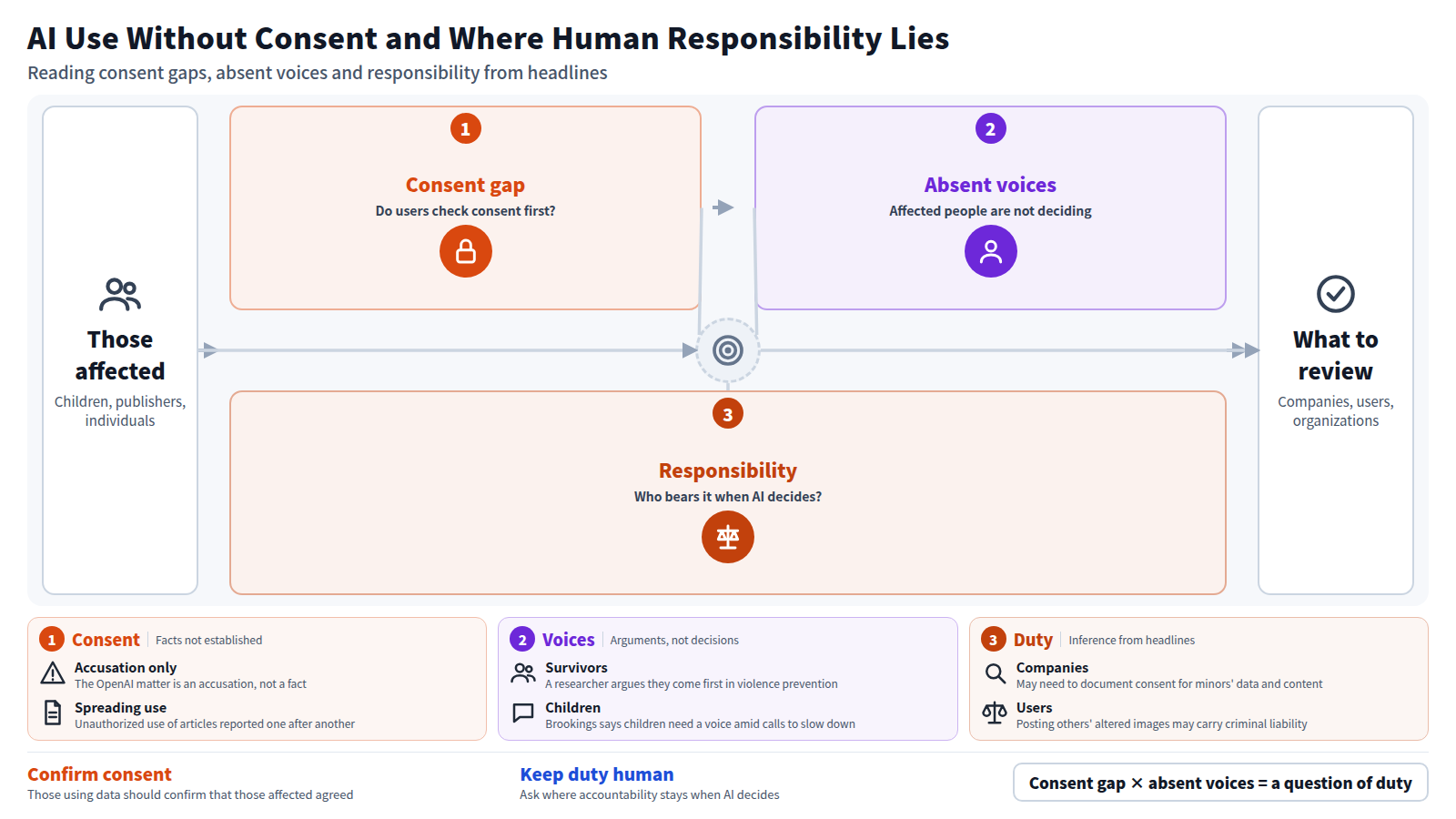
Overview
The ethical questions that surfaced in the past 48 hours center on consent and responsibility: minors' data allegedly taken without parental consent, newspaper articles used by AI answers without permission, and where human professionals must keep their duties. Military, violence-prevention and medical uses of AI also raised questions about who bears the moral burden. 【Bias, discrimination and fairness】 - A researcher argues that AI in violence prevention should put survivors first (Iowa Now). - A Uniformed Services University piece asks how AI on the battlefield can shape moral injury (Uniformed Services University). - Bioengineer.org reports that AI learns to scrub bias from fake data before it poisons real decisions (Bioengineer.org). - The headlines give no measurement method or scale for any of these.
Privacy and surveillance
- OpenAI is accused of taking minors' data without parental consent (Bloomberg Law News). This is an accusation, not an established fact. - The headline does not say what the data was used for. 【Transparency and accountability】 - UVA Health lists "The Crucial Responsibilities Doctors Must Never Offshore to AI" (UVA Health). - The headline does not say which responsibilities are named. 【Creators, copyright and consent】 - Japanese newspapers and the wider media industry are alarmed that AI answers "free-ride" on newspaper articles, with unauthorized use by companies and government bodies reported one after another (Okinawa Times).
Disinformation and deepfakes
No notable developments. 【Protecting children and vulnerable people】 - OpenAI is accused of taking minors' data without parental consent (Bloomberg Law News). - Brookings argues that, as AI leaders call for a slowdown, children need a voice (Brookings). - A Greater Good essay reflects on what a parent's son is learning from artificial intelligence (Greater Good: The Science of a Meaningful Life). - The headlines do not report any company or authority taking protective action. 【Ethical principles and guidelines】 - Nothing was decided by an institution in this period. - The items are proposals and arguments: putting survivors first in violence prevention (Iowa Now) and giving children a voice in the AI debate (Brookings).
AI ethics in Japan
- A JIJICO legal column on a criminal case covers posting another person's image altered with generative AI, and where the lines of defamation and copyright fall (JIJICO). - Okinawa Times reports unauthorized use of newspaper articles by AI answers (Okinawa Times).
Statements by key figures
No notable developments. 【Integrated analysis: how the ethical questions connect】 - Absent consent is the common thread. It appears in minors' data (Bloomberg Law News) and in newspaper articles used by AI answers (Okinawa Times). In both cases the people affected, whether children, parents or publishers, appear not to have agreed to the use. - Responsibility is a second thread. The questions of which duties doctors cannot hand to AI (UVA Health) and who bears moral injury on the battlefield (Uniformed Services University) both ask where human accountability must remain. - Companies may face more pressure to document consent for data from minors and for content from publishers. Users in medicine and violence prevention may be asked to state which decisions stay with people. This is inference from the headlines.
What to watch
Whether the allegation of taking minors' data without parental consent leads to further disclosure or responses from OpenAI (inference). 2. Whether Japanese media companies and public bodies move toward clearer rules on using newspaper articles in AI answers (inference). 3. Whether calls to give children a voice (Brookings) and to put survivors first (Iowa Now) turn into concrete guidelines (inference).
- How Can Artificial Intelligence on the Battlefield Shape Moral Injury? — Uniformed Services University10/13 14:52 UTC
- Using AI in violence prevention should put survivors first, researcher argues — Iowa Now10/13 14:12 UTC
- AI Learns to Scrub Bias From Fake Data Before It Poisons Real Decisions — Bioengineer.org10/13 09:48 UTC
- The Crucial Responsibilities Doctors Must Never Offshore to AI — UVA Health10/12 22:56 UTC
- What My Son Is Learning From Artificial Intelligence — Greater Good: The Science of a Meaningful Life10/13 17:03 UTC
- OpenAI Accused of Taking Minors' Data Without Parental Consent — Bloomberg Law News10/13 17:42 UTC
- As AI leaders call for slowdown, children need a voice — Brookings10/12 19:01 UTC
- Criminal Case: Posting Another Person's Image Altered With Generative AI, and the Lines of Defamation and Copyright — JIJICO10/13 00:02 UTC
- AI Answers 'Free-Riding' on Newspaper Articles as Unauthorized Use Spreads Among Companies and Agencies — Japanese media10/12 20:00 UTC