AI, EQ & Communication News — 2026-10-14 (Wed) Morning News
Source links point to the original outlet. The AI Integrated Analysis is auto-generated from the headlines below only and is not intended to add facts beyond them. Not investment advice.
Overview
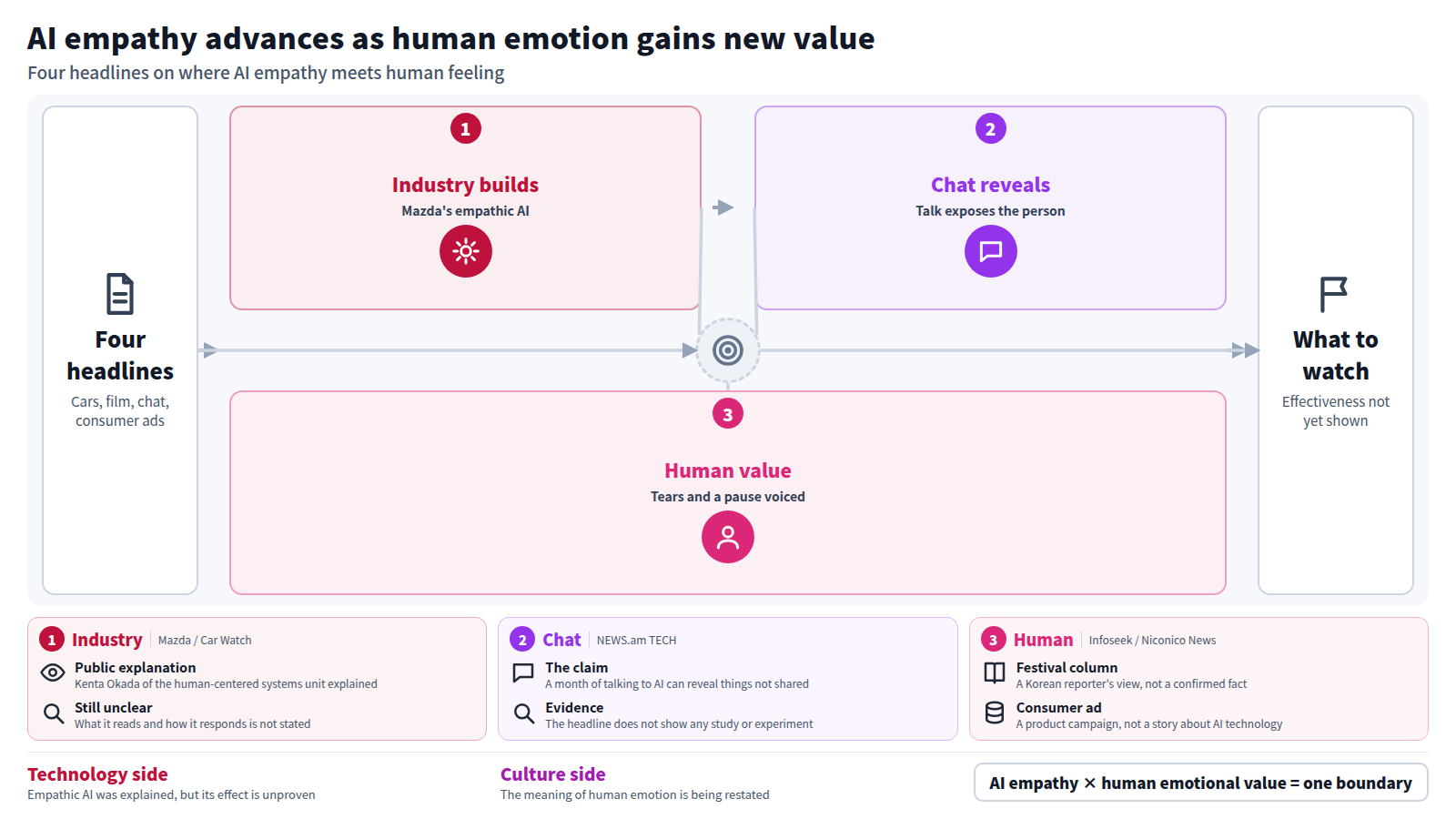
Coverage in the past 48 hours was thin, with four headlines across three areas. Mazda's "empathic AI" technology progress was detailed at the Japan Mobility Show 2026 (Car Watch), a column from the Busan film festival discussed AI and the meaning of human acting (Infoseek), and a report said a month of talking to AI can reveal a lot about a person (NEWS.am TECH).
AI that reads emotions
No notable developments. 【AI empathy and emotional intelligence】 - At the Japan Mobility Show 2026 (JMS2026), Kenta Okada of Mazda's next-generation human-centered systems research division explained in detail the progress of the company's "empathic AI" technology (Car Watch). - A Korean reporter's column on the Busan film festival said AI was a topic of discussion and that actors' tears showed the meaning of human acting (Infoseek). 【Human EQ and skills in the AI era】 No notable developments. 【Changes in conversation and relationships】 - A report says a month of talking to AI can reveal a lot about a person, including things they have not shared directly (NEWS.am TECH).
Words AI writes and speaks
No notable developments.
Speaking practice and coaching
No notable developments.
Research and surveys
No notable developments. 【EQ, communication and AI in Japan】 - A campaign called "こんな日も、まる" ("Even on days like this, Maru") features a cat drawn in small moments of bad luck and Ise tea brand "Maruno Cha", and promotes taking a moment to pause and be close to people's feelings in the AI era (Niconico News).
Statements from key figures
No notable developments. Kenta Okada of Mazda appeared in a technical explanation, but the headline gives no statement of his to report (Car Watch). 【Integrated analysis: what is happening】 The four headlines share one structure: each places a human emotional or expressive quality against AI, and each does so from a different angle.
- Mazda's work on empathic AI points to AI that returns empathic responses in a product setting, in this case a car (Car Watch). The wording is the company's own, and the headline does not show how the technology works or what it has been shown to do. - The Busan film festival column goes the other way. It frames actors' tears as showing the meaning of human acting, which suggests the writer sees human expression as the thing AI throws into relief (Infoseek). - The report on a month of conversation with AI treats the dialogue itself as a source of information about the person, including what they have not said directly (NEWS.am TECH). This appears to shift attention from what AI says to what AI can infer about the user. - The Japanese campaign works on the human side, offering a pause and closeness to feelings as a counterweight in the AI era (Niconico News).
Taken together, the headlines suggest that discussion is moving from whether AI can sound empathic to what is left distinctly human and what AI learns from people in the process. That is inference from a small sample of four headlines, and none of them contains evidence on how well empathic AI works.
What to watch
- Whether Mazda or others publish concrete details of how empathic AI technology is used and evaluated in vehicles (likely a follow-up to the JMS2026 explanation). - Whether the idea that conversation with AI reveals undisclosed personal traits is backed by research data, and how it is received (appears to be an open question from the NEWS.am TECH report). - Whether discussion of human expression, as in the Busan film festival column, extends to other creative and performing fields.
- A month of talking to AI can reveal a lot about a person — even things they haven’t shared directly — NEWS.am TECH10/12 16:30 UTC