AI and Cancer Research ── Cancer biology ── 2026-10-14
Cancer molecular biology and AI
- Abstract
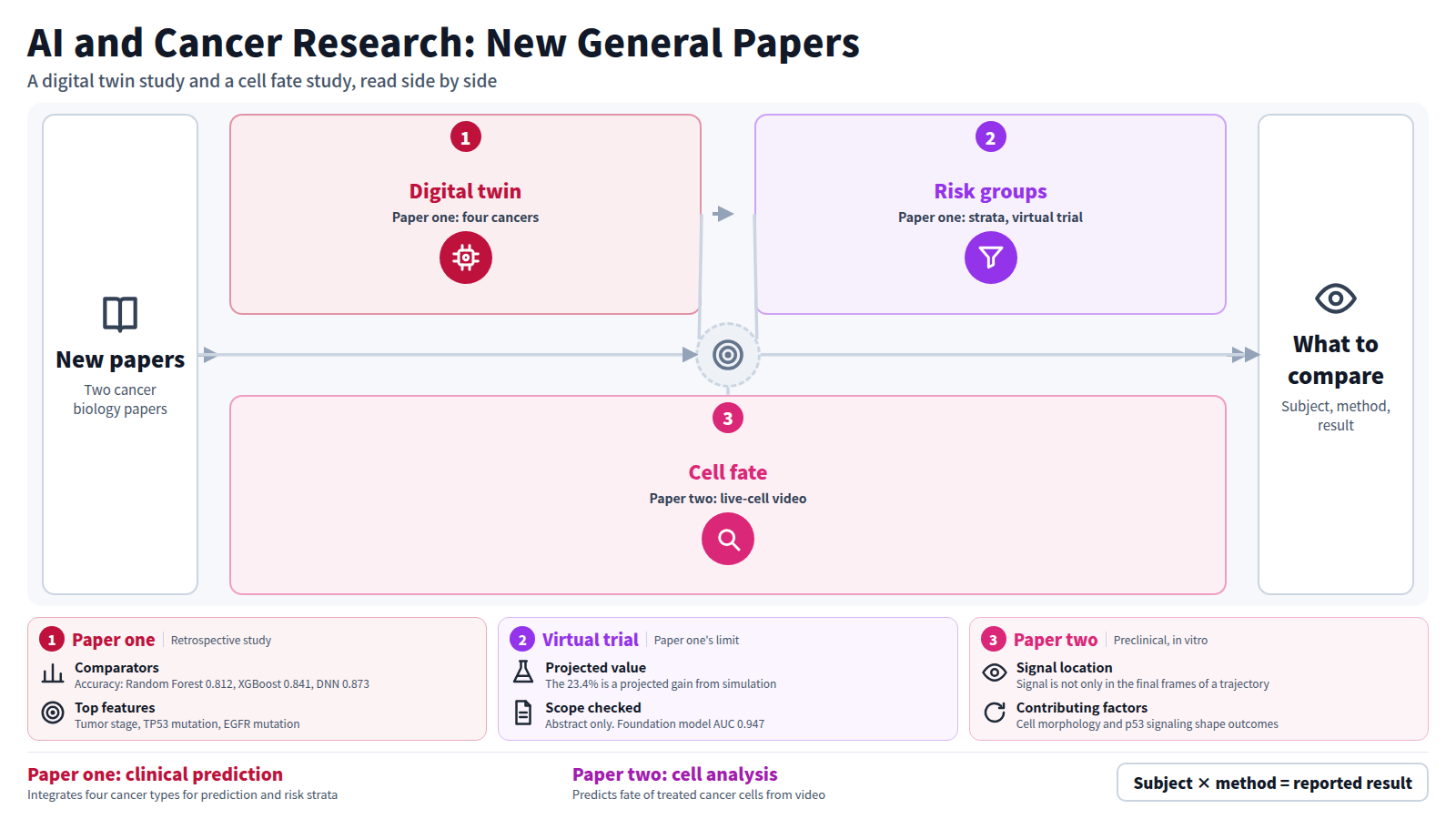
Background: The convergence of multi-omics profiling, radiomics, and advanced machine learning has opened new frontiers in precision oncology.Despite this progress, existing computational frameworks remain static, failing to incorporate evolving patient data or simulate treatment outcomes dynamically.A self-evolving digital twin ecosystem offers a solution by continuously synchronizing patient-specific virtual models with real-world clinical trajectories.Objective: To develop and validate a self-evolving digital twin ecosystem integrating clinical, genomic, transcriptomic, proteomic, radiomic, and pathological data for early cancer detection, disease progression prediction, and personalized treatment optimization across breast, lung, colorectal, and ovarian cancers.Methods: A retrospective multi-center cohort of 400 patients (breast n=120, lung n=100, colorectal n=100, ovarian n=80; age range 25-75 years) was assembled.A six-layer digital twin framework was constructed, incorporating a cross-modal transformer foundation model alongside Random Forest, XGBoost, and Deep Neural Network comparators.Key performance metrics included accuracy, precision, recall, F1-score, and area under the ROC curve (AUC).Virtual clinical trial simulations and feature importance analyses were performed.Results: The foundation model achieved superior performance across all metrics (accuracy 0.921, AUC 0.947) compared with Random Forest (0.812/0.847),XGBoost (0.841/0.879), and Deep Neural Network (0.873/0.906).Tumor stage, TP53 mutation, and EGFR mutation emerged as the most predictive features.Risk stratification identified 148 (37.0%) low-risk, 153 (38.3%) moderate-risk, and 99 (24.8%)high-risk patients.Virtual trial simulation demonstrated a 23.4% improvement in projected progression-free survival for the high-risk subgroup.Conclusion: The self-evolving digital twin ecosystem significantly outperforms conventional machine learning approaches and provides a clinically actionable, adaptive platform for real-time precision oncology decision support across multiple cancer types.
Journal IF-equivalent: 0.0 (OpenAlex 2-year mean citedness, value as of 2026-10-07, retrieved 2026-10-08; not the official Clarivate IF)Reference: [No authors listed]. Self-Evolving Digital Twin Ecosystems for Early Detection and Precision Management of Breast, Lung, Colorectal, and Ovarian Cancers. IJDDT. 2026 Oct 12;16(65s). doi:10.25258/ijddt.16.65s.22.Checked: Abstract only - Abstract
Understanding non-genetic determinants of cell fate is critical for developing and improving cancer therapies, as genetically identical cells can exhibit divergent outcomes under the same treatment conditions. In this work, we present a deep learning approach for cell fate prediction from raw long-term live-cell recordings of cancer cell populations under chemotherapeutic treatment. Our Transformer model is trained to predict cell fate directly from raw image sequences, without relying on predefined morphological or molecular features. Beyond classification, we introduce a comprehensive explainability framework for interpreting the temporal and morphological cues guiding the model’s predictions. We demonstrate that prediction of cell outcomes is possible based on the video only, our model achieves balanced accuracy of 0.94 and an F1-score of 0.93. Attention and masking experiments further indicate that the signal predictive of the cell fate is not uniquely located in the final frames of a cell trajectory, as reliable predictions are possible up to 8 h before the event. Our analysis reveals distinct temporal distribution of predictive information in the mitotic and apoptotic sequences, as well as the role of cell morphology and p53 signaling in determining cell outcomes. Together, these findings demonstrate that attention-based temporal models enable accurate cell fate prediction while providing biologically interpretable insights into non-genetic determinants of cellular decision-making.
Journal IF-equivalent: 4.7 (OpenAlex 2-year mean citedness, value as of 2026-10-13, retrieved 2026-10-14; not the official Clarivate IF)Reference: Bürger F, Dias Gomes M, Granada AE, Moreau N, Bozek K. Understanding cell fate decisions with temporal attention. PLoS Comput Biol. 2026 Oct 12;22(10):e1014813. doi:10.1371/journal.pcbi.1014813.Checked: Abstract only