AI and Cancer Research ── Breast ── 2026-10-14
Breast cancer: treatment, trials and AI
- Abstract
Background: Accurate preoperative assessment of HER2 status is critical for guiding targeted therapy, but conventional biopsy-based methods are invasive and limited by tumor heterogeneity. Mammography is a widely accessible and cost-effective imaging modality routinely performed in the preoperative setting. This study aimed to develop and validate a mammography-based deep learning radiomics model for noninvasive prediction of HER2 expression status in breast cancer.
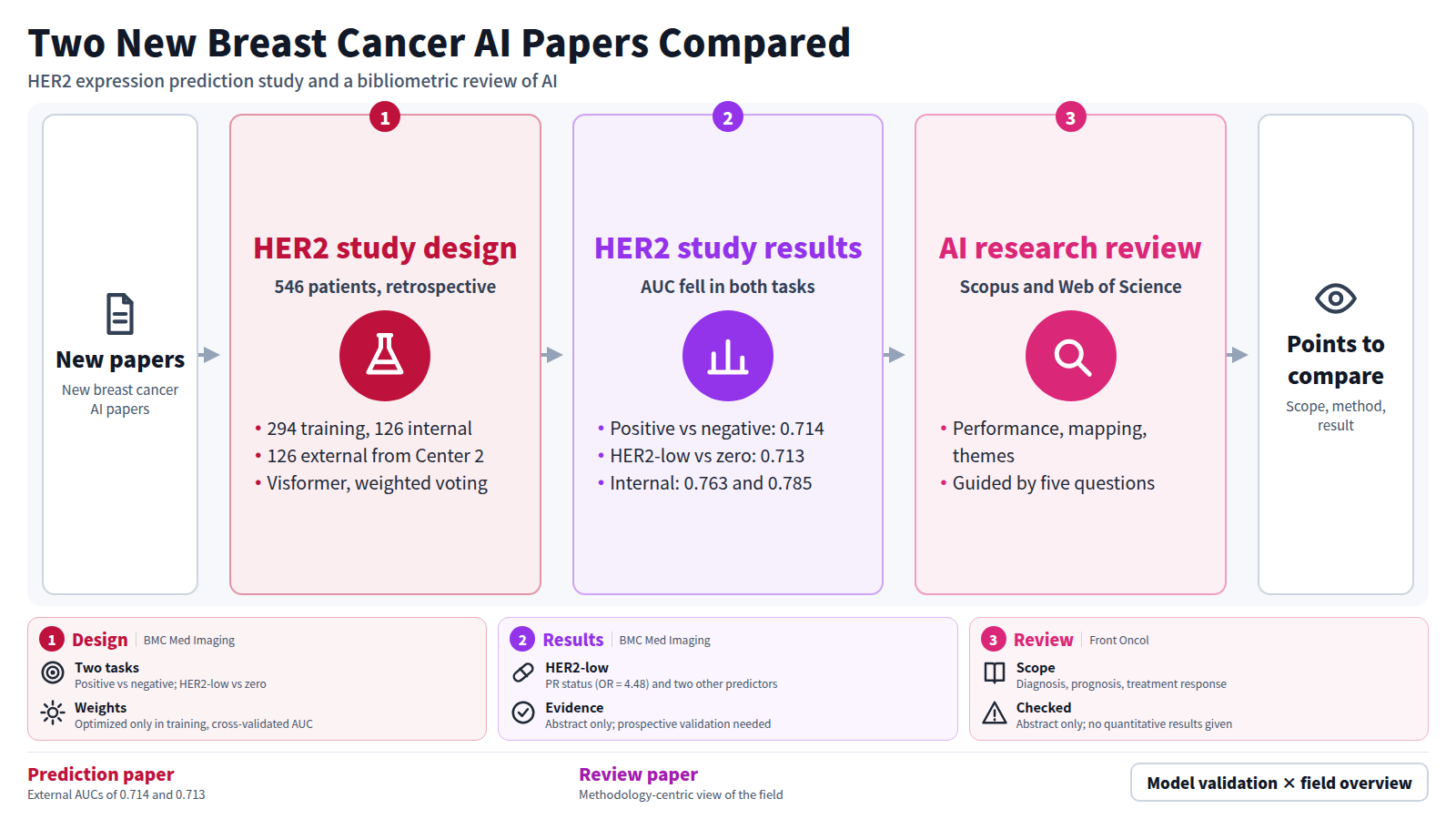
Methods: A total of 546 breast cancer patients from two centers were retrospectively enrolled: 420 from Center 1 (294 in the training cohort and 126 in the internal validation cohort) and 126 from Center 2 as the external validation cohort. Two classification tasks were defined: Task 1 distinguished HER2-positive from HER2-negative breast cancer, and Task 2 distinguished HER2-low from HER2-zero breast cancer. Radiomic features were extracted using the Visformer architecture. A weighted voting ensemble method was then employed to construct the prediction model, with weights optimized solely within the training cohort using cross-validated AUC. Model performance for both tasks was evaluated using receiver operating characteristic (ROC) curves.
Results: For Task 1 (HER2-positive vs. HER2-negative), the radiomics model achieved AUCs of 0.836, 0.763, and 0.714 in the training, internal validation, and external validation cohorts, respectively. For Task 2 (HER2-low vs. HER2-zero), the corresponding AUCs were 0.890, 0.785, and 0.713. Clinicopathological analysis revealed that histological grade (OR = 2.28), Ki-67 index (OR = 4.71), and BI-RADS category (OR = 2.49) were independent predictors of HER2-positive status, while PR status (OR = 4.48), BI-RADS category (OR = 1.75), and breast density (OR = 0.32) were independent predictors of HER2-low status (all P < 0.05).
Conclusion: The mammography-based deep learning radiomics model demonstrated meaningful discriminative ability for predicting HER2 expression status in breast cancer and may serve as a potential noninvasive adjunct for preoperative HER2 assessment, warranting further prospective validation. Clinical trial number Not applicable.
Journal IF-equivalent: 3.8 (OpenAlex 2-year mean citedness, value as of 2026-10-02, retrieved 2026-10-03; not the official Clarivate IF)Reference: Wang H, Liu C, Zhao Y, Fang Y, Kang Z, Deng L, et al. Mammography-based deep learning radiomics for predicting HER2 expression in breast cancer: a dual-center study with focus on HER2-low status. BMC Med Imaging. 2026 Oct 12 [Epub ahead of print]. doi:10.1186/s12880-026-02921-z.Checked: Abstract only - Abstract
INTRODUCTION: Breast cancer remains a leading cause of cancer incidence and mortality among women worldwide, with ongoing challenges in early detection, accurate diagnosis, prognosis estimation, and treatment-response assessment. Artificial intelligence (AI), including machine learning and deep learning, has rapidly advanced breast cancer research by enabling analysis of high-dimensional imaging, pathological, genomic, and clinical data. However, the rapid expansion of this literature has resulted in substantial fragmentation across clinical tasks, data modalities, algorithmic paradigms, and software ecosystems. This systematic review presents a comprehensive bibliometric analysis of AI-driven breast cancer research published recently. METHODS: Using a multi-database, Scopus and Web of Science, as primary data sources, a systematic bibliometric framework integrating performance analysis, science mapping, and thematic evolution was employed. The analysis is guided by explicit research questions examining: (i) the evolution of AI applications across diagnosis, prognosis, and treatment-response prediction; (ii) the adoption of explainable AI and hyperparameter optimization practices; (iii) the datasets, software frameworks, and algorithms shaping the field; (iv) the role of mammography as a core modality; and (v) emerging research hotspots, including transformer-based architectures. RESULTS AND DISCUSSION: Unlike prior bibliometric studies focused mainly on citation metrics, this work adopts a task-aware, methodologycentric perspective, offering actionable insights to support reproducible, interpretable, and clinically integrated AI systems for breast cancer care.
Journal IF-equivalent: 2.7 (OpenAlex 2-year mean citedness, value as of 2026-10-02, retrieved 2026-10-03; not the official Clarivate IF)Reference: Mohamed YB, ZainEldin H, Eladl SG, Sayed HA, Shehata M, Badawy M, et al. Artificial intelligence in breast cancer research: a systematic review and bibliometric analysis of emerging trends and future directions. Front Oncol. 2026 Sep 28;16:1800218. doi:10.3389/fonc.2026.1800218.Checked: Abstract only