AI Ethics News — 2026-10-18 (Sun) Morning News
Source links point to the original outlet. The AI Integrated Analysis is auto-generated from the headlines below only and is not intended to add facts beyond them. Not investment advice.
Overview
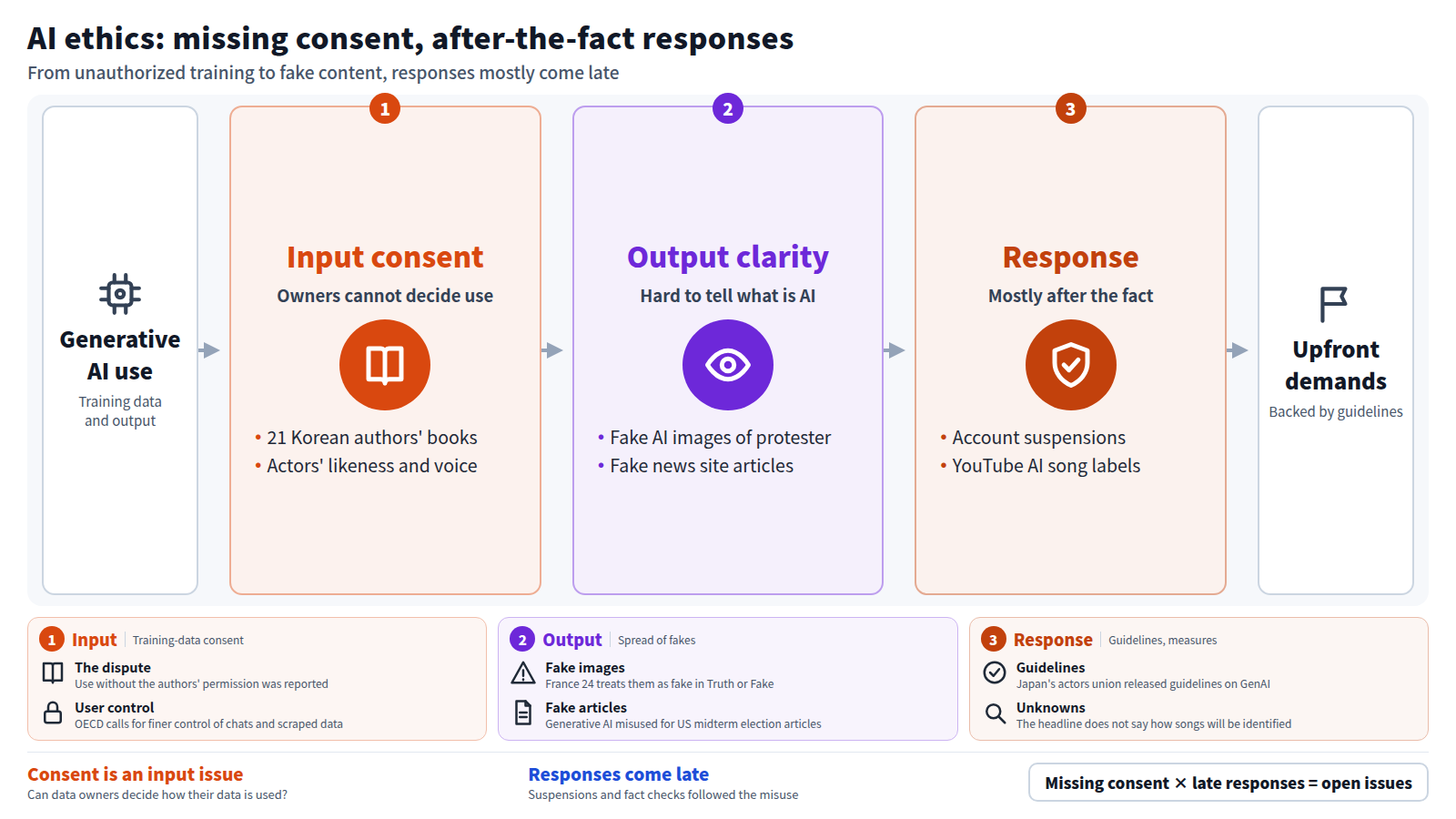
Questions about consent over data used for AI training surfaced most clearly, in the report on Korean authors' books (Asia Economy) and the guidelines from Japan's actors union (Digital Watch Observatory). Labeling of AI-generated content (YouTube) and the misuse of generative AI for disinformation (France 24, Yomiuri Shimbun) were also in the news. The OECD's call for user control over chatbot conversations and scraped data, and the German bishops' child-protection initiative, added principle-level proposals. 【Bias, discrimination and fairness】 No notable developments.
Privacy and surveillance
- The OECD is calling for finer user control over chatbot conversations and web-scraped data. This is a call, not a decision (The Policy Edge). - A listing under the Universidad de Córdoba (UCO) name carries a headline advertising a free AI porn generator for adults 18+ "with privacy controls". The headline gives no further detail (Universidad de Córdoba). 【Transparency and accountability】 - YouTube will label AI-generated songs across its platforms to increase "transparency" (ET BrandEquity). The headline does not say how AI-generated songs will be identified. - The headline on the Anthropic account suspensions does not say how the misuse was detected (Yomiuri Shimbun). 【Creators, copyright and consent】 - Authors vs. Anthropic: Asia Economy reports that Anthropic used 21 books by Korean authors, including Han Kang and Kim Youngha, for "Unauthorized AI Training". The dispute is over use without the authors' permission (Asia Economy). - Actors vs. generative AI: Japan's actors union released guidelines on GenAI (Digital Watch Observatory).
Disinformation and deepfakes
- Fake AI images of a protester went viral after a woman was punched at Trump's Ohio rally. France 24's "Truth or Fake" segment treats the images as fake (France 24). - A fake news site misused generative AI to write articles about the US midterm elections, and Anthropic suspended the accounts (Yomiuri Shimbun). - On the response side, YouTube will label AI-generated songs (ET BrandEquity). 【Protection of children and vulnerable people】 German bishops have joined an initiative for "child-friendly" artificial intelligence (EWTN News). The headline does not describe specific risks or measures. 【Ethical principles and guidelines】 - Proposal: the OECD calls for finer user control over chatbot conversations and web-scraped data (The Policy Edge). - Published: Japan's actors union released guidelines on GenAI (Digital Watch Observatory). - Joined: German bishops joined an initiative for "child-friendly" artificial intelligence (EWTN News).
AI ethics in Japan
- A fake news site misused generative AI to write articles about the US midterm elections, and Anthropic suspended the accounts (Yomiuri Shimbun). - Japan's actors union released guidelines on GenAI (Digital Watch Observatory).
Statements by key figures
No notable developments. 【Integrated analysis: how the ethical questions connect】 - Lack of consent appears in two places. Authors say their books were used for training without authorization (Asia Economy), and the OECD is calling for user control over chatbot conversations and scraped data (The Policy Edge). The actors' guidelines (Digital Watch Observatory) may reflect the same concern in the performing arts. - Lack of explanation appears in two places. The YouTube labels (ET BrandEquity) and the fake images that went viral (France 24) both concern whether people can tell what is AI-generated. The labels may help, but the headlines do not show whether they work. - Misuse by third parties is a shared problem. The Anthropic account suspensions (Yomiuri Shimbun) show a developer acting after misuse, while the Korean authors' case concerns the developer's own data practices. - Likely effects on decisions: AI developers may face more pressure to document training data sources. Platforms may weigh content labeling more heavily. Organizations with vulnerable users, such as the German bishops' initiative, may demand child-focused design.
What to watch
Whether Anthropic or the authors respond to the unauthorized-training report on Korean authors' books (Asia Economy). 2. Whether the OECD's call on user control over chatbot conversations and scraped data leads to concrete measures (The Policy Edge). 3. Whether YouTube's AI music labels and similar measures reduce the spread of fake AI content (ET BrandEquity, France 24).
- ai character chatbot free image to video ai porn generator for adults 18+ with privacy controls — Universidad de Córdoba (UCO)10/15 21:21 UTC 🔗 Share link
- OECD Calls for Finer User Control Over Chatbot Conversations and Web-Scraped Data — The Policy Edge 🔗 Share link10/17 13:19 UTC 🔗 Share link
- Fake news sites misused generative AI to write US midterm election articles; Anthropic suspends accounts — Japanese media 🔗 Share link10/15 23:07 UTC 🔗 Share link