AI and Cancer Research ── Breast ── 2026-10-15
Breast cancer: treatment, trials and AI
- Abstract
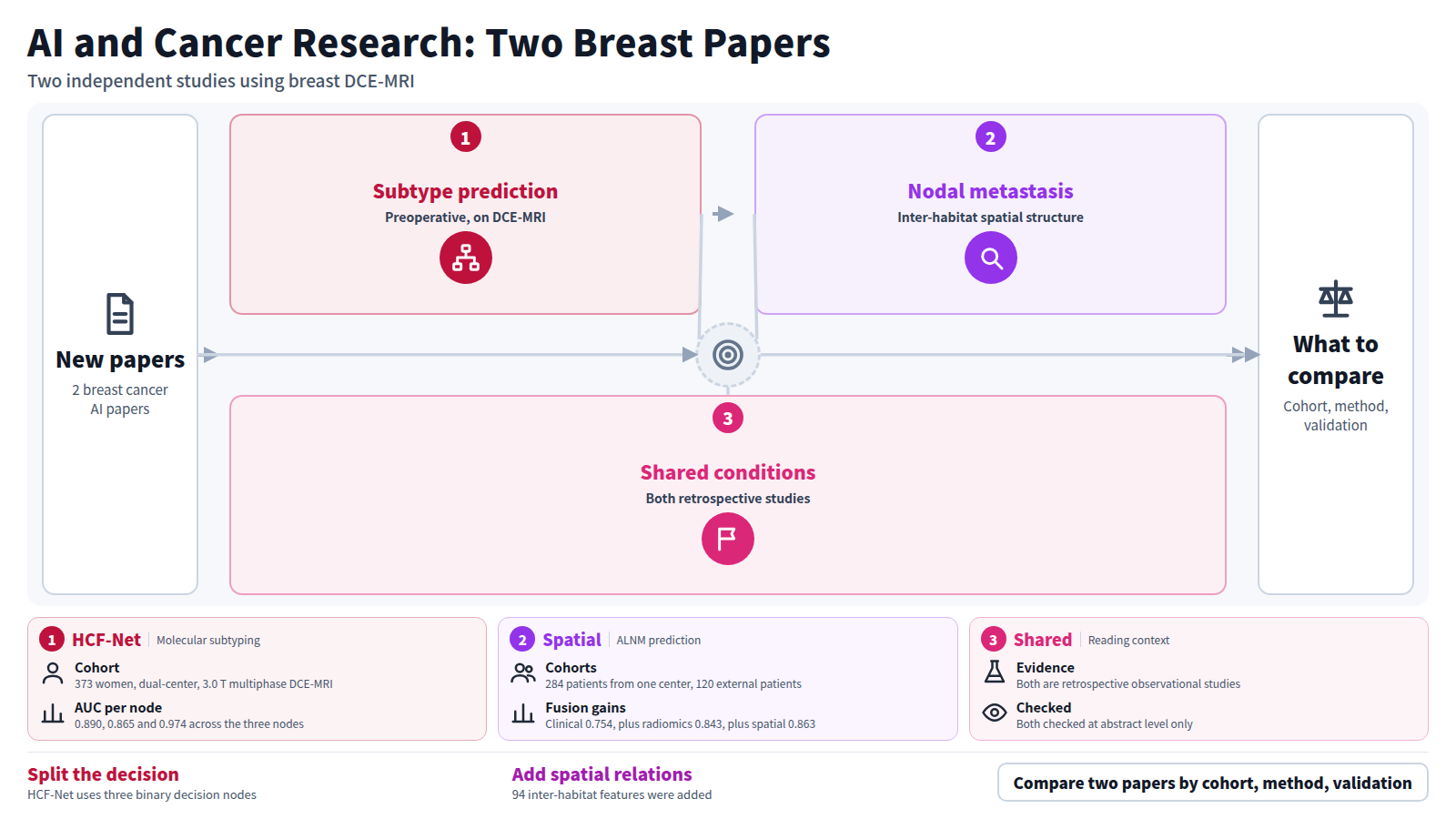
Preoperative molecular subtyping of breast cancer is essential for treatment selection and prognosis assessment, yet most deep learning approaches formulate subtype prediction as a conventional flat multi-class task without reflecting the sequential clinical decision process. We developed HCF-Net, a hierarchical cascade fusion network that decomposes subtype prediction into three clinically aligned binary decision nodes and integrates multiphase DCE-MRI with clinicoradiologic information. The model was retrospectively developed and validated using a dual-center cohort of 373 women who underwent preoperative 3.0 T multiphase DCE-MRI. On an independent test set (n = 75), HCF-Net achieved a Macro-AUC of 0.868 (95% CI, 0.806-0.923), accuracy of 73.3%, Macro-F1 of 0.732, and Cohen's κ of 0.631. The fusion model consistently achieved the highest AUC across all three hierarchical decision nodes, reaching 0.890 for luminal versus non-luminal tumors, 0.865 for Luminal A versus Luminal B tumors, and 0.974 for HER2-enriched versus triple-negative tumors. The same ordering of classification strategies was observed with a ConvNeXt-Tiny backbone. Compared with conventional flat classification strategies, hierarchical cascade decomposition and decision-level fusion provided substantial performance gains. These findings suggest that a hierarchical fusion framework aligned with clinical decision pathways may provide an effective and interpretable approach for preoperative breast cancer molecular subtype prediction.
Journal IF-equivalent: 3.9 (OpenAlex 2-year mean citedness, value as of 2026-10-13, retrieved 2026-10-15; not the official Clarivate IF)Reference: Chen Y, Hu L, Hou J, Xie Y, Nie S, Jiang Y, et al. HCF-Net: a Hierarchical Cascade Fusion Network Aligned with Clinical Treatment Pathways for Preoperative Molecular Subtyping of Breast Cancer on Dynamic Contrast-Enhanced MRI. J Digit Imaging Inform med. 2026 Oct 13 [Epub ahead of print]. doi:10.1007/s10278-026-02331-1.Checked: Abstract only - Abstract
Habitat radiomics characterizes texture within tumor subregions but discards the spatial relationships between them. We developed a landscape-ecology-inspired framework quantifying inter-habitat spatial structure on DCE-MRI, evaluated its complementary value alongside within-habitat radiomics, and compared early versus late fusion, using axillary lymph node metastasis (ALNM) prediction as the evaluation task. In this multicenter retrospective study, 284 patients from one center were randomly split into training (n = 198) and validation (n = 86) cohorts, with 120 patients from an independent institution as the external test set. Tumors were partitioned into six habitats by k-means clustering of 19 voxel-wise texture descriptors, with centroids derived exclusively from the training cohort. Three feature domains were constructed: 8 clinical parameters, 642 within-habitat radiomics features, and 94 inter-habitat spatial structure features spanning fragmentation (n = 30), morphology (n = 24), inter-habitat contact (n = 15), inter-habitat distance (n = 15), area ratio (n = 6), and diversity (n = 4). In the external test set, progressive fusion yielded incremental gains in AUC: clinical alone 0.754, plus within-habitat radiomics 0.843, plus inter-habitat spatial structure 0.863 (95% CI 0.792-0.934). The full early fusion model achieved higher AUC than the clinical-only (DeLong P = 0.011) and spatial-structure-only models (P = 0.044); early fusion yielded a numerically higher AUC than late fusion without reaching significance (0.863 vs 0.851, P = 0.636). The two single-domain imaging models were statistically indistinguishable (0.817 vs 0.784, P = 0.512). Inter-habitat spatial structure captures tumor organization overlooked by conventional habitat radiomics and provides complementary information for preoperative ALNM prediction.
Journal IF-equivalent: 3.9 (OpenAlex 2-year mean citedness, value as of 2026-10-13, retrieved 2026-10-15; not the official Clarivate IF)Reference: Liu P, Wang P, Zou X, Zhang Q, Wang W. From Intra- to Inter-habitat Analysis: Spatial Structure Features for Axillary Lymph Node Metastasis Prediction on Breast DCE-MRI. J Digit Imaging Inform med. 2026 Oct 13 [Epub ahead of print]. doi:10.1007/s10278-026-02384-2.Checked: Abstract only