AI and Cancer Research ── Brain ── 2026-10-15
Brain tumours: treatment, trials and AI
- Abstract
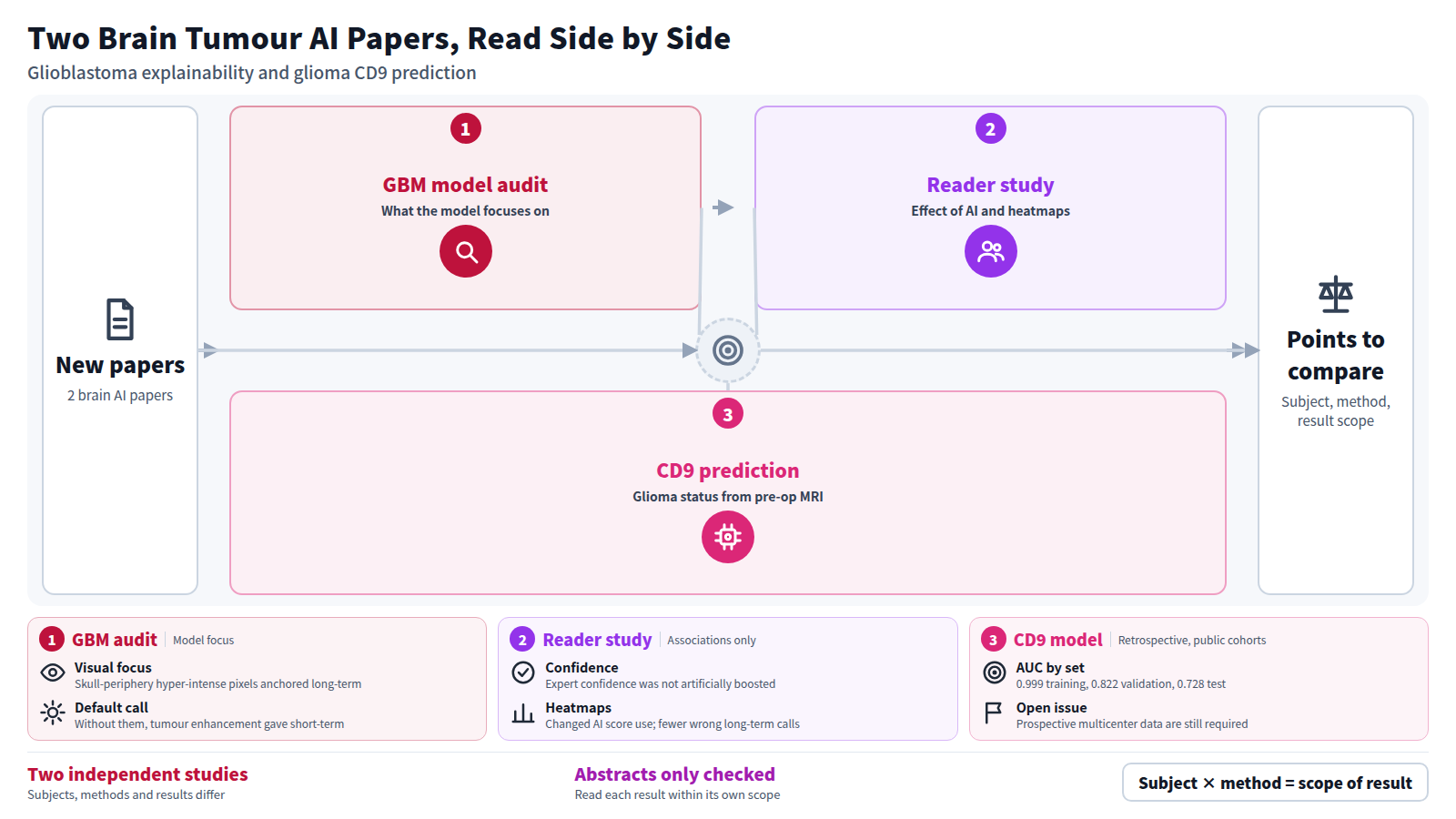
Glioblastoma (GBM) treatment response is highly heterogeneous. Predicting outcomes from pre-treatment MRI is a critical unmet need, yet the clinical adoption of "black box" deep learning (DL) models is hindered by a lack of transparency. Robust and holistic validation frameworks still need to be developed to allow clinical trust. A multi-layered eXplainable AI (XAI) pipeline was employed to dissect a previously developed deep learning model trained to predict GBM overall survival. First, the model's visual focus was qualitatively and quantitatively analysed. Second, the model's feature dependence was quantified using input ablation studies. Third, the depth at which class information becomes decodable was traced by linear probing of the internal representations. Finally, the clinical impact of the AI and its explanations was assessed in a multi-reader, multi-case study (37 patients, 4 readers, 3 phases, 444 observations) using Generalised Estimating Equations (GEE) and clustered bootstrapping. Analysis revealed a high-intensity heuristic: hyper-intense pixels at the skull periphery anchored "Long-Term" predictions, while the model defaulted to "Short-Term" based on tumour enhancement in its absence. The ablation study established this dependence, and linear probing pointed in the same direction. In the clinical study, AI assistance significantly improved expert accuracy (OR 1.598, p < 0.01) without artificially boosting confidence (p = 0.561). Importantly, the addition of XAI heatmaps was associated with a change in how experts used the AI score (interaction p < 0.01), and with fewer patients wrongly called long-term survivors. High predictive accuracy can mask reliance on low-level intensity heuristics. While superficial interpretation of saliency maps is perilous, multi-layered audits expose these shortcuts. Clinically, spatial heatmaps were associated with improved expert diagnostic accuracy and a shift in decision-making strategy.
Journal IF-equivalent: 3.9 (OpenAlex 2-year mean citedness, value as of 2026-10-13, retrieved 2026-10-15; not the official Clarivate IF)Reference: Andres R, Moreau NN, Dessoude L, Le Henaff L, Missohou F, Stefan D, et al. Explainability and Clinical Trust of Deep Learning in Glioblastoma Treatment Efficacy Prediction: A Comprehensive Framework. J Digit Imaging Inform med. 2026 Oct 13 [Epub ahead of print]. doi:10.1007/s10278-026-02381-5.Checked: Abstract only - Abstract
BACKGROUND: High CD9 expression is significantly associated with shorter overall survival (OS) in patients with adult-type diffuse gliomas (ADGs). Concurrently, drug screening analyses have identified emetine as a potential targeted therapeutic agent for gliomas exhibiting high CD9 expression, indicating that CD9 may serve as a novel biomarker with the potential to transform glioma diagnosis and treatment. This study aimed to develop an artificial intelligence prediction model based on preoperative magnetic resonance imaging (MRI) images to facilitate the early identification of high CD9 expression in patients with ADGs. METHODS: We retrospectively collected CD9 expression data from 262 patients with ADGs in The Cancer Genome Atlas (TCGA) and Chinese Glioma Genome Atlas (CGGA) cohorts. Using preoperative MRI sequences [contrast-enhanced T1-weighted imaging (CET1) and T2-weighted imaging (T2WI)], Habitat features were extracted, using K-means clustering algorithm, together with radiomic features. Additionally, multi-channel 2.5-dimensional deep learning (2.5D_DL) data were constructed, based on neural network architectures, including ResNet101, DenseNet121, and SimpleViT, and DL features were extracted. Seven classifiers were utilized to construct individual Radiomics, Habitat, and 2.5D_DL predictive models. Subsequently, a Stacking model was developed via an ensemble fusion strategy to predict high CD9 expression. Model performance was evaluated using receiver operating characteristic (ROC) curves, and clinical efficacy was assessed by decision curve analysis (DCA). Shapley Additive Explanations (SHAP) analysis was performed to explore the interpretation of the models, enhancing the transparency of the machine learning predictions. In addition, Patients were stratified into high- and low-risk groups based on Stacking model scores, and survival differences were compared using the Kaplan-Meier analysis and the log-rank test. RESULTS: The Habitat model exhibited superior ROC curve [area under the ROC (AUC)] values than the Radiomics model. Among the multi-channel 2.5D_DL models, the SimpleViT model achieved slightly better performance than the convolutional neural network (CNN)-based models (ResnNet101 and DenseNet121). The final Stacking model, which integrated the outputs from Habitat, Radiomics, and 2.5D_DL models exhibited superior AUC values. The AUC reached 0.999, 0.822, and 0.728 in the training, validation, and test sets, respectively. DeLong testing confirmed the statistically significant differences in the AUC values of each model in the training set, but no statistically significant differences were observed among the other sets. In addition, enhanced net clinical benefit across a more extensive range of risk thresholds for this integrated model was verified by DCA. Prognostic stratification by Stacking model revealed significant differences in survival outcomes between high-risk and low-risk groups. CONCLUSIONS: The preoperative MRI-based Stacking model effectively identifies patients with high CD9 expression among ADGs and stratifies patient risk, providing support for clinical therapeutic decision-making and individualized prognostic evaluation. Prospective multicenter data are still required to validate the prognostic performance and generalizability of this model.
Journal IF-equivalent: 1.4 (OpenAlex 2-year mean citedness, value as of 2026-10-13, retrieved 2026-10-15; not the official Clarivate IF)Reference: Pang B, Yuan M, Yan Y, Li J, Xue J, Jing L, et al. MRI-derived habitat radiomics integrated with transformer deep learning for preoperative prediction of high CD9 expression: a novel prognostic marker in adult-type diffuse gliomas. Transl Cancer Res. 2026 Sep;15(9):703-3. doi:10.21037/tcr-2026-1847.Checked: Abstract only